Gehani Manish, Kapur Suman, Madhuri Sudha D, Pittala Vara Prasad, Korvi Sree Kala, Kammili Nagamani, Sharad Shashwat
Department of Biological Sciences, Birla Institute of Technology and Science, Pilani, Hyderabad Campus, Hyderabad 500078, India.
Department of Microbiology, Gandhi Medical College and Hospital, Secunderabad 500003, India.
EClinicalMedicine. 2021 Mar 2;33:100762. doi: 10.1016/j.eclinm.2021.100762. eCollection 2021 Mar.
Premature babies suffer higher mortality and life-long disabilities. Asymptomatic bacteriuria (ASB) is postulated to induce preterm labor. Routine antenatal screening for ASB using urine culture is not feasible in most developing countries due to long turn-around time, user-unfriendliness, and lack of resources. The current parallel-group superiority pragmatic randomized controlled trial evaluated the effect of screening and evidence-based treatment of ASB using an optical-sensor-based point-of-care rapid-test on the incidence of preterm birth and low birthweight (LBW).
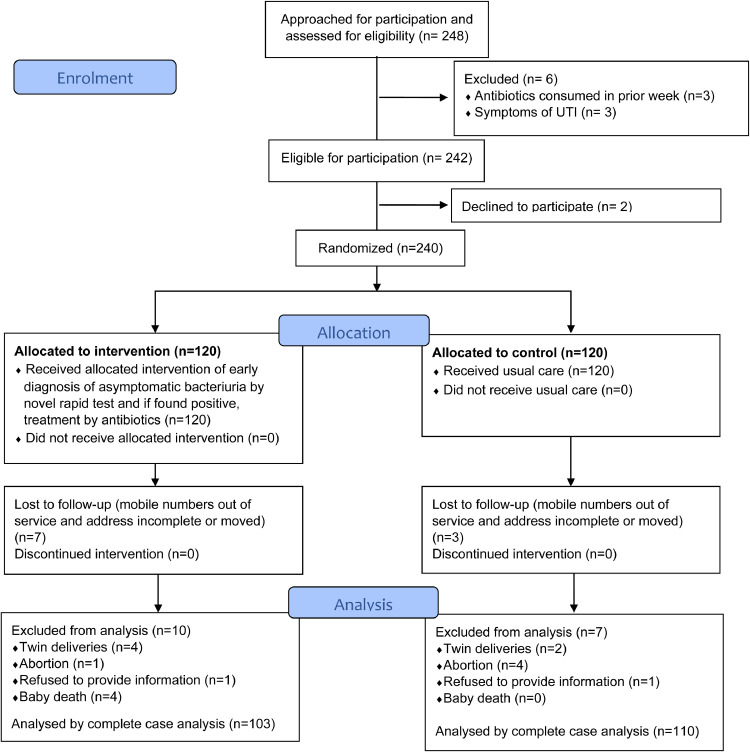
240 consenting asymptomatic pregnant women visiting an Indian tertiary public hospital for first antenatal check-up, irrespective of trimester/gravida, who had not consumed antibiotics in the preceding week, were enrolled from February-May 2017. Computer-generated concealed simple randomization allocation sequence was used to assign participants to intervention (120) and control arm (120). Usual hospital-care was provided in the control arm. In the intervention arm, urine samples were additionally screened for ASB using the rapid-test and the positive women were prescribed susceptible antibiotics. Blinded outcome assessors followed up with women post-delivery. The study was registered with the Clinical Trials Registry-India (CTRI/2016/09/007240).
213 participants were analyzed (intervention: 103, control: 110). 21 women were found positive for ASB and prescribed pathogen-specific antibiotics. The incidence of preterm birth/LBW in intervention arm ( = 27) was lower than control arm ( = 45) by 14·7% (95% CI: 2·2-27·2); RR: 0.64, (95% CI: 0·43-0·95); = 0·023, X=5·13.
Rapid-test-guided treatment for ASB reduced the incidence of preterm birth/LBW in a pragmatic setting without any adverse event.
Department of Biotechnology, Government of India.
早产儿面临更高的死亡率和终身残疾风险。无症状菌尿(ASB)被认为会诱发早产。在大多数发展中国家,由于周转时间长、使用不便以及资源匮乏,使用尿培养进行常规产前ASB筛查并不可行。当前的平行组优效性实用随机对照试验评估了使用基于光学传感器的即时快速检测对ASB进行筛查和循证治疗对早产和低出生体重(LBW)发生率的影响。
2017年2月至5月,招募了240名同意参与研究的无症状孕妇,她们前往印度一家三级公立医院进行首次产前检查,不限孕周/妊娠次数,且在前一周未使用过抗生素。使用计算机生成的隐藏简单随机分配序列将参与者分配到干预组(120名)和对照组(120名)。对照组提供常规医院护理。在干预组中,使用快速检测额外筛查尿样中的ASB,对检测呈阳性的女性开具敏感抗生素。 blinded结果评估者在女性分娩后进行随访。该研究已在印度临床试验注册中心注册(CTRI/2016/09/007240)。
对213名参与者进行了分析(干预组:103名,对照组:110名)。发现21名女性ASB检测呈阳性,并开具了针对病原体的抗生素。干预组的早产/LBW发生率(=27)比对照组(=45)低14.7%(95%CI:2.2 - 27.2);RR:0.64,(95%CI:0.43 - 0.95);=0.023,X = 5.13。
在实际应用中,快速检测引导的ASB治疗降低了早产/LBW的发生率,且无任何不良事件。
印度政府生物技术部。