General and Emergency Surgery Dept, School of Medicine and Surgery, Milano-Bicocca University, Via Pergolesi 33, 20900, Monza, Italy.
Emergency Surgery and Trauma Center Dept, Pisa University Hospital, Pisa, Italy.
Eur J Trauma Emerg Surg. 2021 Oct;47(5):1359-1365. doi: 10.1007/s00068-021-01663-7. Epub 2021 Apr 12.
During pandemic, admissions for surgical emergencies dropped down dramatically. Also acute appendicitis decreased. The aim of the present study was to evaluate the change in volume and clinical presentation of patients with acute appendicitis during pandemic and the variation in treatment.
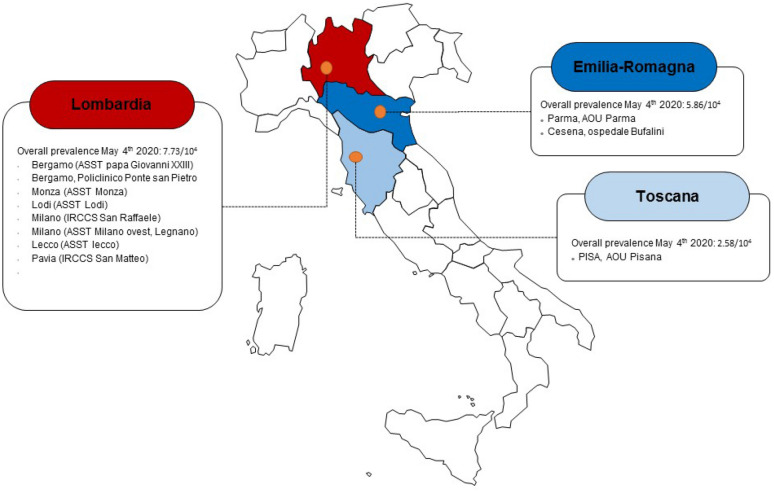
This is a retrospective study of patients admitted in 11 Italian hospital for acute appendicitis during the lockdown period (March-April 2020) compared with the same period of the previous 2 years (2018-2019). The number and the rate of complicated and non-complicated acute appendicitis were recorded and compared between the two study periods; non-operative vs operative treatment and negative appendectomy rate were also recorded.
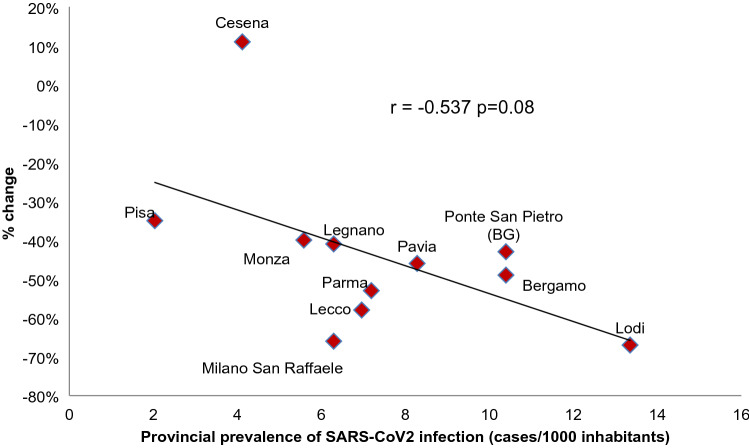
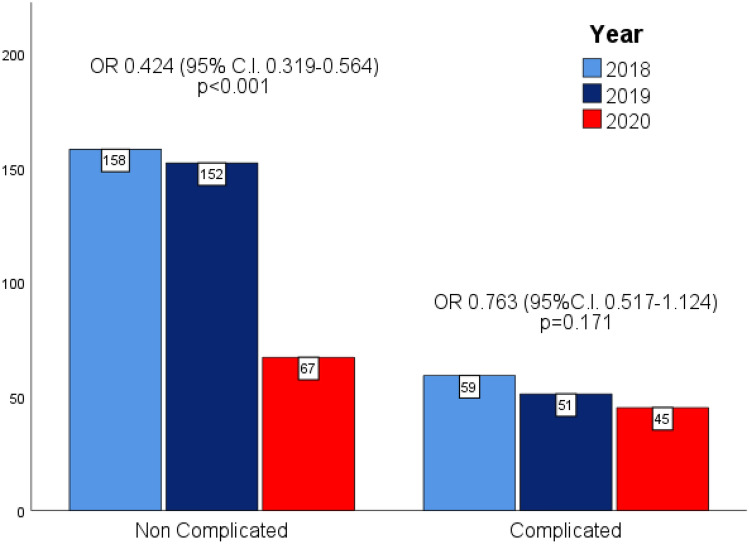
The study included 532 patients, 112 in the study period and 420 in the control period; Hospital admission for acute appendicitis dropped by 46% (OR 0.516 95% CI 0.411-0.648 p < 0.001) during the 2020 lockdown. The number of complicated acute appendicitis did not change (- 18%, OR 0.763 95% CI 0.517-1.124 p = 0.1719), whereas the number of non-complicated acute appendicitis significantly decreased (- 56%, OR 0.424 95% CI 0.319-0.564 p < 0.001). Non-operative treatment rate remained similar (12.1% vs. 11.6% p = 0.434). The negative appendectomy rate also significantly decreased (6.1% vs. 17.3%, p = 0.006).
The present study found a significant reduction of both admissions for non-complicated acute appendicitis and negative appendectomy rate during the pandemic period. Conversely, admissions for complicated acute appendicitis did not change.
NCT04649996.
在大流行期间,外科急症入院人数大幅下降。急性阑尾炎也减少了。本研究旨在评估大流行期间急性阑尾炎患者的数量和临床表现的变化,以及治疗方法的变化。
这是一项回顾性研究,纳入了 2020 年 3 月至 4 月大流行期间在意大利 11 家医院因急性阑尾炎入院的患者(112 例),并与前两年(2018-2019 年)同期入院的患者(420 例)进行比较。记录并比较了两个研究期间单纯性和复杂性急性阑尾炎的数量和比例;非手术治疗与手术治疗和阴性阑尾切除率也进行了记录。
本研究共纳入 532 例患者,研究期间 112 例,对照组 420 例;2020 年大流行期间,急性阑尾炎住院人数下降了 46%(OR 0.516,95%CI 0.411-0.648,p<0.001)。复杂性急性阑尾炎的数量没有变化(-18%,OR 0.763,95%CI 0.517-1.124,p=0.1719),而非复杂性急性阑尾炎的数量则显著减少(-56%,OR 0.424,95%CI 0.319-0.564,p<0.001)。非手术治疗率保持相似(12.1% vs. 11.6%,p=0.434)。阴性阑尾切除率也显著降低(6.1% vs. 17.3%,p=0.006)。
本研究发现,大流行期间非复杂性急性阑尾炎入院人数和阴性阑尾切除率显著减少,而复杂性急性阑尾炎入院人数无变化。