Nguyen Hai V, Tran Loc H, Ly Tuan H, Pham Quang T, Pham Vu Q, Tran Ha N, Trinh Loc T, Dinh Thien T, Pham Dinh T, Mai Phan Tuong Anh
Department of General Surgery, University of Medicine and Pharmacy at Ho Chi Minh City, Ho Chi Minh City, VNM.
Department of Digestive Surgery, Nhan Dan Gia Dinh Hospital, Ho Chi Minh City, VNM.
Cureus. 2023 Aug 3;15(8):e42923. doi: 10.7759/cureus.42923. eCollection 2023 Aug.
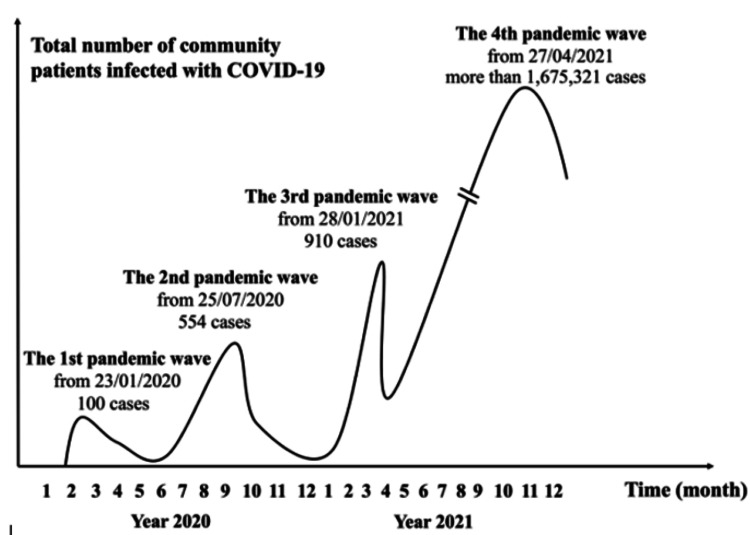
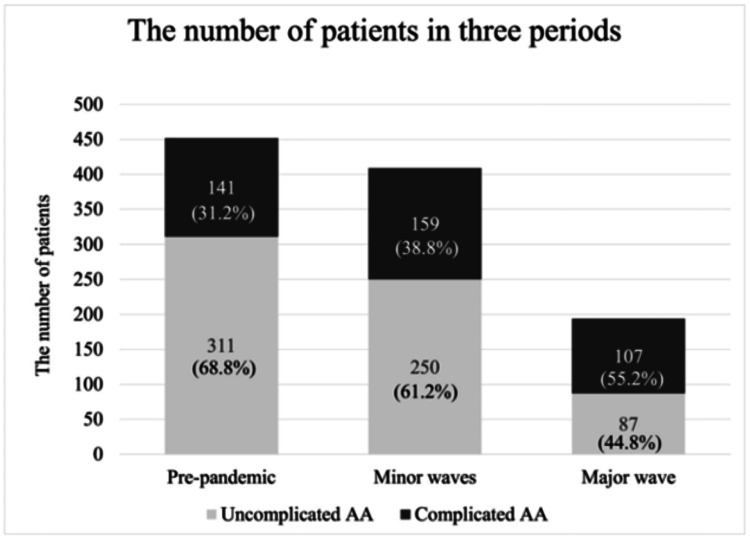
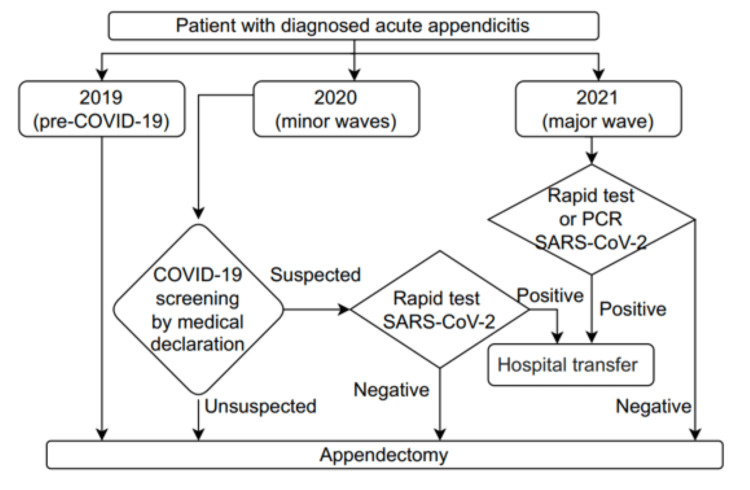
Background The coronavirus disease 2019 (COVID-19) pandemic caused changes in surgical practice. For acute appendicitis (AA), measures to control the pandemic might hinder patients from seeking medical care timely, resulting in increasing severity, postoperative complications, and mortality. This study aimed to investigate whether the COVID-19 pandemic had a negative impact on the severity and postoperative outcomes of patients with AA. Methodology We retrospectively reviewed medical records of AA patients treated operatively at Nhan Dan Gia Dinh Hospital hospital from June 1st to September 30th in three consecutive years: pre-pandemic (2019)/Group 1, minor waves (2020)/Group 2, and major wave (2021)/Group 3 (2021). Data were collected focusing on the duration of symptoms, severity of AA, time from admission to operation, postoperative complications, and mortality. Results There were 1,055 patients, including 452 patients in Group 1, 409 in Group 2, and 194 in Group 3. The overall number of patients decreased mainly in non-complicated AA. The percentages of hospital admission after 24 hours gradually increased (20.8%, 27.9%, and 43.8%, p < 0.05). The percentages of complicated AA in Group 2 and Group 3 were statistically higher than in Group 1 (39% and 55% vs. 31%, p < 0.05). Waiting time for operation increased to five hours during the major wave. Laparoscopic appendectomy was performed in 98-99% of AA patients during the pandemic, with an early postoperative complication rate of 5-9% and a mortality rate of 0.2-1%. Conclusions Although the percentages of hospital admission after 24 hours and complicated AA increased, laparoscopic appendectomy was still feasible and effective and should be maintained as the standard management for AA during the COVID-19 pandemic.
背景 2019 冠状病毒病(COVID - 19)大流行导致了外科手术实践的改变。对于急性阑尾炎(AA),控制大流行的措施可能会阻碍患者及时就医,从而导致病情加重、术后并发症增加以及死亡率上升。本研究旨在调查 COVID - 19 大流行是否对 AA 患者的病情严重程度和术后结果产生负面影响。
方法 我们回顾性分析了连续三年(2019年疫情前/第1组、小波动期(2020年)/第2组、大流行期(2021年)/第3组)6月1日至9月30日在越南人民军医医院接受手术治疗的 AA 患者的病历。收集的数据重点关注症状持续时间、AA 的严重程度、入院至手术时间、术后并发症及死亡率。
结果 共有1055例患者,其中第1组452例,第2组409例,第3组194例。患者总数总体下降,主要是在非复杂性 AA 患者中。24小时后入院的患者比例逐渐增加(分别为20.8%、27.9%和43.8%,p < 0.05)。第2组和第3组复杂性 AA 的比例在统计学上高于第1组(分别为39%和55%,对比第1组的31%,p < 0.05)。大流行期手术等待时间增加到5小时。在大流行期间,98 - 99%的 AA 患者接受了腹腔镜阑尾切除术,术后早期并发症发生率为5 - 9%,死亡率为0.2 - 1%。
结论 尽管24小时后入院和复杂性 AA 的比例有所增加,但腹腔镜阑尾切除术仍然可行且有效,在 COVID - 19 大流行期间应继续作为 AA 的标准治疗方法。