Behavioral Science Department, The University of Texas MD Anderson Cancer Center.
Epidemiology Department, The University of Texas MD Anderson Cancer Center.
Behav Neurosci. 2021 Aug;135(4):571-580. doi: 10.1037/bne0000467. Epub 2021 Apr 12.
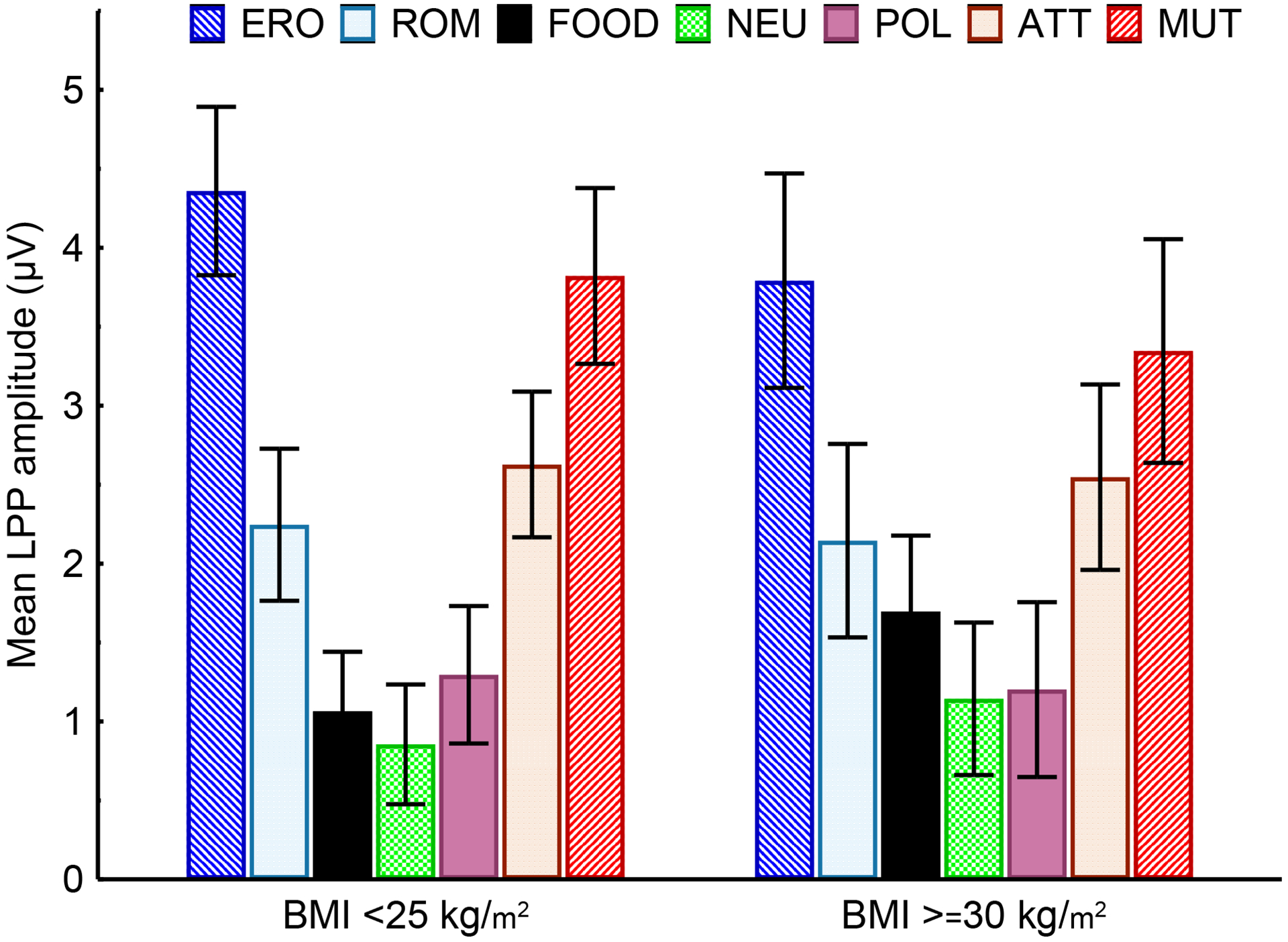
Continuing to eat even when full leads to excessive calorie consumption and obesity. Thus, understanding brain responses to food cues when satiated has important implications for weight control interventions. We used the late positive potential (LPP, a component of the event-related potentials (ERP) indexing motivational relevance) to determine the extent to which satiety affects brain responses to images of highly palatable foods (high-fat, high-sugar), high and low motivationally relevant (pleasant, unpleasant) and neutral stimuli in a sample of obese (body mass index [BMI] ≥ 30 kg/m2) and lean (BMI < 25 kg/m2) individuals. Satiated individuals ( = 55, 21 with BMI ≥ 30 kg/m2) were fed a nutritional drink prior to the experimental session and were individually matched with 55 unsatiated individuals who saw the same images during a passive viewing task. Satiety did not affect LPP response to food-related or motivationally relevant cues in either BMI < 25 kg/m2 or BMI ≥ 30 kg/m2 individuals ( = .6). Irrespective of satiety, all participants showed larger LPPs as a function of the images' motivational relevance. There were no differences in LPP amplitude between BMI < 25 kg/m2 and BMI ≥ 30 kg/m2 individuals for any picture category, including food. However, within-group comparisons showed that BMI < 25 kg/m2 individuals had larger LPPs to low motivationally relevant pleasant images than to food-related cues ( < .001); this difference was not significant for BMI ≥ 30 kg/m2 individuals. Although satiety does not affect LPP responses to food-related cues, these results highlight the importance of evaluating reactivity to food-related cues in relation to other motivationally relevant stimuli. (PsycInfo Database Record (c) 2021 APA, all rights reserved).
即使吃饱了也要继续进食会导致卡路里摄入过多和肥胖。因此,了解饱食状态下大脑对食物线索的反应对于控制体重的干预措施具有重要意义。我们使用晚期正电位(LPP,事件相关电位(ERP)的一个组成部分,用于索引动机相关性)来确定饱腹感在多大程度上影响肥胖(体重指数 [BMI] ≥ 30 kg/m2)和瘦(BMI < 25 kg/m2)个体对高美味食物(高脂肪、高糖)、高和低动机相关(愉快、不愉快)和中性刺激的图像的大脑反应。在实验前,饱腹组(n = 55,21 人 BMI ≥ 30 kg/m2)先喝营养饮料,然后与 55 名在被动观看任务中观看相同图像的未饱腹个体进行个体匹配。饱腹感对 BMI < 25 kg/m2 或 BMI ≥ 30 kg/m2 个体的食物相关或动机相关线索的 LPP 反应均无影响(p =.6)。无论饱腹感如何,所有参与者的 LPP 都随着图像的动机相关性而增大。BMI < 25 kg/m2 和 BMI ≥ 30 kg/m2 个体在任何图片类别(包括食物)的 LPP 振幅之间均无差异。然而,组内比较显示,BMI < 25 kg/m2 个体对低动机相关愉快图像的 LPP 大于对食物相关线索的 LPP(p <.001);而 BMI ≥ 30 kg/m2 个体则没有显著差异。尽管饱腹感不会影响对食物相关线索的 LPP 反应,但这些结果强调了在评估与其他动机相关刺激有关的食物相关线索的反应时,需要考虑个体差异。(PsycInfo 数据库记录(c)2021 APA,保留所有权利)。