Division of General Academic Pediatrics, MassGeneral Hospital for Children and Harvard Medical School, Boston, MA.
Faculty of Medicine and Health, Children's Hospital Westmead Clinical School, University of Sydney, Camperdown, Australia.
Am J Obstet Gynecol. 2021 Oct;225(4):424.e1-424.e12. doi: 10.1016/j.ajog.2021.04.210. Epub 2021 Apr 15.
The postpartum year is a vulnerable period for women with opioid use disorder, with increased rates of fatal and nonfatal overdose; however, data on the continuation of medications for opioid use disorder on a population level are limited.
This study aimed to examine the effect of discontinuing methadone and buprenorphine in women with opioid use disorder in the year following delivery and determine the extent to which maternal and infant characteristics are associated with time to discontinuation of medications for opioid use disorder.
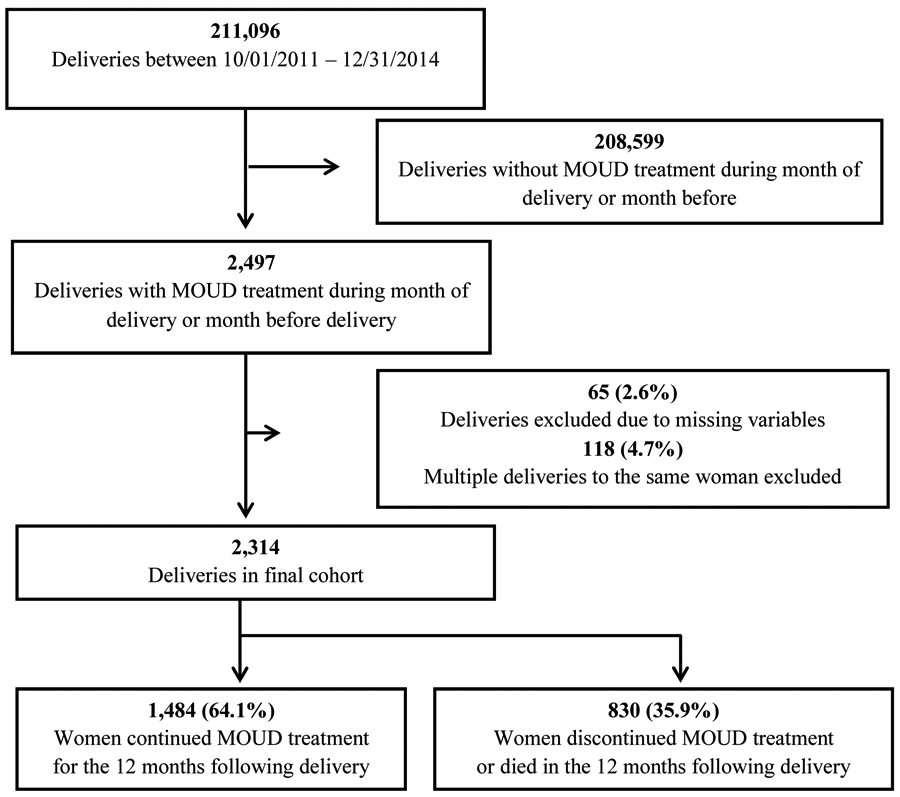
This population-based retrospective cohort study used linked administrative data of 211,096 deliveries in Massachusetts between 2011 and 2014 to examine the adherence to medications for opioid use disorder. Individuals receiving medications for opioid use disorder after delivery were included in the study. Here, demographic, psychosocial, prenatal, and delivery characteristics are described. Kaplan-Meier survival analysis and Cox regression modeling were used to examine factors associated with medication discontinuation.
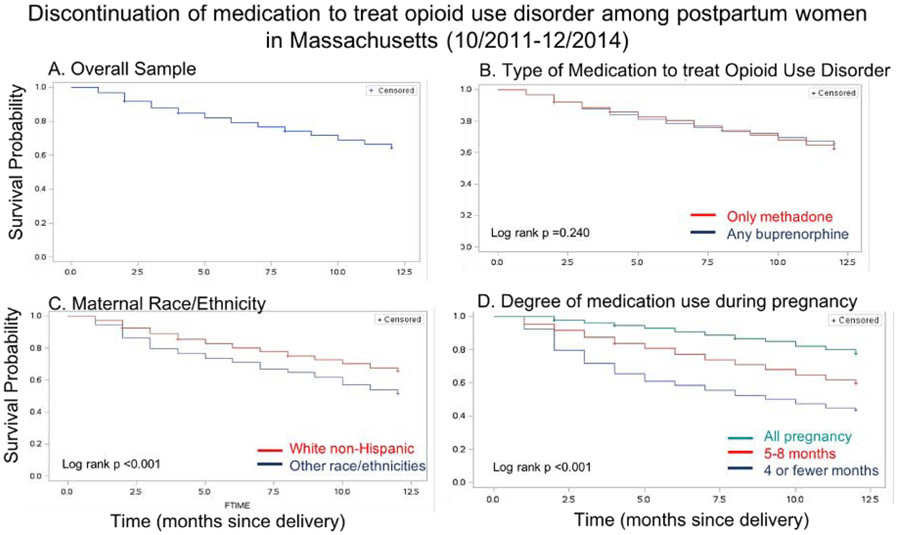
A total of 2314 women who received medications for opioid use disorder at delivery were included in our study. Overall, 1484 women (64.1%) continued receiving medications for opioid use disorder for a full 12 months following delivery. The rate of continued medication use varied from 34% if women started on medications for opioid use disorder the month before delivery to 80% if the medications were used throughout pregnancy. Kaplan-Meier survival curves differed by maternal race and ethnicity (the 12-month continuation probability was .65 for White non-Hispanic women and .51 for non-White women; P<.001) and duration of use of prenatal medications for opioid use disorder (12-month continuation probability was .78 for women with full prenatal engagement and .60 and .44 for those receiving medications for opioid use disorder ≥5 months [but not throughout pregnancy] and ≤4 months prenatally, respectively; P<.001). In all multivariable models, duration of receipt of prenatal medications for opioid use disorder (≤4 months vs throughout pregnancy: adjusted hazard ratio, 3.26; 95% confidence interval, 2.72-3.91) and incarceration (incarceration during pregnancy or after delivery vs none: adjusted hazard ratio, 1.79; 95% confidence interval, 1.52-2.12) were most strongly associated with the discontinuation of medications for opioid use disorder.
Almost two-thirds of women with opioid use disorder continued using medications for opioid use disorder for a full year after delivery; however, the rates of medication continuation varied significantly by race and ethnicity, degree of use of prenatal medications for opioid use disorder, and incarceration status. Prioritizing medication continuation across the perinatal continuum, enhancing sex-specific and family-friendly recovery supports, and expanding access to medications for opioid use disorder despite being incarcerated can help improve postpartum medication adherence.
产后一年是患有阿片类药物使用障碍的女性的脆弱时期,致命和非致命药物过量的发生率增加;然而,关于人口水平上阿片类药物使用障碍药物的持续使用的数据是有限的。
本研究旨在研究产后一年内停止使用美沙酮和丁丙诺啡对患有阿片类药物使用障碍的女性的影响,并确定产妇和婴儿特征与停止使用阿片类药物使用障碍药物的时间之间的关联程度。
这项基于人群的回顾性队列研究使用马萨诸塞州 2011 年至 2014 年间 211096 次分娩的相关行政数据,研究了阿片类药物使用障碍药物的依从性。分娩后接受阿片类药物使用障碍药物治疗的人被纳入研究。在这里,描述了人口统计学、心理社会、产前和分娩特征。采用 Kaplan-Meier 生存分析和 Cox 回归模型来研究与药物停药相关的因素。
共有 2314 名在分娩时接受阿片类药物使用障碍药物治疗的女性被纳入本研究。总体而言,1484 名女性(64.1%)在分娩后整整 12 个月继续接受阿片类药物使用障碍药物治疗。药物使用的持续率从分娩前一个月开始使用阿片类药物使用障碍药物的女性的 34%到整个孕期使用药物的女性的 80%不等。Kaplan-Meier 生存曲线因产妇种族和民族而异(白人非西班牙裔女性的 12 个月持续概率为.65,非白人女性为.51;P<.001)和产前阿片类药物使用障碍药物使用时间(12 个月持续概率为接受完全产前治疗的女性为.78,接受药物治疗≥5 个月[但不是整个孕期]和≤4 个月的女性分别为.60 和.44;P<.001)。在所有多变量模型中,产前阿片类药物使用障碍药物的使用时间(≤4 个月与整个孕期:调整后的危险比,3.26;95%置信区间,2.72-3.91)和监禁(怀孕期间或分娩后监禁与无监禁:调整后的危险比,1.79;95%置信区间,1.52-2.12)与阿片类药物使用障碍药物的停药最密切相关。
近三分之二的阿片类药物使用障碍女性在分娩后整整一年继续使用阿片类药物使用障碍药物;然而,药物持续使用的比例因种族和民族、产前阿片类药物使用障碍药物使用程度以及监禁状况而有很大差异。在围产期连续体中优先考虑药物的持续使用,加强针对女性和家庭友好的康复支持,并扩大阿片类药物使用障碍药物的获取途径,即使在监禁期间,也可以帮助提高产后药物依从性。