Institute for Physical Activity and Nutrition (IPAN), School of Exercise and Nutrition Sciences, Deakin University, Geelong, Australia.
Learning Futures, Deakin University, Burwood, Victoria, Australia.
Int J Behav Nutr Phys Act. 2021 Apr 12;18(1):52. doi: 10.1186/s12966-021-01110-1.
There has been increasing interest in using wearable activity trackers to promote physical activity in youth. This study examined the short- and longer-term effects of a wearable activity tracker combined with digital behaviour change resources on the physical activity of adolescents attending schools in socio-economically disadvantaged areas.
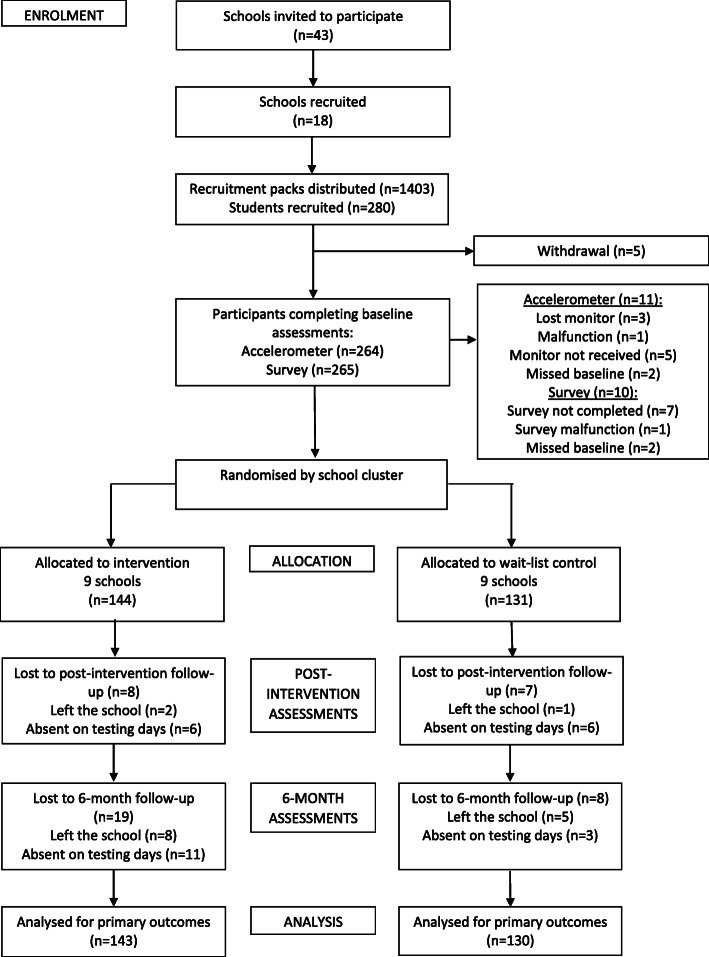
The Raising Awareness of Physical Activity (RAW-PA) Study was a 12-week, multicomponent intervention that combined a Fitbit Flex (and accompanying app), and online digital behaviour change resources and weekly challenges delivered via Facebook. RAW-PA was evaluated using a cluster-randomised controlled trial with 275 adolescents (50.2% female; 13.7 ± 0.4 years) from 18 Melbourne secondary schools (intervention n = 9; wait-list control group n = 9). The primary outcome was moderate- to vigorous-intensity physical activity (MVPA), measured using hip-worn ActiGraph accelerometers. The secondary outcome was self-reported physical activity. Data were collected at baseline, 12-weeks (immediately post-intervention), and 6-months post-intervention (follow-up). Multilevel models were used to determine the effects of the intervention on daily MVPA over time, adjusting for covariates.
No significant differences were observed between intervention and wait-list control adolescents' device-assessed MVPA immediately post-intervention. At 6-months post-intervention, adolescents in the intervention group engaged in 5 min (95% CI: - 9.1 to - 1.0) less MVPA per day than those in the wait-list control group. Males in the intervention group engaged in 11 min (95% CI: - 17.6 to - 4.5) less MVPA than males in the wait-list control group at 6-months post-intervention. No significant differences were observed for females at either time point. For self-reported physical activity, no significant effects were found at 12-weeks and 6-months post-intervention.
Combining a wearable activity tracker with digital behaviour change resources and weekly challenges did not increase inactive adolescents' accelerometer-derived and self-reported physical activity levels immediately post-intervention. This contrasts previous research that has suggested wearable activity tracker may increase youth physical activity levels in the short-term. Lower engagement in MVPA 6-months post-intervention was observed for males but not for females, though it is unclear why this finding was observed. The results suggest wearable activity trackers, in combination with supporting materials, may not be effective for increasing physical activity levels in adolescents.
ACTRN12616000899448 . Australian and New Zealand Clinical Trials Registry. Registered 7 July 2016.
使用可穿戴活动追踪器来促进青少年的身体活动已引起越来越多的关注。本研究调查了可穿戴活动追踪器与数字行为改变资源相结合对来自社会经济处于不利地位地区学校的青少年身体活动的短期和长期影响。
提高身体活动意识(RAW-PA)研究是一项为期 12 周的多成分干预措施,结合了 Fitbit Flex(和配套应用程序)以及在线数字行为改变资源和每周通过 Facebook 发布的挑战。使用来自 18 所墨尔本中学(干预组 n = 9;等待名单对照组 n = 9)的 275 名青少年(50.2%为女性;13.7±0.4 岁)的群组随机对照试验评估了 RAW-PA。主要结果是使用佩戴在臀部的 ActiGraph 加速度计测量的中度至剧烈强度的身体活动(MVPA)。次要结果是自我报告的身体活动。在基线、12 周(干预后立即)和 6 个月(随访)时收集数据。使用多水平模型来确定干预对随时间推移的日常 MVPA 的影响,同时调整协变量。
干预组和等待名单对照组青少年的设备评估 MVPA 没有立即在干预后显示出显著差异。在 6 个月时,干预组青少年每天进行的 MVPA 少 5 分钟(95%置信区间:-9.1 至-1.0),而等待名单对照组的青少年每天进行的 MVPA 少 5 分钟。干预组男性在 6 个月时进行的 MVPA 比等待名单对照组男性少 11 分钟(95%置信区间:-17.6 至-4.5)。在这两个时间点,女性均未观察到显著差异。在 12 周和 6 个月时,自我报告的身体活动均未显示出显著效果。
将可穿戴活动追踪器与数字行为改变资源和每周挑战相结合,并未立即增加不活跃青少年的加速度计衍生和自我报告的身体活动水平。这与之前的研究结果形成对比,后者表明可穿戴活动追踪器可能会在短期内增加青少年的身体活动水平。在干预后 6 个月时,男性的 MVPA 参与度较低,但女性没有,尽管不清楚为什么会出现这种情况。结果表明,在青少年中,可穿戴活动追踪器与支持材料结合使用可能无法有效提高身体活动水平。
ACTRN12616000899448。澳大利亚和新西兰临床试验注册中心。2016 年 7 月 7 日注册。
