Zhang Wei, Xiong Keying, Zhu Chengyan, Evans Richard, Zhou Lijuan, Podrini Christine
School of Medicine and Health Management, Huazhong University of Science and Technology, Wuhan, China.
School of Political Science and Public Administration, Wuhan University, Wuhan, China.
Digit Health. 2024 Jun 11;10:20552076241260507. doi: 10.1177/20552076241260507. eCollection 2024 Jan-Dec.
Wearable technology is used in healthcare to monitor the health of individuals. This study presents an updated systematic literature review of the use of wearable technology in promoting child and adolescent health, accompanied by recommendations for future research.
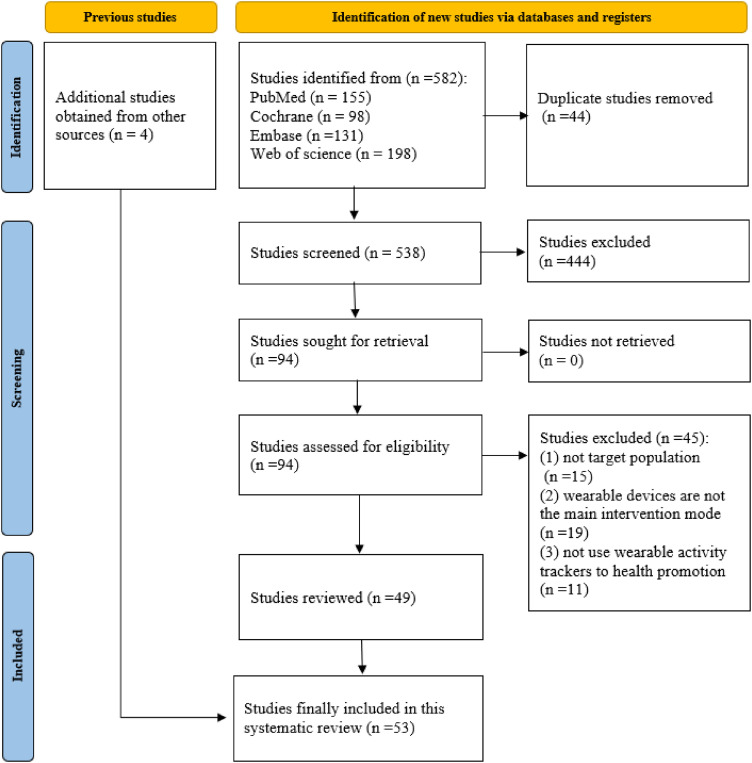
This review focuses on studies involving children and adolescents aged between 2 and 18 years, regardless of their health condition or disabilities. Studies that were published from 2016 to 2024, and which met the inclusion criteria, were extracted from four academic databases (i.e. PubMed, Cochrane, Embase, and Web of Science) using the Preferred Reporting Items for Systematic Review and Meta-Analyses (PRISMA) protocol. Data on intervention purposes, interventions deployed, intervention duration, measurements, and the main outcomes of the studies were collected.
A total of 53 studies involving 14,852 participants were reviewed. They focused on various aspects, including the ownership and use of wearable devices ( = 3), the feasibility ( = 22), effectiveness ( = 4), and adherence ( = 2) of intervention strategies, or a combination of multiple aspects ( = 22). Among the interventions deployed, Fitbit was the most frequently used, featuring in 26 studies, followed by ActiGraph ( = 11). In intervention studies, the majority of studies focused on pre-morbidity prevention ( = 26) and the treatment of illnesses ( = 20), with limited attention given to postoperative monitoring ( = 4).
The use of wearable technology by children and adolescents has proven to be both feasible and effective for health promotion. This systematic review summarizes existing research by exploring the use of wearable technology in promoting health across diverse youth populations, including healthy and unhealthy individuals. It examines health promotion at various stages of the disease continuum, including pre-disease prevention, in-disease treatment, and postoperative monitoring. Additionally, the review provides directions for future research.
可穿戴技术在医疗保健领域用于监测个人健康状况。本研究对可穿戴技术在促进儿童和青少年健康方面的应用进行了最新的系统文献综述,并给出了未来研究的建议。
本综述聚焦于年龄在2至18岁之间的儿童和青少年参与的研究,无论其健康状况或是否存在残疾。使用系统评价和Meta分析的首选报告项目(PRISMA)协议,从四个学术数据库(即PubMed、Cochrane、Embase和Web of Science)中提取2016年至2024年发表且符合纳入标准的研究。收集有关干预目的、所采用的干预措施、干预持续时间、测量方法以及研究主要结果的数据。
共审查了53项涉及14852名参与者的研究。这些研究聚焦于多个方面,包括可穿戴设备的拥有和使用(n = 3)、干预策略的可行性(n = 22)、有效性(n = 4)和依从性(n = 2),或多个方面的组合(n = 22)。在所采用的干预措施中,Fitbit是使用最频繁的,在26项研究中出现,其次是ActiGraph(n = 11)。在干预研究中,大多数研究聚焦于发病前预防(n = 26)和疾病治疗(n = 20),对术后监测的关注有限(n = 4)。
事实证明,儿童和青少年使用可穿戴技术对促进健康既可行又有效。本系统综述通过探索可穿戴技术在促进不同青年人群(包括健康和不健康个体)健康方面的应用,总结了现有研究。它考察了疾病连续体各个阶段的健康促进情况,包括疾病预防、疾病治疗和术后监测。此外,该综述为未来研究提供了方向。