Laboratory of Animal Resources, Center for Disease Biology and Integrative Medicine, Graduate School of Medicine, The University of Tokyo, 7-3-1 Hongo, Bunkyo-ku, Tokyo, 113-0033, Japan.
International Institute for Integrative Sleep Medicine (WPI-IIIS), University of Tsukuba, 1-1-1 Tennodai, Tsukuba, 305-8575, Japan.
Mol Brain. 2021 Apr 12;14(1):68. doi: 10.1186/s13041-021-00778-7.
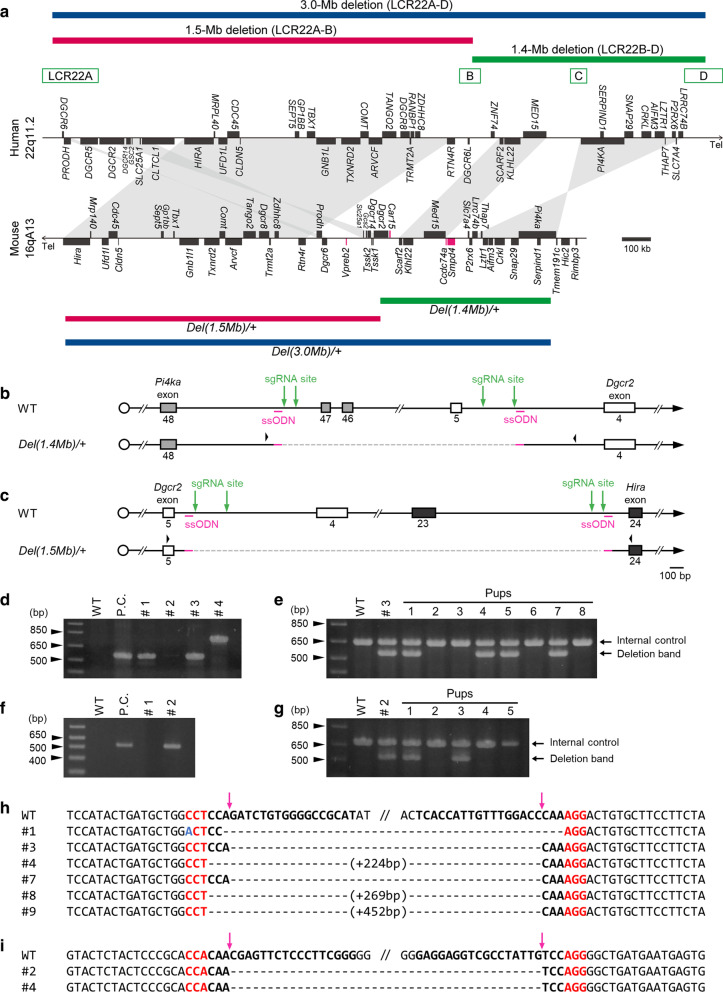
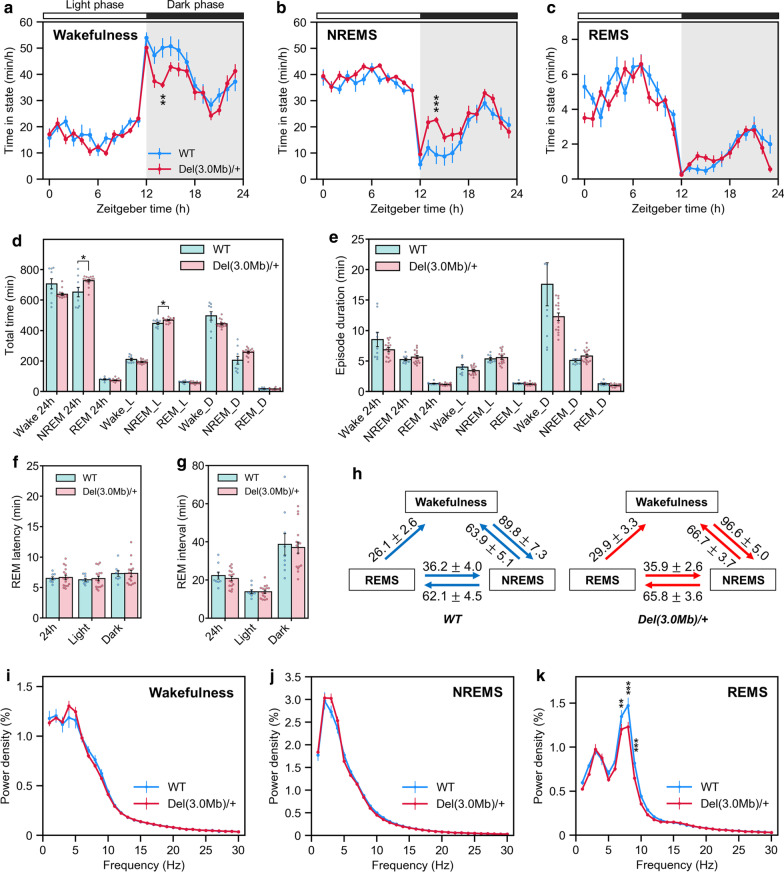
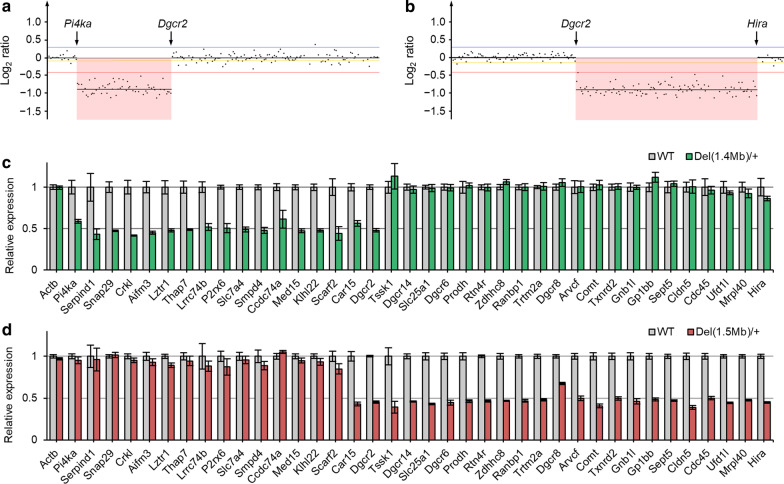
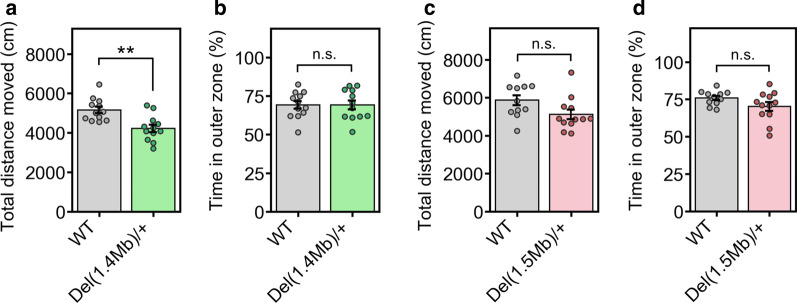
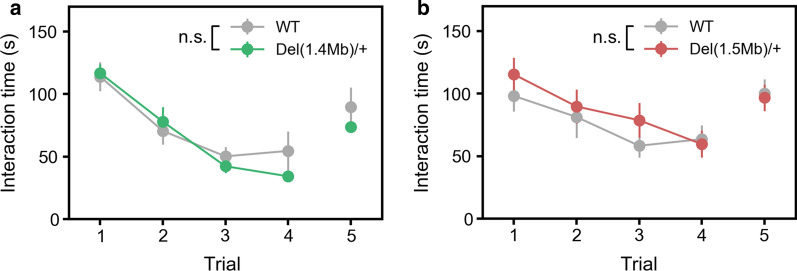
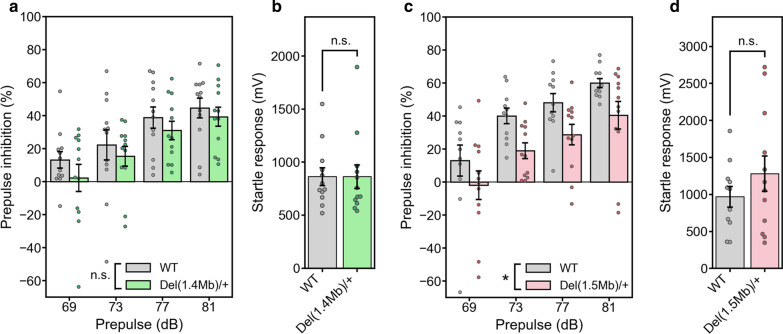
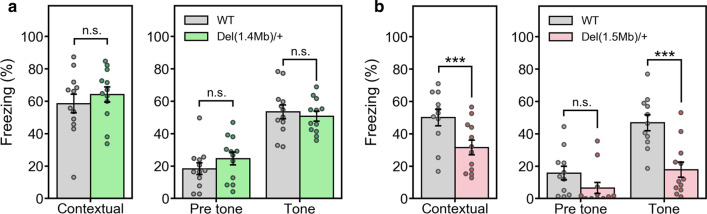
22q11.2 deletion syndrome (22q11.2DS) is a disorder caused by the segmental deletion of human chromosome 22. This chromosomal deletion is known as high genetic risk factors for various psychiatric disorders. The different deletion types are identified in 22q11.2DS patients, including the most common 3.0-Mb deletion, and the less-frequent 1.5-Mb and 1.4-Mb deletions. In previous animal studies of psychiatric disorders associated with 22q11.2DS mainly focused on the 1.5-Mb deletion and model mice mimicking the human 1.5-Mb deletion have been established with diverse genetic backgrounds, which resulted in the contradictory phenotypes. On the other hand, the contribution of the genes in 1.4-Mb region to psychiatric disorders is poorly understood. In this study, we generated two mouse lines that reproduced the 1.4-Mb and 1.5-Mb deletions of 22q11.2DS [Del(1.4 Mb)/+ and Del(1.5 Mb)/+] on the pure C57BL/6N genetic background. These mutant mice were analyzed comprehensively by behavioral tests, such as measurement of locomotor activity, sociability, prepulse inhibition and fear-conditioning memory. Del(1.4 Mb)/+ mice displayed decreased locomotor activity, but no abnormalities were observed in all other behavioral tests. Del(1.5 Mb)/+ mice showed reduction of prepulse inhibition and impairment of contextual- and cued-dependent fear memory, which is consistent with previous reports. Furthermore, apparently intact social recognition in Del(1.4 Mb)/+ and Del(1.5 Mb)/+ mice suggests that the impaired social recognition observed in Del(3.0 Mb)/+ mice mimicking the human 3.0-Mb deletion requires mutations both in 1.4-Mb and 1.5 Mb regions. Our previous study has shown that Del(3.0 Mb)/+ mice presented disturbance of behavioral circadian rhythm. Therefore, we further evaluated sleep/wakefulness cycles in Del(3.0 Mb)/+ mice by electroencephalogram (EEG) and electromyogram (EMG) recording. EEG/EMG analysis revealed the disturbed wakefulness and non-rapid eye moving sleep (NREMS) cycles in Del(3.0 Mb)/+ mice, suggesting that Del(3.0 Mb)/+ mice may be unable to maintain their wakefulness. Together, our mouse models deepen our understanding of genetic contributions to schizophrenic phenotypes related to 22q11.2DS.
22q11.2 缺失综合征(22q11.2DS)是一种由人类染色体 22 的片段缺失引起的疾病。这种染色体缺失被认为是各种精神疾病的高遗传风险因素。在 22q11.2DS 患者中,已确定不同的缺失类型,包括最常见的 3.0-Mb 缺失以及较不常见的 1.5-Mb 和 1.4-Mb 缺失。在与 22q11.2DS 相关的精神疾病的先前动物研究中,主要集中在 1.5-Mb 缺失上,并且已经建立了模拟人类 1.5-Mb 缺失的具有不同遗传背景的模型小鼠,这些模型小鼠导致了矛盾的表型。另一方面,1.4-Mb 区域中的基因对精神疾病的贡献尚不清楚。在这项研究中,我们在纯 C57BL/6N 遗传背景上产生了两种复制 22q11.2DS 中的 1.4-Mb 和 1.5-Mb 缺失的小鼠系[Del(1.4 Mb)/+ 和 Del(1.5 Mb)/+]。通过行为测试,例如测量运动活动、社交性、前脉冲抑制和恐惧条件记忆,全面分析了这些突变小鼠。Del(1.4 Mb)/+ 小鼠表现出运动活动减少,但在所有其他行为测试中均未观察到异常。Del(1.5 Mb)/+ 小鼠表现出前脉冲抑制减少和上下文和线索依赖性恐惧记忆受损,这与以前的报道一致。此外,Del(1.4 Mb)/+ 和 Del(1.5 Mb)/+ 小鼠明显完整的社交识别表明,模拟人类 3.0-Mb 缺失的 Del(3.0 Mb)/+ 小鼠中观察到的受损社交识别需要在 1.4-Mb 和 1.5-Mb 区域中都发生突变。我们之前的研究表明,Del(3.0 Mb)/+ 小鼠表现出行为昼夜节律紊乱。因此,我们通过脑电图(EEG)和肌电图(EMG)记录进一步评估 Del(3.0 Mb)/+ 小鼠的睡眠/觉醒周期。EEG/EMG 分析显示 Del(3.0 Mb)/+ 小鼠的觉醒和非快速眼动睡眠(NREMS)周期紊乱,表明 Del(3.0 Mb)/+ 小鼠可能无法保持清醒。总之,我们的小鼠模型加深了我们对与 22q11.2DS 相关的精神分裂症表型的遗传贡献的理解。