De Blasio Carlo, Verma Nagendra, Moretti Marta, Cialfi Samantha, Zonfrilli Azzurra, Franchitto Matteo, Truglio Federica, De Smaele Enrico, Ichijo Hidenori, Naguro Isao, Screpanti Isabella, Talora Claudio
Department of Molecular Medicine, Sapienza University of Rome, Viale Regina Elena 291, Rome, 00161, Italy.
IRCM, Institut de Recherche en Cancérologie de Montpellier, INSERM U1194, Université de Montpellier, Institut régional du Cancer de Montpellier, Montpellier, France.
Cell Death Discov. 2021 Apr 12;7(1):75. doi: 10.1038/s41420-021-00459-3.
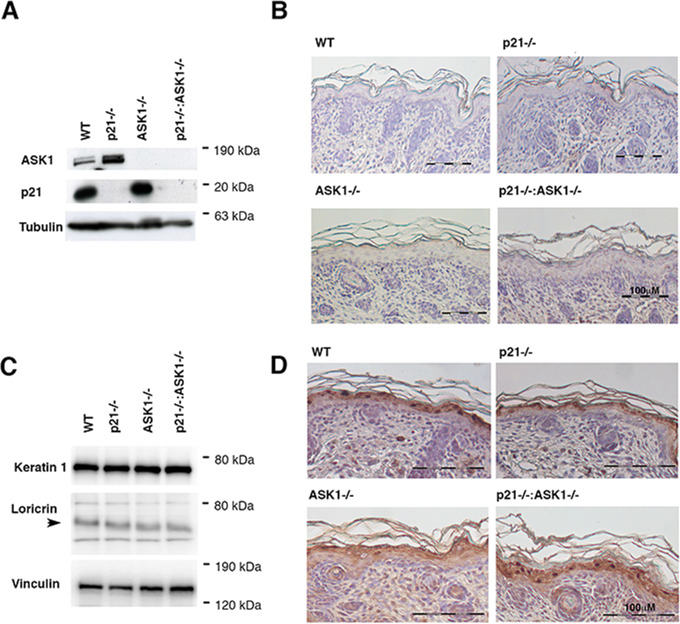
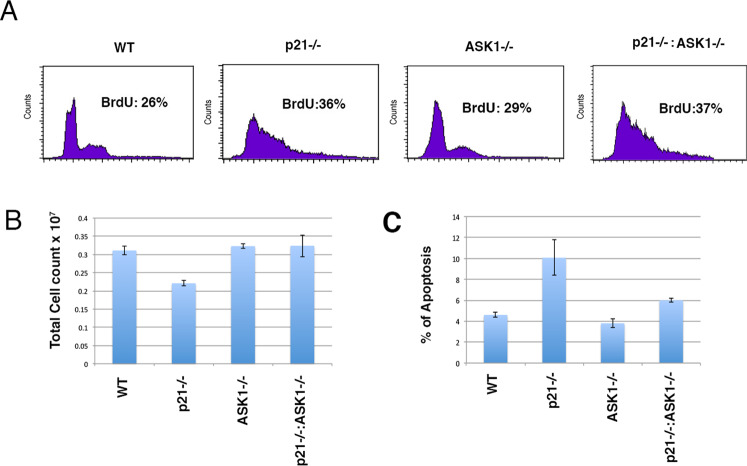
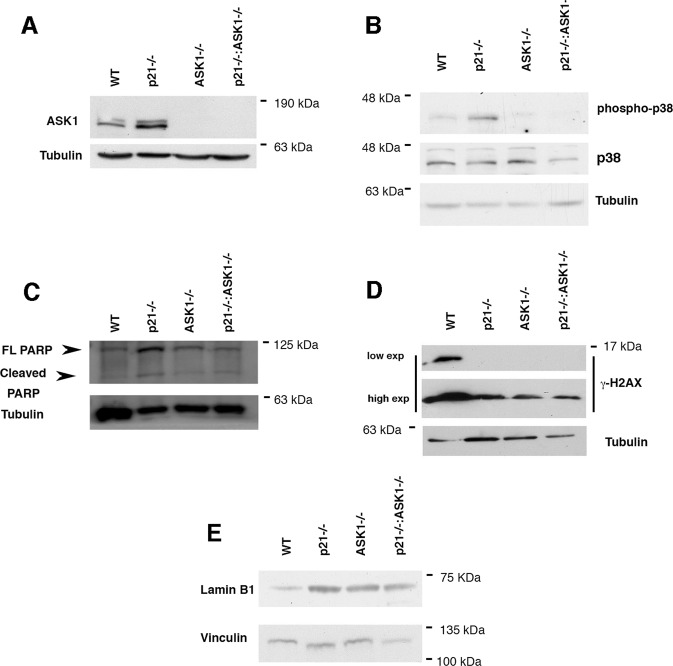
Both CDKN1A (p21 ) and Apoptosis signal-regulating kinase 1 (ASK1) play important roles in tumorigenesis. The role of p21 in attenuating ASK1-induced apoptosis by various stress conditions is well established. However, how ASK1 and p21 functionally interact during tumorigenesis is still unclear. To address this aspect, we crossed ASK1 knockout (ASK1KO) mice with p21 knockout (p21KO) mice to compare single and double-mutant mice. We observed that deletion of p21 leads to increased keratinocyte proliferation but also increased cell death. This is mechanistically linked to the ASK1 axis-induced apoptosis, including p38 and PARP. Indeed, deletion of ASK1 does not alter the proliferation but decreases the apoptosis of p21KO keratinocytes. To analyze as this interaction might affect skin carcinogenesis, we investigated the response of ASK1KO and p21KO mice to DMBA/TPA-induced tumorigenesis. Here we show that while endogenous ASK1 is dispensable for skin homeostasis, ASK1KO mice are resistant to DMBA/TPA-induced tumorigenesis. However, we found that epidermis lacking both p21 and ASK1 reacquires increased sensitivity to DMBA/TPA-induced tumorigenesis. We demonstrate that apoptosis and cell-cycle progression in p21KO keratinocytes are uncoupled in the absence of ASK1. These data support the model that a critical event ensuring the balance between cell death, cell-cycle arrest, and successful divisions in keratinocytes during stress conditions is the p21-dependent ASK1 inactivation.
细胞周期蛋白依赖性激酶抑制剂1A(p21)和凋亡信号调节激酶1(ASK1)在肿瘤发生过程中均发挥重要作用。p21在减轻各种应激条件下ASK1诱导的细胞凋亡中的作用已得到充分证实。然而,在肿瘤发生过程中ASK1和p21如何在功能上相互作用仍不清楚。为了解决这一问题,我们将ASK1基因敲除(ASK1KO)小鼠与p21基因敲除(p21KO)小鼠杂交,以比较单突变和双突变小鼠。我们观察到,p21的缺失导致角质形成细胞增殖增加,但也导致细胞死亡增加。这在机制上与ASK1轴诱导的细胞凋亡有关,包括p38和聚(ADP-核糖)聚合酶(PARP)。事实上,ASK1的缺失不会改变p21KO角质形成细胞的增殖,但会减少其凋亡。为了分析这种相互作用可能如何影响皮肤癌发生,我们研究了ASK1KO和p21KO小鼠对二甲基苯并蒽(DMBA)/12-O-十四酰佛波醇-13-乙酸酯(TPA)诱导的肿瘤发生的反应。在此我们表明,虽然内源性ASK1对皮肤稳态并非必需,但ASK1KO小鼠对DMBA/TPA诱导的肿瘤发生具有抗性。然而,我们发现同时缺乏p21和ASK1的表皮对DMBA/TPA诱导的肿瘤发生重新获得了更高的敏感性。我们证明,在没有ASK1的情况下,p21KO角质形成细胞中的细胞凋亡和细胞周期进程是解偶联的。这些数据支持了这样一种模型,即在应激条件下,确保角质形成细胞在细胞死亡、细胞周期停滞和成功分裂之间保持平衡的关键事件是p21依赖的ASK1失活。