Department of Urology, Qilu Hospital, Cheeloo College of Medicine, Shandong University, Jinan, Shandong 250012, P.R. China.
Department of Urology, People's Hospital of Laoling, Laoling, Shandong 253600, P.R. China.
Mol Med Rep. 2021 Jun;23(6). doi: 10.3892/mmr.2021.12066. Epub 2021 Apr 13.
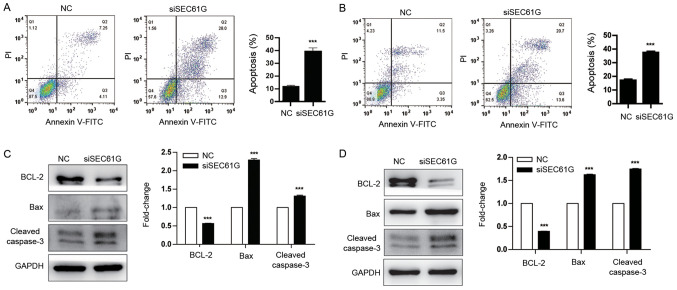
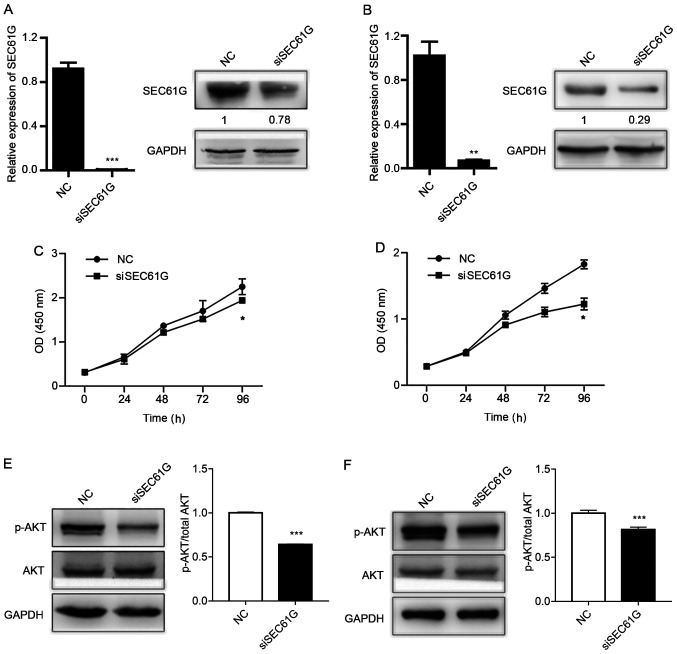
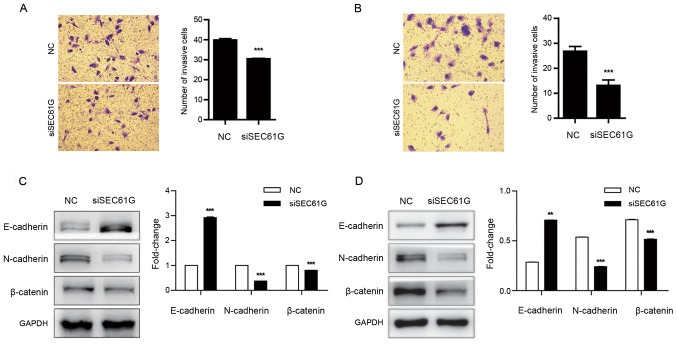
Kidney cancer is a malignant tumor of the urinary system. Although the 5‑year survival rate of patients with kidney cancer has increased by ~30% in recent years due to the early detection of low‑grade tumors using more accurate diagnostic methods, the global incidence of kidney cancer continues to increase every year. Therefore, identification of novel and efficient candidate genes for predicting the prognosis of patients with kidney cancer is important. The present study aimed to investigate the role of SEC61 translocon subunit‑γ (SEC61G) in kidney cancer. The Cancer Genome Atlas database was screened to obtain the expression profile of SEC61G and identify its association with kidney cancer prognosis. Furthermore, the effect of SEC61G knockdown on kidney cancer cell proliferation, migration, invasion and apoptosis was investigated using a Cell Counting Kit‑8 assay, wound healing assay, Transwell assay and flow cytometry. The results demonstrated that compared with healthy tissues, SEC61G was upregulated in human kidney tumor tissues, which was associated with poor prognosis. In addition, SEC61G knockdown significantly inhibited kidney cancer cell proliferation, migration and invasion compared with the negative control (NC) group. Furthermore, E‑cadherin expression was significantly upregulated, and N‑cadherin and β‑catenin expression levels were significantly downregulated in SEC61G‑knockdown kidney cancer cells compared with the NC group. In addition, compared with the NC group, SEC61G knockdown significantly promoted cell apoptosis in a caspase‑dependent manner. The aforementioned results suggested that SEC61G might serve as a proto‑oncogene to promote kidney tumor progression. Therefore, the present study provided a novel candidate gene for predicting the prognosis of patients with kidney cancer.
肾细胞癌是泌尿系统的一种恶性肿瘤。尽管近年来由于更准确的诊断方法能够早期发现低级别肿瘤,肾细胞癌患者的 5 年生存率提高了约 30%,但全球肾细胞癌的发病率仍在逐年上升。因此,鉴定预测肾细胞癌患者预后的新型有效候选基因是很重要的。本研究旨在探讨 SEC61 易位亚基γ(SEC61G)在肾细胞癌中的作用。通过筛选癌症基因组图谱数据库,获得 SEC61G 的表达谱,并确定其与肾细胞癌预后的关系。此外,通过细胞计数试剂盒-8 检测、划痕愈合实验、Transwell 检测和流式细胞术检测 SEC61G 敲低对肾癌细胞增殖、迁移、侵袭和凋亡的影响。结果表明,与正常组织相比,SEC61G 在人肾肿瘤组织中上调,与预后不良相关。此外,与阴性对照组(NC 组)相比,SEC61G 敲低组肾癌细胞的增殖、迁移和侵袭显著受到抑制。此外,与 NC 组相比,SEC61G 敲低组肾癌细胞中 E-钙黏蛋白表达显著上调,N-钙黏蛋白和 β-连环蛋白表达水平显著下调。此外,与 NC 组相比,SEC61G 敲低组以半胱天冬酶依赖性方式显著促进细胞凋亡。上述结果表明,SEC61G 可能作为一种原癌基因促进肾肿瘤的进展。因此,本研究为预测肾细胞癌患者预后提供了一个新的候选基因。