Department of Physics and Astronomy, University of British Columbia, Vancouver, BC, Canada.
Brain Research Center, Department of Medicine, University of British Columbia, Vancouver, BC, Canada.
Stat Methods Med Res. 2021 Jun;30(6):1502-1522. doi: 10.1177/09622802211002861. Epub 2021 Apr 13.
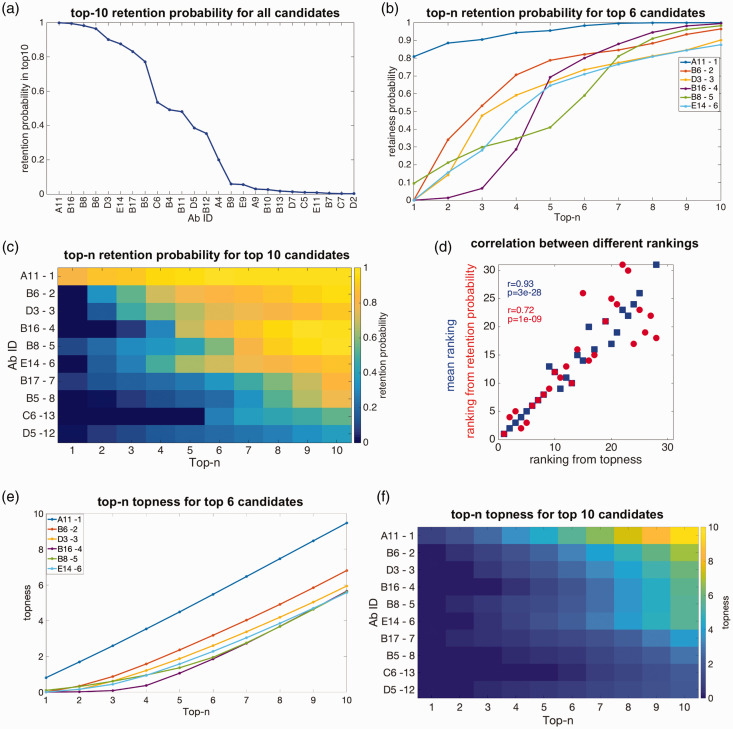
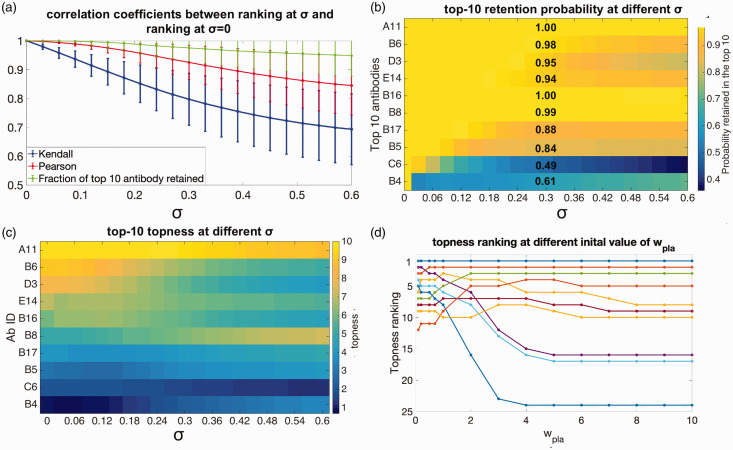
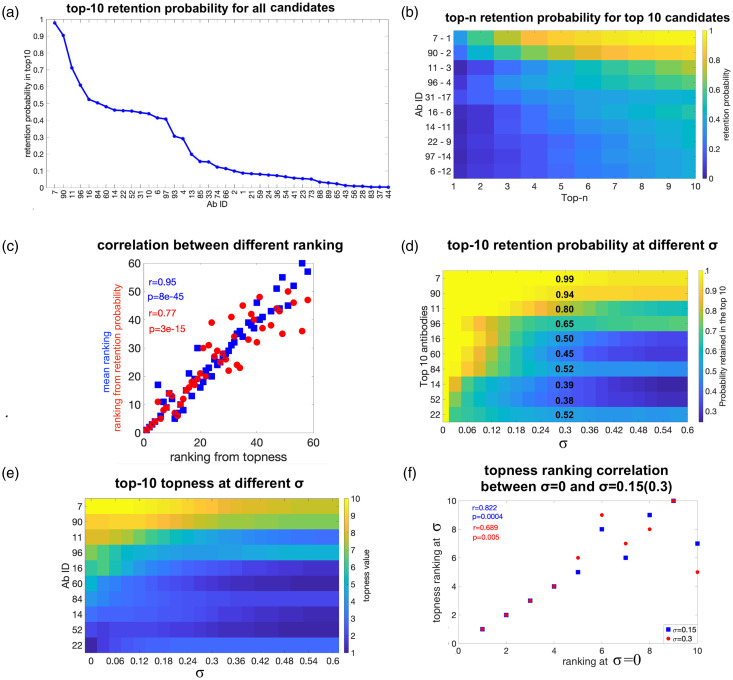
Multiple different screening tests for candidate leads in drug development may often yield conflicting or ambiguous results, sometimes making the selection of leads a nontrivial maximum-likelihood ranking problem. Here, we employ methods from the field of multiple criteria decision making (MCDM) to the problem of screening candidate antibody therapeutics. We employ the SMAA-TOPSIS method to rank a large cohort of antibodies using up to eight weighted screening criteria, in order to find lead candidate therapeutics for Alzheimer's disease, and determine their robustness to both uncertainty in screening measurements, as well as uncertainty in the user-defined weights of importance attributed to each screening criterion. To choose lead candidates and measure the confidence in their ranking, we propose two new quantities, the Retention Probability and the Topness, as robust measures for ranking. This method may enable more systematic screening of candidate therapeutics when it becomes difficult intuitively to process multi-variate screening data that distinguishes candidates, so that additional candidates may be exposed as potential leads, increasing the likelihood of success in downstream clinical trials. The method properly identifies true positives and true negatives from synthetic data, its predictions correlate well with known clinically approved antibodies vs. those still in trials, and it allows for ranking analyses using antibody developability profiles in the literature. We provide a webserver where users can apply the method to their own data: http://bjork.phas.ubc.ca.
在药物开发中,多种不同的筛选测试可能会产生相互矛盾或模棱两可的结果,有时使得先导化合物的选择成为一个非平凡的最大似然排序问题。在这里,我们将多准则决策(MCDM)领域的方法应用于筛选候选抗体治疗药物的问题。我们使用 SMAA-TOPSIS 方法对一大群抗体进行排名,使用多达八个加权筛选标准,以找到阿尔茨海默病的先导候选治疗药物,并确定它们对筛选测量的不确定性以及用户定义的每个筛选标准重要性权重的不确定性的稳健性。为了选择先导候选药物并衡量其排名的置信度,我们提出了两个新的量,保留概率和顶部,作为排名的稳健度量。当直观地处理区分候选药物的多变量筛选数据变得困难时,这种方法可以更系统地筛选候选治疗药物,从而可能会有更多的潜在候选药物被暴露为潜在的先导药物,增加下游临床试验成功的可能性。该方法可以正确地从合成数据中识别真阳性和真阴性,其预测与已知的临床批准抗体与仍在临床试验中的抗体很好地相关,并且允许使用文献中的抗体可开发性分析进行排名分析。我们提供了一个网络服务器,用户可以在其中将该方法应用于他们自己的数据:http://bjork.phas.ubc.ca。