School of Psychological and Cognitive Sciences and Beijing Key Laboratory of Behavior and Mental Health, Peking University, Beijing, People's Republic of China.
IDG/McGovern Institute for Brain Research, Peking University, Beijing, People's Republic of China.
J Vis. 2021 Apr 1;21(4):6. doi: 10.1167/jov.21.4.6.
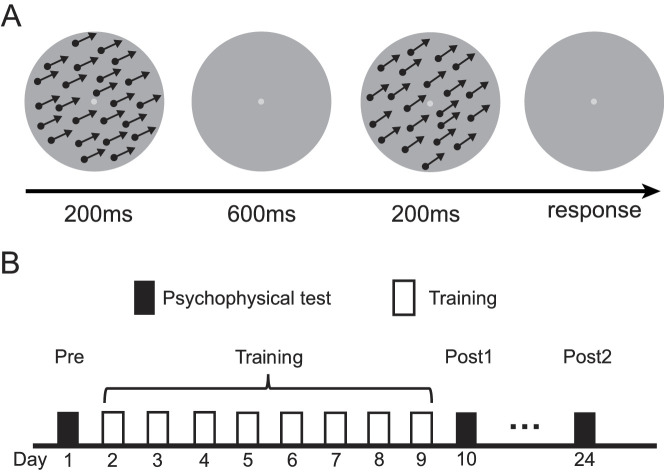
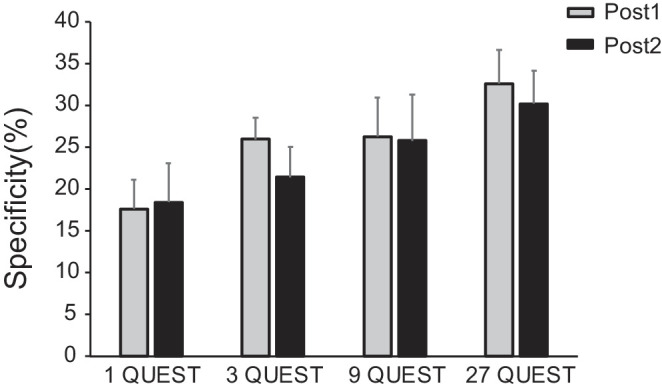
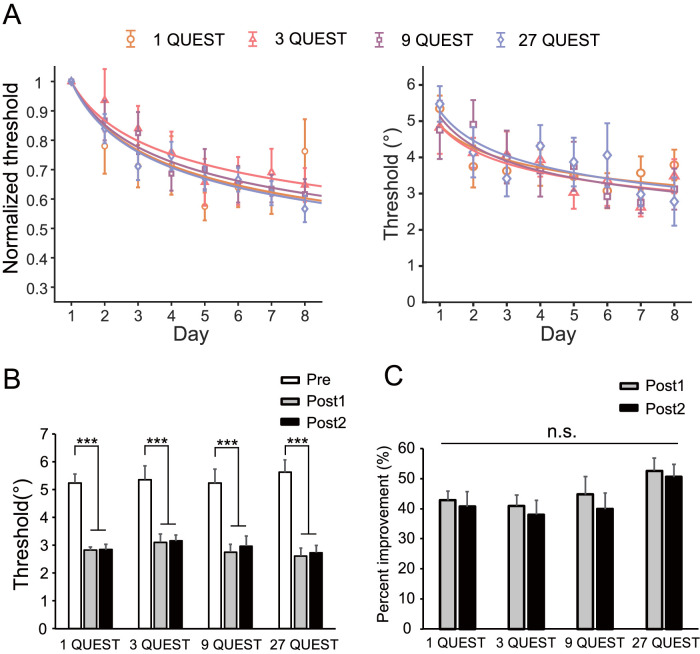
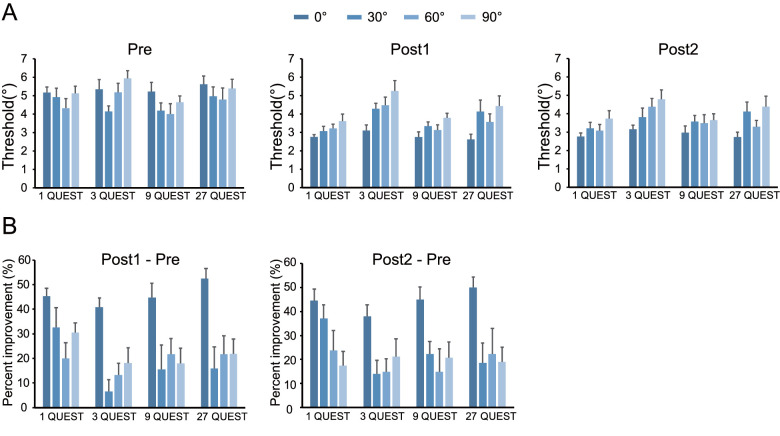
Perceptual learning has been widely used to study the plasticity of the visual system in adults. Owing to the belief that practice makes perfect, perceptual learning protocols usually require subjects to practice a task thousands of times over days, even weeks. However, we know very little about the relationship between training amount and behavioral improvement. Here, four groups of subjects underwent motion direction discrimination training over 8 days with 40, 120, 360, or 1080 trials per day. Surprisingly, different daily training amounts induced similar improvement across the four groups, and the similarity lasted for at least 2 weeks. Moreover, the group with 40 training trials per day showed more learning transfer from the trained direction to the untrained directions than the group with 1080 training trials per day immediately after training and 2 weeks later. These findings suggest that perceptual learning of motion direction discrimination is not always dependent on the daily training amount and less training leads to more transfer.
知觉学习已被广泛用于研究成人视觉系统的可塑性。由于相信熟能生巧,知觉学习方案通常要求受试者在数天甚至数周内练习任务数千次。然而,我们对训练量与行为改善之间的关系知之甚少。在这里,四组受试者在 8 天内每天接受 40、120、360 或 1080 次运动方向辨别训练。令人惊讶的是,不同的每日训练量在四组中引起了相似的改善,这种相似性至少持续了 2 周。此外,与每天进行 1080 次训练的组相比,每天进行 40 次训练的组在训练后立即和 2 周后,从训练方向到未训练方向的学习迁移更多。这些发现表明,运动方向辨别知觉学习并不总是依赖于每日训练量,较少的训练会导致更多的迁移。