Lengyel Gábor, Fiser József
Department of Cognitive Science, Central European University, Budapest, Hungary.
J Vis. 2019 Apr 1;19(4):28. doi: 10.1167/19.4.28.
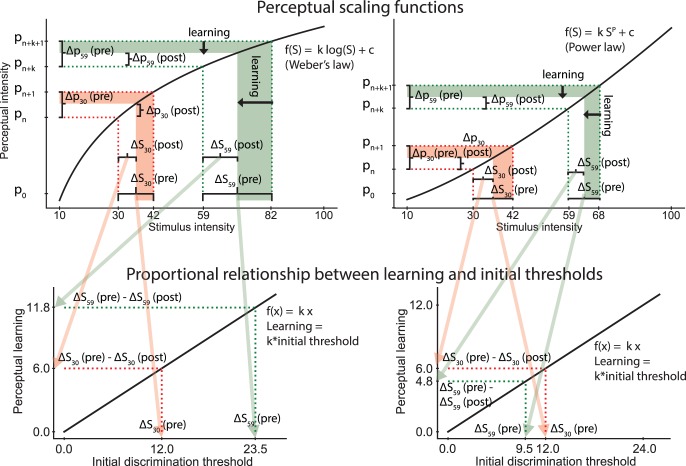
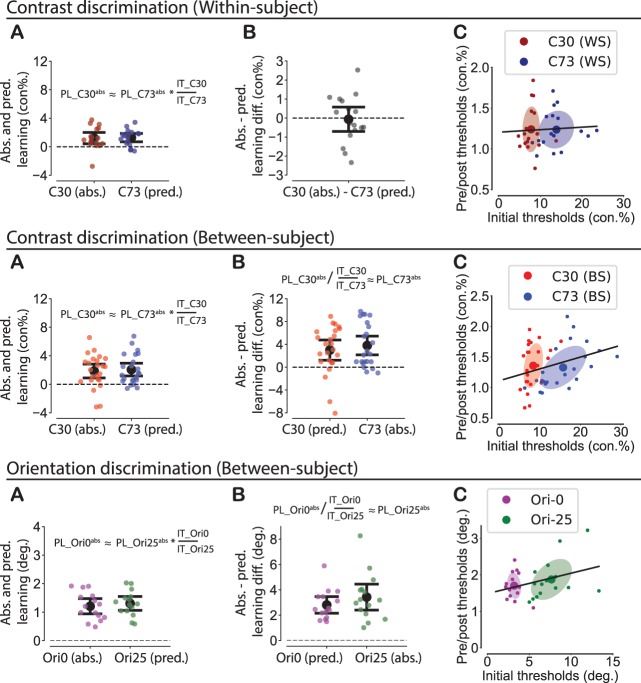
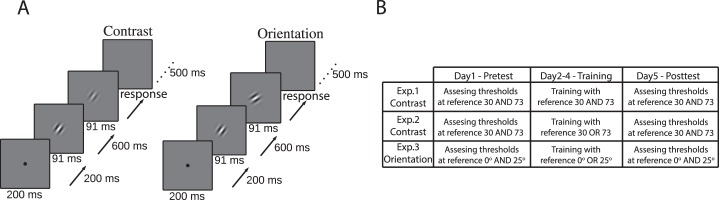
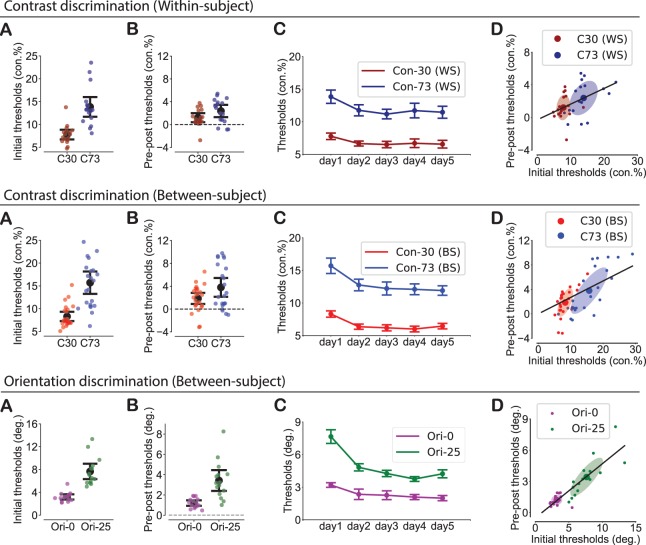
We investigated the origin of two previously reported general rules of perceptual learning. First, the initial discrimination thresholds and the amount of learning were found to be related through a Weber-like law. Second, increased training length negatively influenced the observer's ability to generalize the obtained knowledge to a new context. Using a five-day training protocol, separate groups of observers were trained to perform discrimination around two different reference values of either contrast (73% and 30%) or orientation (25° and 0°). In line with previous research, we found a Weber-like law between initial performance and the amount of learning, regardless of whether the tested attribute was contrast or orientation. However, we also showed that this relationship directly reflected observers' perceptual scaling function relating physical intensities to perceptual magnitudes, suggesting that participants learned equally on their internal perceptual space in all conditions. In addition, we found that with the typical five-day training period, the extent of generalization was proportional to the amount of learning, seemingly contradicting the previously reported diminishing generalization with practice. This result suggests that the negative link between generalization and the length of training found in earlier studies might have been due to overfitting after longer training and not directly due to the amount of learning per se.
我们研究了之前报道的两条感知学习通用规则的起源。首先,发现初始辨别阈值和学习量通过类似韦伯定律的方式相关联。其次,增加训练时长会对观察者将所获知识推广到新情境的能力产生负面影响。采用为期五天的训练方案,将不同组的观察者分别训练以围绕对比度(73%和30%)或方向(25°和0°)的两个不同参考值进行辨别。与之前的研究一致,我们发现无论测试属性是对比度还是方向,初始表现和学习量之间都存在类似韦伯定律的关系。然而,我们还表明这种关系直接反映了观察者将物理强度与感知大小相关联的感知缩放函数,这表明参与者在所有条件下在其内部感知空间上的学习程度相同。此外,我们发现,在典型的五天训练期内,推广程度与学习量成正比,这似乎与之前报道的随着练习推广能力下降相矛盾。这一结果表明,早期研究中发现的推广与训练时长之间的负相关可能是由于长时间训练后的过拟合,而不是直接由于学习量本身。