Northumbria Sleep Research, Department of Psychology, Northumbria University, Newcastle upon Tyne, UK.
Department of Psychiatry, University of Pennsylvania, Philadelphia, PA.
Sleep. 2021 Sep 13;44(9). doi: 10.1093/sleep/zsab095.
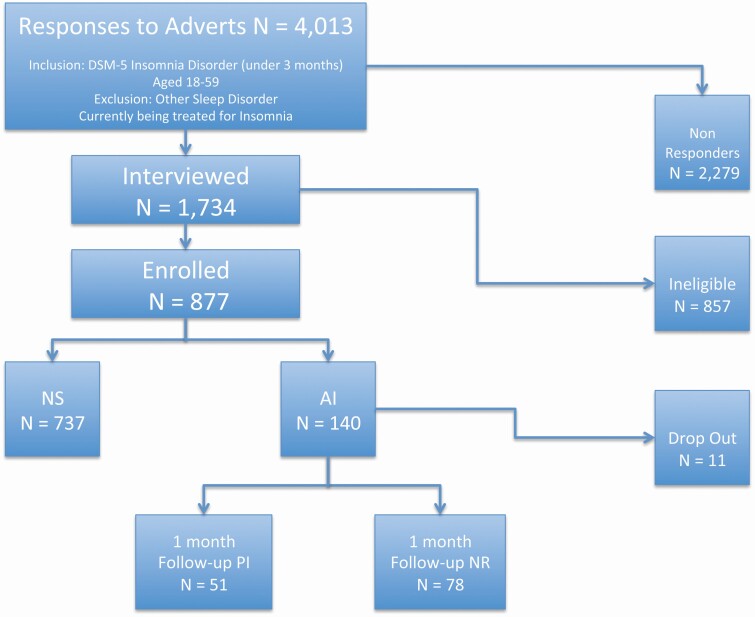
While there is an extensive literature on predisposing, precipitating, coping, and perpetuating factors in those with chronic insomnia, very little work has been undertaken to evaluate these factors over the early developmental course of insomnia. The present aim was to determine whether several hypothesized factors in each domain (predisposing, precipitating, coping, and perpetuating), assessed during an episode of acute insomnia (AI), are related to its persistence or remission to normal sleep. Participants comprised n = 140 people with AI and n = 737 normal sleepers (NS) recruited from the general public. Participants completed measures assessing predisposing characteristics (personality traits, arousal predisposition, and insomnia vulnerability), precipitating events and outcomes (life events, perceived stress, anxiety, and depression), coping styles (thought control strategies and coping styles), and perpetuating factors (sleep preoccupation, pre-sleep arousal, dysfunctional beliefs, and fatigue). Additionally, insomnia status (from AI at baseline to its persistence or natural remission [NR]) was assessed 1 month later (n = 129). Baseline differences between NS and individuals with AI were observed in each domain with increasing age, lower openness to experience and conscientiousness, higher insomnia severity, levels of anxiety, and affective sleep preoccupation significantly predicting AI status. Further, a previous episode of insomnia, higher depression scores, and affective sleep preoccupation scores significantly predicted its persistence, as opposed to its NR. Results are discussed with reference to the conceptualization of insomnia and how the findings may influence the design of preventative interventions to circumvent the transition from acute to chronic insomnia.
虽然有大量文献研究了慢性失眠患者的易患、诱发、应对和持续因素,但很少有研究评估这些因素在失眠早期发展过程中的作用。本研究旨在确定在急性失眠(AI)发作期间评估的每个领域(易患、诱发、应对和持续)中的几个假设因素是否与 AI 的持续存在或恢复正常睡眠有关。参与者包括 n = 140 名 AI 患者和 n = 737 名正常睡眠者(NS),他们均来自普通人群。参与者完成了评估易患特征(人格特质、觉醒倾向和失眠易感性)、诱发事件和结果(生活事件、感知压力、焦虑和抑郁)、应对方式(思维控制策略和应对方式)和持续因素(睡眠关注、睡前觉醒、功能失调信念和疲劳)的量表。此外,在 1 个月后(n = 129)评估了从基线 AI 到其持续存在或自然缓解(NR)的失眠状况。在每个领域中,NS 和 AI 患者之间存在基线差异,表现为年龄越大、开放性和尽责性越低、失眠严重程度越高、焦虑水平越高、以及情感性睡眠关注显著预测 AI 状态。此外,先前的失眠发作、更高的抑郁评分和情感性睡眠关注评分显著预测其持续存在,而不是自然缓解。结果参考了失眠的概念化,以及这些发现如何影响预防干预措施的设计,以避免从急性失眠向慢性失眠的转变。