Arthritis Clinic & Research Center, Peking University People's Hospital, Peking University, Beijing, 100044, China.
Arthritis Institute, Peking University, Beijing, China.
BMC Musculoskelet Disord. 2021 Apr 13;22(1):351. doi: 10.1186/s12891-021-04213-9.
This study aimed to determine whether the accelerometer-based navigation (ABN) could improve the accuracy of restoring mechanical axis (MA), component positioning, and clinical outcomes compared to conventional (CON) total knee arthroplasty (TKA).
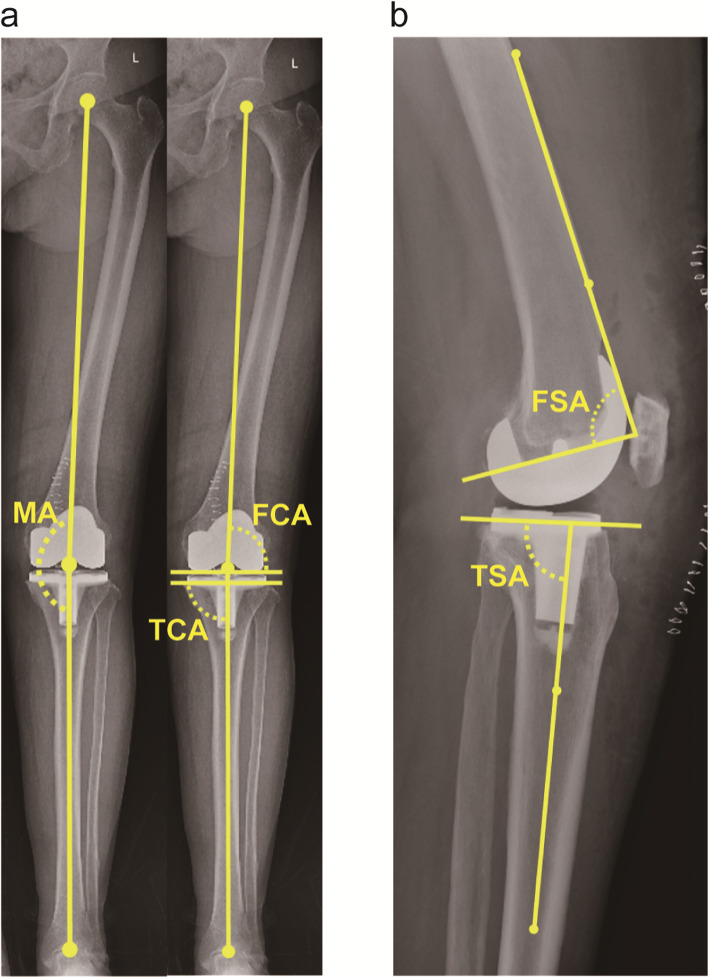
A total of 301 consecutive patients (ABN: 27, CON: 274) were included. A 1:4 propensity score matching (PSM) was performed between the two groups according to preoperative demographic and clinical parameters. The postoperative MA, femoral coronal angle (FCA), femoral sagittal angle (FSA), tibial coronal angle (TCA) and tibial sagittal angle (TSA) were compared. Absolute deviations of aforementioned angles were calculated as the absolute value of difference between the exact and ideal value and defined as norms if within 3°, otherwise regarded as outliers. Additional clinical parameters, including the Knee Society knee and function scores (KSKS and KSFS) and range of motion (ROM), were assessed at final follow-up (FU) (mean FU was 21.88 and 21.56 months respectively for ABN and CON group). A secondary subgroup analysis and comparison on clinical outcomes were conducted between norms and outliers in different radiological parameters.
A total of 98 patients/102 knees were analyzed after the PSM (ABN: 21 patients/24 knees, CON: 77 patients/78 knees). In the ABN group, the mean MA, FCA and TSA were significantly improved (p = 0.019, 0.006, < 0.001, respectively). Proportions of TKAs within a ± 3°deviation were significantly improved in all the postoperative radiological variables except for TCA (p = 0.003, 0.021, 0.042, 0.013, respectively for MA, FCA, FSA, and TSA). The absolute deviations of FSA and TSA were also significantly lower in the ABN group (p = 0.020, 0.048, respectively). No significant differences were found in either mean value, absolute deviation or outlier ratio of TCA between two groups. On clinical outcomes, there were no significant differences between two groups, although KSKS, KSFS and ROM (p < 0.01, respectively) dramatically improved compared to baseline. The subgroup analysis also demonstrated no statistical difference on clinical outcomes between the outliers and norms in varied radiological parameters.
The ABN could improve the accuracy and precision of mechanical alignment and component positioning without significant improvement of clinical outcomes. Further high quality studies with long term FU are warranted to comprehensively evaluate the value of the ABN.
本研究旨在比较基于加速度计的导航(ABN)与传统(CON)全膝关节置换术(TKA)在恢复机械轴(MA)、假体位置和临床结果方面的准确性,以确定 ABN 是否更优。
共纳入 301 例连续患者(ABN:27 例,CON:274 例)。根据术前人口统计学和临床参数,对两组患者进行了 1:4 的倾向评分匹配(PSM)。比较两组术后 MA、股骨冠状角(FCA)、股骨矢状角(FSA)、胫骨冠状角(TCA)和胫骨矢状角(TSA)。上述角度的绝对偏差定义为精确值与理想值之差的绝对值,如果在 3°以内,则定义为正常范围,否则视为离群值。在最终随访(FU)时(ABN 和 CON 组的平均 FU 分别为 21.88 和 21.56 个月),还评估了膝关节学会膝关节和功能评分(KSKS 和 KSFS)和活动范围(ROM)等其他临床参数。
PSM 后共分析了 98 例患者/102 例膝关节(ABN:21 例患者/24 例膝关节,CON:77 例患者/78 例膝关节)。在 ABN 组中,MA、FCA 和 TSA 的均值显著改善(p=0.019、0.006、<0.001)。除 TCA 外(p=0.003、0.021、0.042、0.013,分别为 MA、FCA、FSA 和 TSA),所有术后影像学变量中 TKAs 在±3°偏差内的比例均显著提高。FSA 和 TSA 的绝对偏差也显著降低(p=0.020、0.048)。两组间 TCA 的均值、绝对偏差或离群值比例均无显著差异。在临床结果方面,虽然 KSKS、KSFS 和 ROM(p<0.01)与基线相比均显著改善,但两组间无显著差异。亚组分析还表明,在不同影像学参数中,离群值与正常范围之间的临床结果无统计学差异。
ABN 可提高机械对线和假体位置的准确性和精密度,而对临床结果无显著改善。需要进一步进行高质量、长期随访的研究,以全面评估 ABN 的价值。