Cargill Innovation Centre, Camino a Pargua km 57, Colaco km 5, Calbuco, Puerto Montt, Chile.
Cargill Innovation Centre, Dirdalsstranda 51, 4335, Dirdal, Norway.
BMC Vet Res. 2021 Apr 13;17(1):155. doi: 10.1186/s12917-021-02853-6.
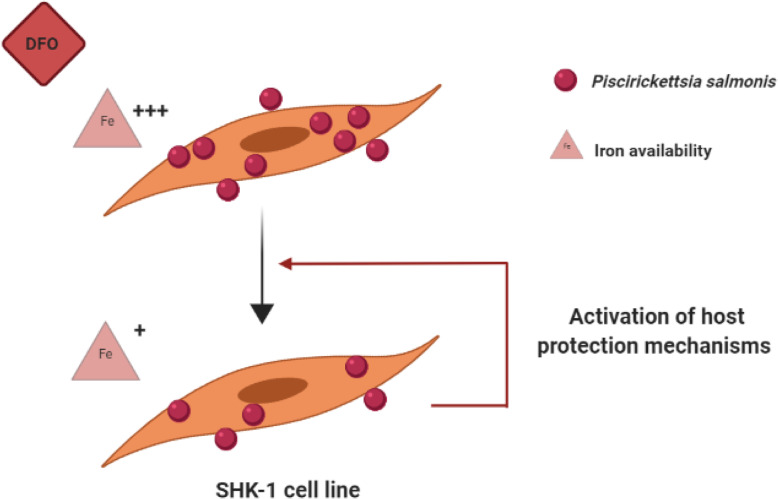
Vertebrate hosts limit the availability of iron to microbial pathogens in order to nutritionally starve the invaders. The impact of iron deficiency induced by the iron chelator deferoxamine mesylate (DFO) was investigated in Atlantic salmon SHK-1 cells infected with the facultative intracellular bacterium Piscirickettsia salmonis.
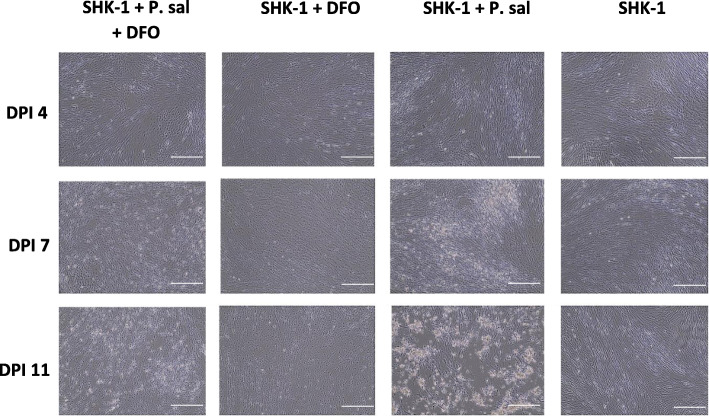
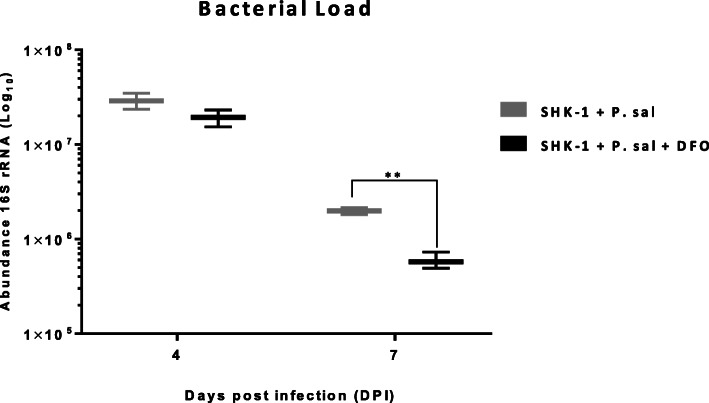
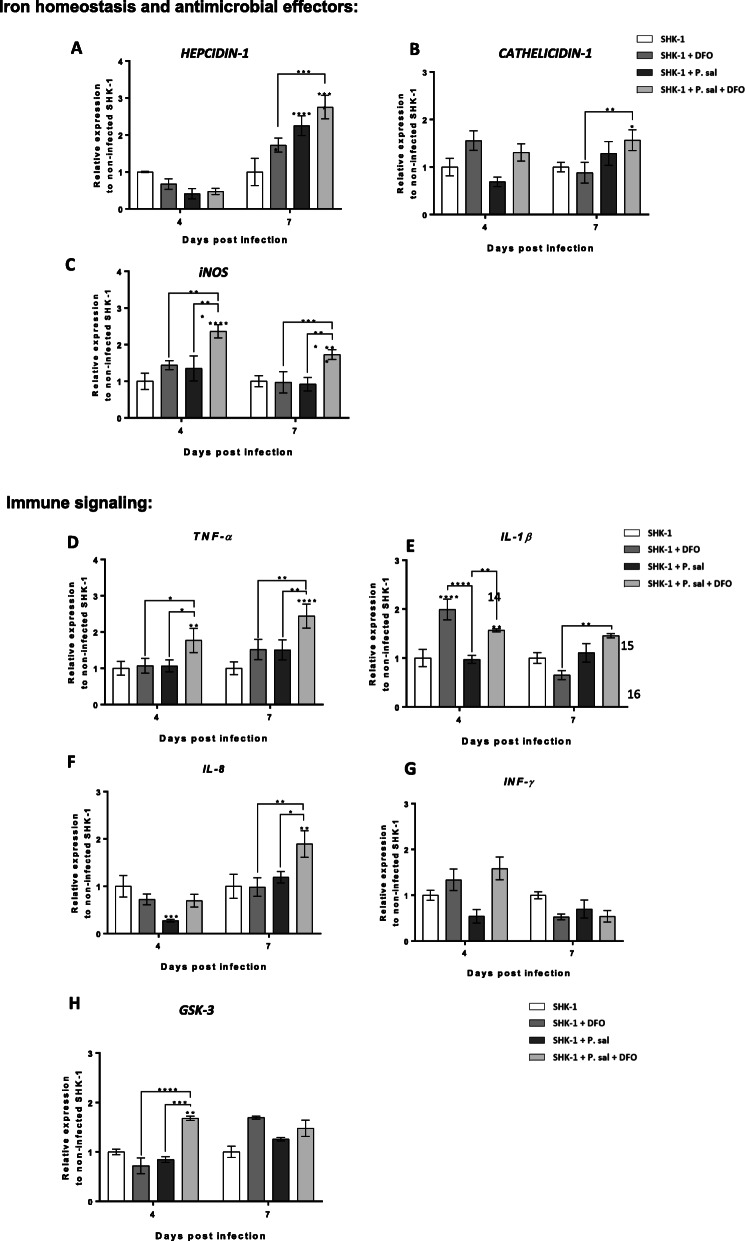
Effects of the DFO treatment and P. salmonis on SHK-1 cells were gaged by assessing cytopathic effects, bacterial load and activity, and gene expression profiles of eight immune biomarkers at 4- and 7-days post infection (dpi) in the control group, groups receiving single treatments (DFO or P. salmonis) and their combination. The chelator appears to be well-tolerated by host cells, while it had a negative impact on the number of bacterial cells and associated cytotoxicity. DFO alone had minor effects on gene expression of SHK-1 cells, including an early activation of IL-1β at 4 dpi. In contrast to few moderate changes induced by single treatments (either infection or chelator), most genes had highest upregulation in the infected groups receiving DFO. The mildest induction of hepcidin-1 (antimicrobial peptide precursor and regulator of iron homeostasis) was observed in cells exposed to DFO alone, followed by P. salmonis infected cells while the addition of DFO to infected cells further increased the mRNA abundance of this gene. Transcripts encoding TNF-α (immune signaling) and iNOS (immune effector) showed sustained increase at both time points in this group while cathelicidin-1 (immune effector) and IL-8 (immune signaling) were upregulated at 7 dpi. The stimulation of protective gene responses seen in infected cultures supplemented with DFO coincided with the reduction of bacterial load and activity (judged by the expression of P. salmonis 16S rRNA), and damage to cultured host cells.
The absence of immune gene activation under normal iron conditions suggests modulation of host responses by P. salmonis. The negative effect of iron deficiency on bacteria likely allowed host cells to respond in a more protective manner to the infection, further decreasing its progression. Presented findings encourage in vivo exploration of iron chelators as a promising strategy against piscirickettsiosis.
脊椎动物宿主通过营养剥夺的方式限制铁元素的可利用性,从而抑制微生物病原体的生长。本研究采用铁螯合剂甲磺酸去铁胺(DFO)诱导铁缺乏,探究其对兼性胞内菌鲑鱼鱼立克次氏体(Piscirickettsia salmonis)感染大西洋鲑鱼 SHK-1 细胞的影响。
通过评估细胞病变效应、细菌载量和活性以及对照组、单独接受处理(DFO 或 P. salmonis)和两者联合处理组在感染后 4 天和 7 天的 8 种免疫生物标志物的基因表达谱,来评估 DFO 处理和 P. salmonis 对 SHK-1 细胞的影响。螯合剂似乎被宿主细胞耐受良好,同时对细菌细胞数量和相关细胞毒性有负面影响。DFO 单独处理对 SHK-1 细胞的基因表达影响较小,包括在 4 天时早期激活白细胞介素-1β(IL-1β)。与单独处理(感染或螯合剂)引起的少数适度变化相比,大多数基因在接受 DFO 的感染组中表达上调。单独用 DFO 处理时观察到铁调素-1(抗菌肽前体和铁稳态调节剂)的诱导最为温和,其次是感染 P. salmonis 的细胞,而将 DFO 添加到感染细胞中进一步增加了该基因的 mRNA 丰度。在该组中,肿瘤坏死因子-α(免疫信号)和诱导型一氧化氮合酶(免疫效应)的转录本在两个时间点均持续增加,而 cathelicidin-1(免疫效应)和 IL-8(免疫信号)在 7 天增加。在添加 DFO 的感染培养物中观察到的保护性基因反应的刺激与细菌载量和活性的降低(通过 P. salmonis 16S rRNA 的表达判断)以及培养宿主细胞的损伤同时发生。
在正常铁条件下未观察到免疫基因激活,表明 P. salmonis 对宿主反应进行了调节。铁缺乏对细菌的负面影响可能使宿主细胞以更具保护作用的方式对感染做出反应,从而进一步降低感染的进展。本研究结果鼓励在体内探索铁螯合剂作为对抗鲑鱼鱼立克次氏体病的有前途的策略。