Department of Psychiatry and Behavioural Neurosciences, McMaster University, 1280 Main St W, Hamilton, ON, L8S 4L8, Canada.
Department of Health Research Methods, Evidence, and Impact, McMaster University, 1280 Main St W, Hamilton, ON, L8S 4L8, Canada.
Subst Abuse Treat Prev Policy. 2021 Apr 13;16(1):34. doi: 10.1186/s13011-021-00372-z.
As the legalization of recreational cannabis becomes more widespread, its impact on individuals with substance use disorders must be studied. Amidst an ongoing opioid crisis, Canada's legalization of recreational cannabis in October 2018 provides an important setting for investigation. We examined changes to cannabis use patterns in patients receiving medication-assisted treatment (MAT) for opioid use disorder (OUD) following legalization.
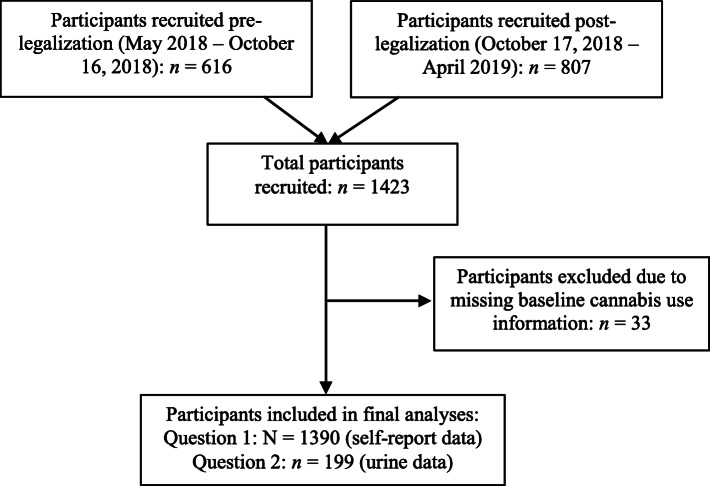
This study includes cross-sectional data from 602 participants recruited 6 months pre-legalization and 788 participants recruited 6 months post-legalization, providing information on cannabis use. Regression analysis was used to estimate the association between legalization and cannabis use patterns. We collected longitudinal urine drug screens (UDSs) detecting cannabis-metabolites for 199 participants recruited pre-legalization and followed prospectively post-legalization. Conditional logistic regression was used to assess the association between legalization and UDS results.
Past-month cannabis use was self-reported by 54.8 and 52.3% of participants recruited pre- and post-legalization, respectively. Legalization was not associated with changes in any measured cannabis characteristics: cannabis use (OR 0.91, 95% CI 0.73-1.13), days of use/month (B -0.42, 95% CI - 2.05-1.21), money spent, or cannabis source. There was no association between legalization and prevalence of cannabis use on UDS (OR 1.67, 95% CI 0.93-2.99) or percentage of cannabis-positive UDSs (OR 1.00, 95% CI 0.99-1.01). Participants overwhelmingly reported that legalization would have no impact on their cannabis use (85.7%).
Amongst patients treated for OUD, no significant change in cannabis use was observed following legalization; however, high rates of cannabis use are noted.
随着娱乐性大麻合法化的普及,必须研究其对有物质使用障碍的个人的影响。在阿片类药物危机持续存在的情况下,加拿大于 2018 年 10 月将娱乐性大麻合法化,为调查提供了一个重要背景。我们研究了在合法化之后,接受药物辅助治疗(MAT)治疗阿片类药物使用障碍(OUD)的患者的大麻使用模式的变化。
这项研究包括在合法化前 6 个月招募的 602 名参与者和合法化后 6 个月招募的 788 名参与者的横断面数据,提供了大麻使用情况的信息。回归分析用于估计合法化与大麻使用模式之间的关联。我们为在合法化前招募并进行前瞻性随访的 199 名参与者收集了纵向尿液药物筛查(UDS)检测大麻代谢物的数据。条件逻辑回归用于评估合法化与 UDS 结果之间的关联。
分别有 54.8%和 52.3%的参与者在合法化前和后报告过去一个月有大麻使用。合法化与任何测量的大麻特征的变化均无关:大麻使用(OR 0.91,95%CI 0.73-1.13)、每月使用天数(B-0.42,95%CI-2.05-1.21)、花费或大麻来源。合法化与 UDS 上大麻使用的流行率(OR 1.67,95%CI 0.93-2.99)或 UDS 上大麻阳性的百分比(OR 1.00,95%CI 0.99-1.01)均无关。参与者普遍报告合法化对他们的大麻使用没有影响(85.7%)。
在接受 OUD 治疗的患者中,合法化后大麻使用没有明显变化;然而,大麻使用率很高。