Legemaat Amanda M, Semkovska Maria, Brouwer Marlies, Geurtsen Gert J, Burger Huibert, Denys Damiaan, Bockting Claudi L
Department of Psychiatry, Amsterdam University Medical Centers, Academic Medical Center, University of Amsterdam, Amsterdam Neuroscience & Amsterdam Public Health, Meibergdreef 9 1105 AZ, Amsterdam, The Netherlands.
Department of Psychology, University of Southern Denmark, Campusvej 55 DK-5230 Odense M, Denmark.
Psychol Med. 2021 Apr 14;52(16):1-16. doi: 10.1017/S0033291721001100.
Preliminary evidence suggests beneficial effects of cognitive remediation in depression. An update of the current evidence is needed. The aim was to systematically assess the effectiveness of cognitive remediation in depression on three outcomes.
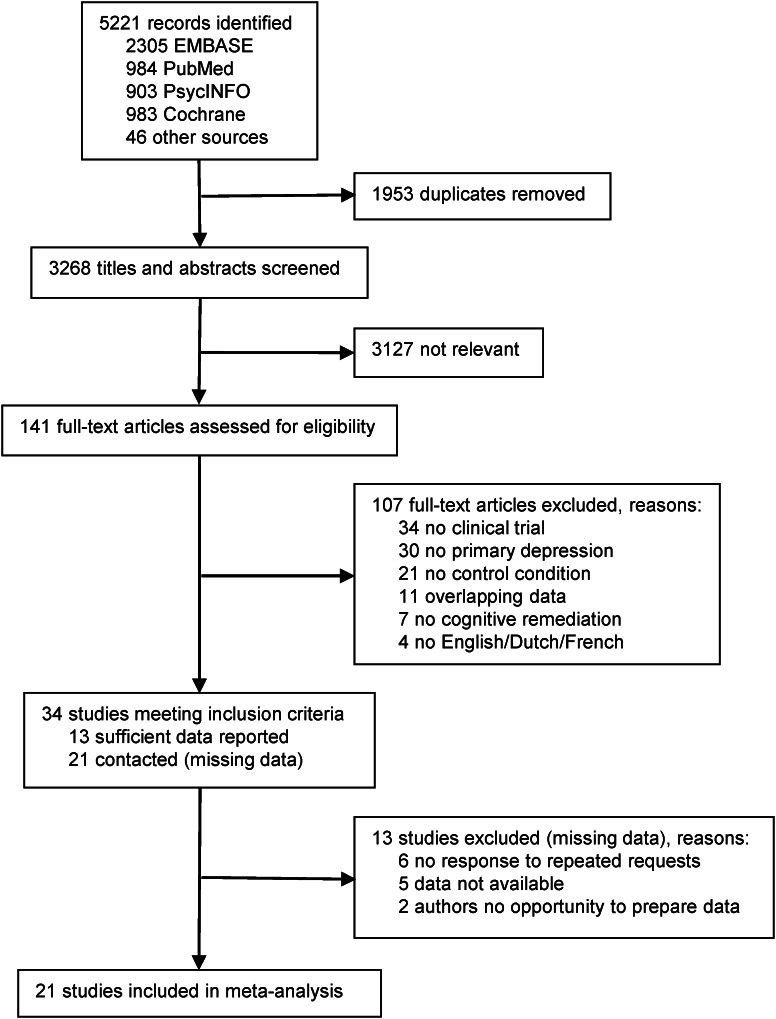
The meta-analysis was pre-registered on PROSPERO (CRD42019124316). PubMed, PsycINFO, Embase and Cochrane Library were searched on 2 February 2019 and 8 November 2020 for peer-reviewed published articles. We included randomized and non-randomized clinical trials comparing cognitive remediation to control conditions in adults with primary depression. Random-effects models were used to calculate Hedges' g, and moderators were assessed using mixed-effects subgroup analyses and meta-regression. Main outcome categories were post-treatment depressive symptomatology (DS), cognitive functioning (CF) and daily functioning (DF).
We identified 5221 records and included 21 studies reporting on 24 comparisons, with 438 depressed patients receiving cognitive remediation and 540 patients in a control condition. We found a small effect on DS (g = 0.28, 95% CI 0.09-0.46, I2 40%), a medium effect on CF (g = 0.60, 95% CI 0.37-0.83, I2 44%) and a small effect on DF (g = 0.22, 95% CI 0.06-0.39, I2 3%). There were no significant effects at follow-up. Confounding bias analyses indicated possible overestimation of the DS and DF effects in the original studies.
Cognitive remediation in depression improves CF in the short term. The effects on DS and DF may have been overestimated. Baseline depressive symptom severity should be considered when administering cognitive remediation.
初步证据表明认知康复对抑郁症有有益影响。需要对当前证据进行更新。目的是系统评估认知康复对抑郁症三个结局的有效性。
该荟萃分析已在PROSPERO(CRD42019124316)上预先注册。于2019年2月2日和2020年11月8日在PubMed、PsycINFO、Embase和Cochrane图书馆中检索同行评审的已发表文章。我们纳入了比较认知康复与原发性抑郁症成年患者对照情况的随机和非随机临床试验。采用随机效应模型计算Hedges' g,并使用混合效应亚组分析和元回归评估调节因素。主要结局类别为治疗后抑郁症状(DS)、认知功能(CF)和日常功能(DF)。
我们识别出5221条记录,纳入了21项研究,报告了24项比较,438名抑郁症患者接受了认知康复,540名患者处于对照状态。我们发现对DS有小的效应(g = 0.28,95% CI 0.09 - 0.46,I² 40%),对CF有中等效应(g = 0.60,95% CI 0.37 - 0.83,I² 44%),对DF有小的效应(g = 0.22,95% CI 0.06 - 0.39,I² 3%)。随访时无显著效应。混杂偏倚分析表明原始研究中DS和DF效应可能被高估。
抑郁症的认知康复在短期内可改善CF。对DS和DF的效应可能被高估了。在进行认知康复时应考虑基线抑郁症状严重程度。