• 文献检索
  • 文档翻译
  • 深度研究
  • 学术资讯
  • Suppr Zotero 插件Zotero 插件
  • 邀请有礼
  • 套餐&价格
  • 历史记录
应用&插件
Suppr Zotero 插件Zotero 插件浏览器插件Mac 客户端Windows 客户端微信小程序
定价
高级版会员购买积分包购买API积分包
服务
文献检索文档翻译深度研究API 文档MCP 服务
关于我们
关于 Suppr公司介绍联系我们用户协议隐私条款
关注我们

Suppr 超能文献

核心技术专利:CN118964589B侵权必究
粤ICP备2023148730 号-1Suppr @ 2026

文献检索

告别复杂PubMed语法,用中文像聊天一样搜索,搜遍4000万医学文献。AI智能推荐,让科研检索更轻松。

立即免费搜索

文件翻译

保留排版,准确专业,支持PDF/Word/PPT等文件格式,支持 12+语言互译。

免费翻译文档

深度研究

AI帮你快速写综述,25分钟生成高质量综述,智能提取关键信息,辅助科研写作。

立即免费体验

在线神经认知康复治疗改善有抑郁症病史的社区居民认知功能:一项试点研究。

Online neurocognitive remediation therapy to improve cognition in community-living individuals with a history of depression: A pilot study.

作者信息

Semkovska Maria, Ahern Elayne

机构信息

Department of Psychology, University of Limerick, Limerick, Ireland.

出版信息

Internet Interv. 2017 Apr 29;9:7-14. doi: 10.1016/j.invent.2017.04.003. eCollection 2017 Sep.

DOI:10.1016/j.invent.2017.04.003
PMID:30135832
原文链接:https://pmc.ncbi.nlm.nih.gov/articles/PMC6096308/
Abstract

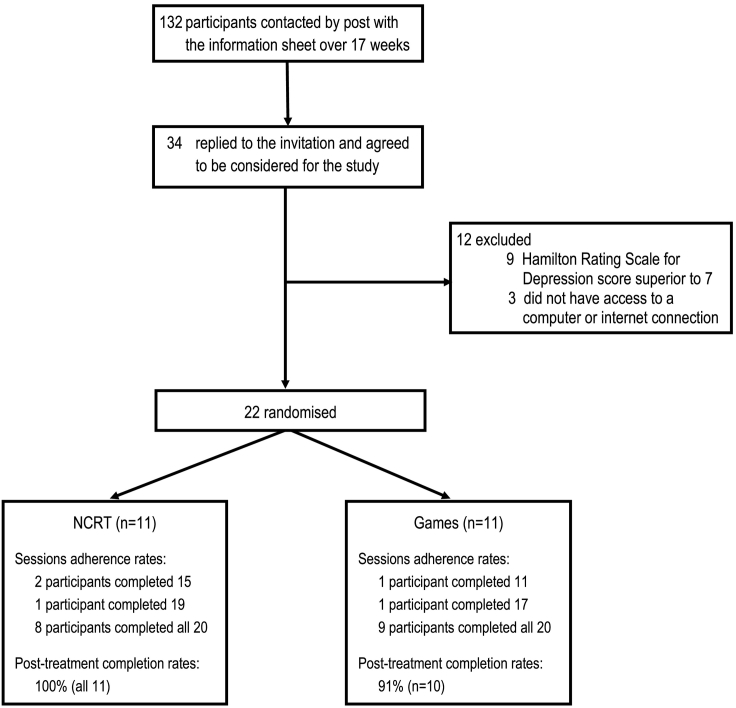
Major depression is a highly prevalent psychopathology with high relapse rates. Following remission from a depressive episode, neurocognitive difficulties in attention, working memory and executive function often persist, preventing full clinical recovery. These neurocognitive deficits are often present since the first depressive episode and have been shown to predict relapse. The efficacy of computerised neurocognitive remediation therapy (NCRT) to improve attention, memory and executive function has been demonstrated in several clinical populations but randomised controlled trials (RCT) have not been conducted in depression. The present study aimed to conduct a pilot, randomised study, of computerised NCRT for individuals with past depression, currently in remission. Twenty two individuals remitted from depression were randomly assigned to receive 20 one-hour sessions over 5 week of ether computerised NCRT or a component-equivalent allocation (play online computer games). The NCRT group showed significantly larger improvements in performance relative to the Games group in the three targeted neurocognitive domains: divided attention, verbal working memory, and planning, but also in non-targeted domains of long-term verbal memory and switching abilities. No significant effect was observed in the NCRT-targeted domain visual working memory. These preliminary results suggest computerised NCRT efficacy to improve targeted neurocognitive processes during depression remission and support its potential value as preventative connected intervention tool.

摘要

重度抑郁症是一种高发性精神病理学疾病,复发率很高。在抑郁发作缓解后,注意力、工作记忆和执行功能方面的神经认知困难往往持续存在,阻碍了临床的完全康复。这些神经认知缺陷自首次抑郁发作起就常常存在,并已被证明可预测复发。计算机化神经认知康复治疗(NCRT)改善注意力、记忆和执行功能的疗效已在多个临床群体中得到证实,但尚未在抑郁症患者中进行随机对照试验(RCT)。本研究旨在针对既往有抑郁症且目前已缓解的个体开展一项计算机化NCRT的试点随机研究。22名抑郁症缓解期患者被随机分配,在5周内接受20次为时1小时的计算机化NCRT治疗或等效的对照治疗(玩在线电脑游戏)。与游戏组相比,NCRT组在三个目标神经认知领域(分散注意力、言语工作记忆和计划)以及长期言语记忆和转换能力等非目标领域的表现有显著更大的改善。在NCRT目标领域视觉工作记忆方面未观察到显著效果。这些初步结果表明,计算机化NCRT在改善抑郁症缓解期的目标神经认知过程方面具有疗效,并支持其作为预防性关联干预工具的潜在价值。
https://cdn.ncbi.nlm.nih.gov/pmc/blobs/e3d5/6096308/8c84769cebb6/gr1.jpg

相似文献

1
Online neurocognitive remediation therapy to improve cognition in community-living individuals with a history of depression: A pilot study.在线神经认知康复治疗改善有抑郁症病史的社区居民认知功能:一项试点研究。
Internet Interv. 2017 Apr 29;9:7-14. doi: 10.1016/j.invent.2017.04.003. eCollection 2017 Sep.
2
Neurocognitive Remediation Therapy for Depression: A Feasibility Study and Randomized Controlled Pilot Protocol Testing.
J Nerv Ment Dis. 2015 Aug;203(8):609-16. doi: 10.1097/NMD.0000000000000337.
3
Cognitive remediation for depressed inpatients: Results of a pilot randomized controlled trial.抑郁症住院患者的认知矫正:一项初步随机对照试验的结果
Aust N Z J Psychiatry. 2016 Jan;50(1):46-55. doi: 10.1177/0004867415622271.
4
A pilot study of cognitive remediation in remitted major depressive disorder patients.缓解期重度抑郁症患者认知矫正的一项试点研究。
Appl Neuropsychol Adult. 2022 Mar-Apr;29(2):172-182. doi: 10.1080/23279095.2020.1726919. Epub 2020 Feb 23.
5
Cognitive deficits in bipolar disorders: Implications for emotion.双相情感障碍中的认知缺陷:对情绪的影响。
Clin Psychol Rev. 2018 Feb;59:126-136. doi: 10.1016/j.cpr.2017.11.006. Epub 2017 Nov 21.
6
Neuropsychological performance in melancholic, atypical and undifferentiated major depression during depressed and remitted states: a prospective longitudinal study.在抑郁和缓解状态下,单相抑郁、非典型和未分化的重性抑郁患者的神经心理学表现:一项前瞻性纵向研究。
J Affect Disord. 2014 Oct;168:184-91. doi: 10.1016/j.jad.2014.06.032. Epub 2014 Jul 2.
7
Cognitive function following a major depressive episode: a systematic review and meta-analysis.重度抑郁发作后的认知功能:一项系统综述和荟萃分析。
Lancet Psychiatry. 2019 Oct;6(10):851-861. doi: 10.1016/S2215-0366(19)30291-3. Epub 2019 Aug 15.
8
Feasibility and effectiveness of a cognitive remediation programme with original computerised cognitive training and group intervention for schizophrenia: a multicentre randomised trial.一项针对精神分裂症患者的认知康复计划的可行性与有效性研究:采用原创计算机化认知训练及小组干预的多中心随机试验
Neuropsychol Rehabil. 2018 Apr;28(3):387-397. doi: 10.1080/09602011.2016.1181555. Epub 2016 May 6.
9
Neurocognitive working mechanisms of the prevention of relapse in remitted recurrent depression (NEWPRIDE): protocol of a randomized controlled neuroimaging trial of preventive cognitive therapy.预防缓解后复发性抑郁障碍复发的神经认知工作机制(NEWPRIDE):预防认知治疗的随机对照神经影像学试验方案。
BMC Psychiatry. 2019 Dec 19;19(1):409. doi: 10.1186/s12888-019-2384-0.
10
Computerised training improves cognitive performance in chronic pain: a participant-blinded randomised active-controlled trial with remote supervision.计算机化训练可改善慢性疼痛患者的认知表现:一项具有远程监督的参与者盲法随机对照试验。
Pain. 2018 Apr;159(4):644-655. doi: 10.1097/j.pain.0000000000001150.

引用本文的文献

1
Effectiveness of Cognitive Rehabilitation in Improving Symptoms and Restoring Cognitive Functions in Patients with Depression: An Updated Meta-Analysis of Randomized Controlled Trials.认知康复对改善抑郁症患者症状及恢复认知功能的有效性:随机对照试验的最新荟萃分析
Alpha Psychiatry. 2024 Nov 1;25(6):727-736. doi: 10.5152/alphapsychiatry.2024.241731. eCollection 2024 Nov.
2
Neurocognitive Remediation Therapy: A Promising Approach to Enhance Cognition in Community Living Pilots with Depression and Anxiety.神经认知修复疗法:一种在患有抑郁症和焦虑症的社区生活试点人群中增强认知能力的有前景的方法。
Psychol Res Behav Manag. 2024 Aug 5;17:2919-2939. doi: 10.2147/PRBM.S446634. eCollection 2024.
3

本文引用的文献

1
Cognitive functioning in the first-episode of major depressive disorder: A systematic review and meta-analysis.首发重度抑郁症的认知功能:系统评价与荟萃分析。
Neuropsychology. 2017 Jan;31(1):52-72. doi: 10.1037/neu0000319. Epub 2016 Oct 10.
2
Computerized cognitive training and functional recovery in major depressive disorder: A meta-analysis.重度抑郁症的计算机化认知训练与功能恢复:一项荟萃分析。
J Affect Disord. 2016 Jan 1;189:184-91. doi: 10.1016/j.jad.2015.09.022. Epub 2015 Sep 26.
3
Neurocognitive Remediation Therapy for Depression: A Feasibility Study and Randomized Controlled Pilot Protocol Testing.
Cognitive rehabilitation for improving cognitive functions and reducing the severity of depressive symptoms in adult patients with Major Depressive Disorder: a systematic review and meta-analysis of randomized controlled clinical trials.
认知康复对改善成年重性抑郁障碍患者认知功能和减轻抑郁症状严重程度的效果:一项随机对照临床试验的系统评价和荟萃分析。
BMC Psychiatry. 2023 Jan 27;23(1):77. doi: 10.1186/s12888-023-04554-w.
4
Randomised controlled cognition trials in remitted patients with mood disorders published between 2015 and 2021: A systematic review by the International Society for Bipolar Disorders Targeting Cognition Task Force.2015 年至 2021 年间发表的缓解期心境障碍患者随机对照认知试验:国际双相障碍认知治疗工作组的系统评价。
Bipolar Disord. 2022 Jun;24(4):354-374. doi: 10.1111/bdi.13193. Epub 2022 Feb 24.
5
Therapeutic use of serious games in mental health: scoping review.严肃游戏在心理健康中的治疗应用:范围综述
BJPsych Open. 2022 Feb 2;8(2):e37. doi: 10.1192/bjo.2022.4.
6
Effectiveness of cognitive remediation in depression: a meta-analysis.认知矫正对抑郁症的疗效:一项荟萃分析。
Psychol Med. 2021 Apr 14;52(16):1-16. doi: 10.1017/S0033291721001100.
7
MicroRNA-202-3p Targets Brain-Derived Neurotrophic Factor and Is Involved in Depression-Like Behaviors.微小RNA-202-3p靶向脑源性神经营养因子并参与类似抑郁的行为。
Neuropsychiatr Dis Treat. 2020 Apr 23;16:1073-1083. doi: 10.2147/NDT.S241136. eCollection 2020.
8
Dysregulation of inflammation, neurobiology, and cognitive function in PTSD: an integrative review.创伤后应激障碍中炎症、神经生物学和认知功能的失调:综合述评。
Cogn Affect Behav Neurosci. 2020 Jun;20(3):455-480. doi: 10.3758/s13415-020-00782-9.
9
Participant Perspectives of Cognitive Rehabilitation for Type 2 Diabetes: Expectations and Impact.2型糖尿病认知康复的参与者观点:期望与影响
J Aging Res. 2018 Aug 19;2018:6563457. doi: 10.1155/2018/6563457. eCollection 2018.
J Nerv Ment Dis. 2015 Aug;203(8):609-16. doi: 10.1097/NMD.0000000000000337.
4
Effectiveness of psychological interventions in preventing recurrence of depressive disorder: meta-analysis and meta-regression.心理干预对预防抑郁症复发的有效性:荟萃分析与元回归分析
J Affect Disord. 2015 Mar 15;174:400-10. doi: 10.1016/j.jad.2014.12.016. Epub 2014 Dec 13.
5
The Effects of Computerized Cognitive Control Training on Community Adults with Depressed Mood.计算机化认知控制训练对社区情绪低落成年人的影响。
Behav Cogn Psychother. 2015 Sep;43(5):578-89. doi: 10.1017/S1352465814000046. Epub 2014 Mar 3.
6
Concurrent cognitive control training augments the antidepressant efficacy of tDCS: a pilot study.经颅直流电刺激联合认知控制训练增强抗抑郁疗效:一项初步研究。
Brain Stimul. 2014 Mar-Apr;7(2):325-31. doi: 10.1016/j.brs.2013.12.008. Epub 2013 Dec 19.
7
Cognitive impairment in depression: a systematic review and meta-analysis.抑郁症中的认知障碍:一项系统评价与荟萃分析。
Psychol Med. 2014 Jul;44(10):2029-40. doi: 10.1017/S0033291713002535. Epub 2013 Oct 29.
8
Computer proficiency questionnaire: assessing low and high computer proficient seniors.计算机能力调查问卷:评估计算机能力低和高的老年人。
Gerontologist. 2015 Jun;55(3):404-11. doi: 10.1093/geront/gnt117. Epub 2013 Oct 9.
9
Cognitive remediation for treatment-resistant depression: effects on cognition and functioning and the role of online homework.难治性抑郁症的认知康复治疗:对认知和功能的影响以及在线作业的作用。
J Nerv Ment Dis. 2013 Aug;201(8):680-5. doi: 10.1097/NMD.0b013e31829c5030.
10
Personalized cognitive training in unipolar and bipolar disorder: a study of cognitive functioning.单相和双相障碍的个性化认知训练:认知功能研究。
Front Hum Neurosci. 2013 May 13;7:108. doi: 10.3389/fnhum.2013.00108. eCollection 2013.