National Research Center "Kurchatov Institute", 1st Akademika Kurchatova Square, Moscow, Russia.
Research Center of Biotechnology of the Russian Academy of Sciences, Moscow, Russia.
Nat Commun. 2021 Apr 13;12(1):2215. doi: 10.1038/s41467-021-22567-5.
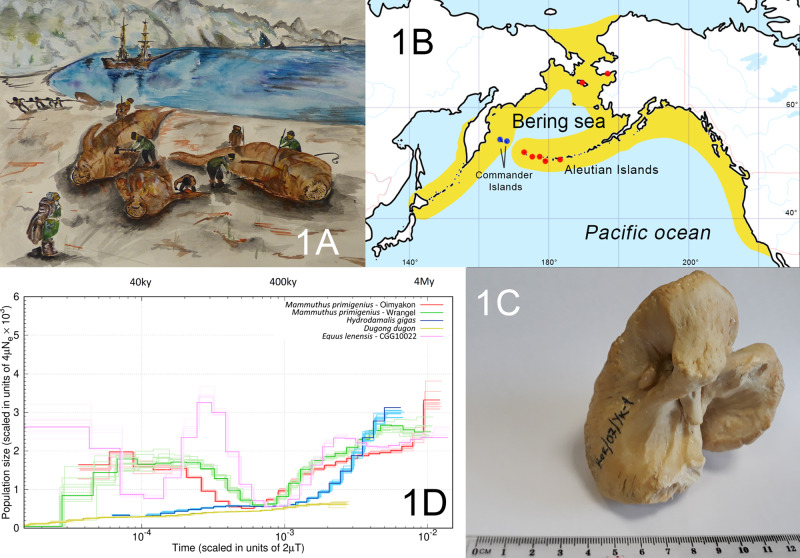
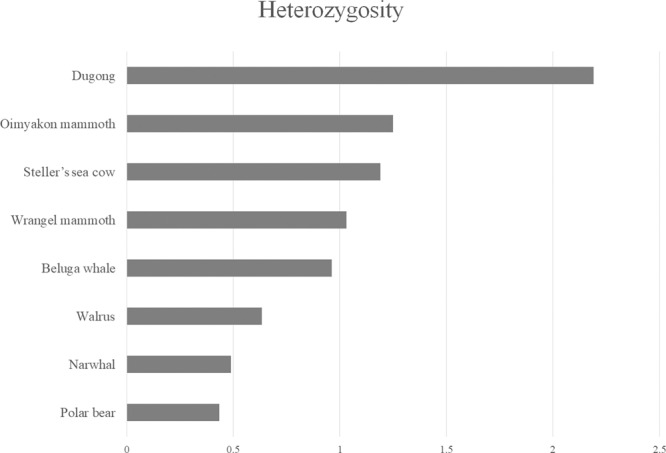
Anthropogenic activity is the top factor directly related to the extinction of several animal species. The last Steller's sea cow (Hydrodamalis gigas) population on the Commander Islands (Russia) was wiped out in the second half of the 18 century due to sailors and fur traders hunting it for the meat and fat. However, new data suggests that the extinction process of this species began much earlier. Here, we present a nuclear de novo assembled genome of H. gigas with a 25.4× depth coverage. Our results demonstrate that the heterozygosity of the last population of this animal is low and comparable to the last woolly mammoth population that inhabited Wrangel Island 4000 years ago. Besides, as a matter of consideration, our findings also demonstrate that the extinction of this marine mammal starts along the North Pacific coastal line much earlier than the first Paleolithic humans arrived in the Bering sea region.
人为活动是与若干动物物种灭绝直接相关的首要因素。18 世纪下半叶,由于水手和毛皮商人捕杀海牛以获取肉和脂肪,指挥官群岛(俄罗斯)上的最后一个斯特勒氏海牛(Hydrodamalis gigas)种群灭绝。然而,新的数据表明,该物种的灭绝过程开始得更早。在这里,我们提供了一个具有 25.4×深度覆盖的 H. gigas 的核从头组装基因组。我们的结果表明,该动物最后一个种群的杂合度较低,与 4000 年前居住在弗兰格尔岛的最后一批长毛猛犸象种群相当。此外,值得考虑的是,我们的发现还表明,这种海洋哺乳动物的灭绝始于北太平洋海岸线,比第一批旧石器时代人类到达白令海地区要早得多。