Lee Christine, Wanson Annabelle, Frangou Sarah, Chong David, Halpape Katelyn
BSP Candidate 2020, College of Pharmacy and Nutrition, University of Saskatchewan, Saskatoon, Saskatchewan, Canada.
Assistant Professor, Department of Psychiatry, College of Medicine, University of Saskatchewan, Saskatoon, Saskatchewan, Canada.
Ment Health Clin. 2021 Mar 31;11(2):70-74. doi: 10.9740/mhc.2021.03.070. eCollection 2021 Mar.
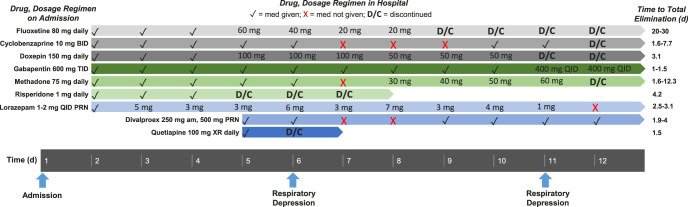
The interaction between methadone and central nervous system depressants can cause serious adverse effects, including profound sedation, respiratory depression, coma, and death. This poses a challenge in the treatment of patients with concurrent psychiatric and substance use disorders as the combined use is often unavoidable. We report a case of a patient with opioid use disorder, mood disorder unspecified, chronic pain, and chronic obstructive pulmonary disease who experienced 2 serious episodes of CNS and respiratory depression due to polypharmacy-induced opioid toxicity. Careful consideration of pharmacokinetics, pharmacodynamics, and patient-specific factors was imperative to identify the suspected contributing medications: methadone, lorazepam, divalproex, gabapentin, and cyclobenzaprine. Cognitive and system factors that contributed to these adverse events and strategies to mitigate risk of recurrence were also identified.
美沙酮与中枢神经系统抑制剂之间的相互作用可导致严重不良反应,包括深度镇静、呼吸抑制、昏迷和死亡。这给患有精神疾病和物质使用障碍的患者的治疗带来了挑战,因为联合使用往往不可避免。我们报告一例患有阿片类物质使用障碍、未特定的心境障碍、慢性疼痛和慢性阻塞性肺疾病的患者,因多种药物联用导致阿片类药物毒性而发生2次严重的中枢神经系统和呼吸抑制发作。必须仔细考虑药代动力学、药效学和患者特异性因素,以确定可疑的相关药物:美沙酮、劳拉西泮、丙戊酸、加巴喷丁和环苯扎林。还确定了导致这些不良事件的认知和系统因素以及降低复发风险的策略。