Institute of Orthopaedic Research and Biomechanics, Centre of Trauma Research, Medical Centre, Ulm University, Ulm, Germany.
Department of Orthopaedic Surgery, Faculty of Medicine, Friedrich-Alexander-Universität Erlangen-Nürnberg, Erlangen, Germany.
Z Orthop Unfall. 2022 Apr;160(2):160-171. doi: 10.1055/a-1348-2873. Epub 2021 Apr 13.
Total hip arthroplasty (THA) presents as an excellent treatment for the osteoarthritic hip, demonstrating good survival rates. However, aseptic loosening and infection are the main causes of operative revision. The methods used in revision surgery are non-modular or modular THA implants. In addition to the abovementioned revision reasons for THA, this treatment could be associated with the possibility of femoral stem fracture, especially in the modular system. The topic of material failure has been focused on in the public media. The question arises as to how such media reports correlate with the published literature. The observed mentioned number of cases concerning a femoral stem fracture vary between one single case and up to 18.5% within a clinical study, thus presenting an inhomogeneous data situation with a large span. The specific aim of this systematic review is to establish facts and clarify the number of unforeseen events of a femoral stem fracture based on peer review articles and registry data. This clarification is important to us, as these media reports have led to uncertainty among patients.
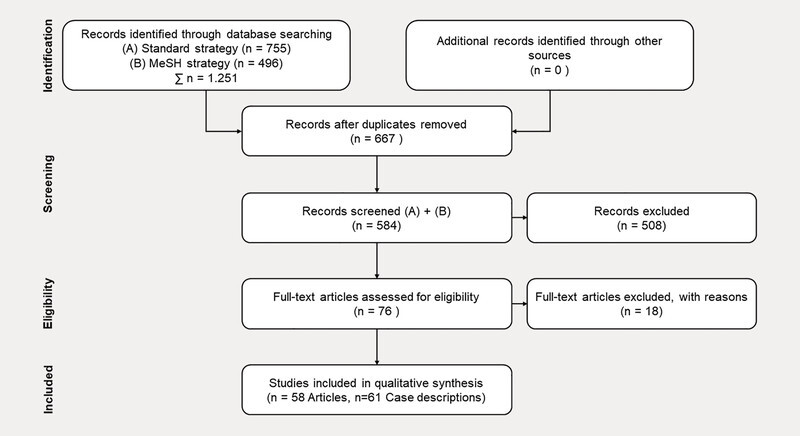
A systematic review was performed in accordance with the PRISMA statement. Peer review articles in English and German, presenting original articles, meta-analyses, or case reports, were searched from the turn of the millennium up to December 2019. Only articles that reported a femoral stem component fracture, with content of clinical data as well as register data, were included. Relevant papers published after the defined research time frame were taken into account within the discussion.
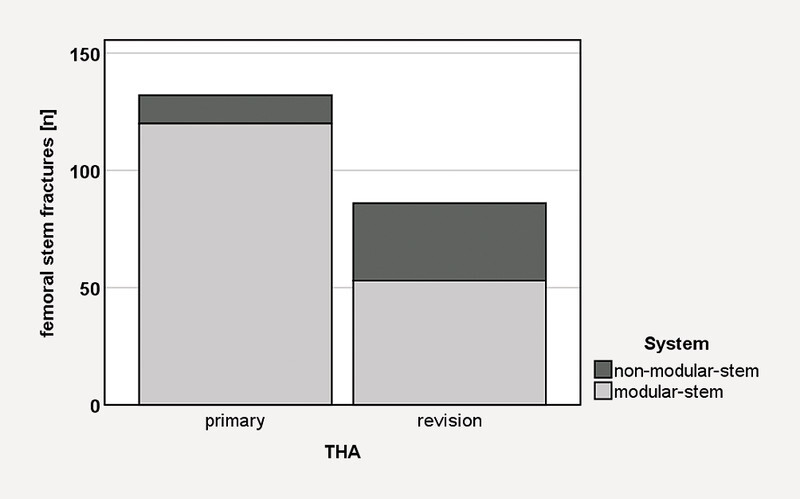
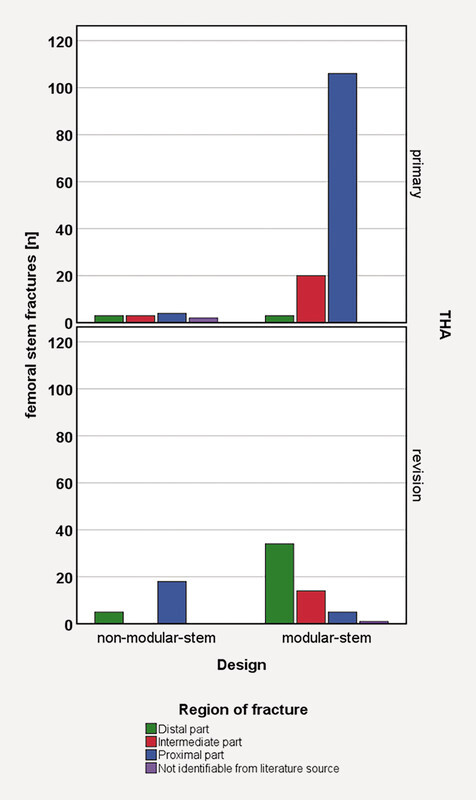
In total, 218 fractures of a femoral stem (141 primary and 77 revision THA) component could be identified within the selected literature. Most cases of a femoral stem fracture occurred in the modular THA implants compared to the non-modular stems. Regarding revision THA, in summary, 77 implants, presenting 23 non-modular and 54 modular implants, failed by means of femoral stem fracture. A review of 11 National Joint Registries shows a revision rate between 0.04 and 0.05% in only 2 registers according to the specific subject of a femoral stem fracture. For the remaining 9 registers, however, detailed information is lacking and only nonspecific information such as a generic "implant failure" or "other reason" (which can cover a multitude of causes) is supplied.
A femoral stem fracture presents a devastating complication for the patient, the surgeon as well as for the manufacturer of the implant. Modular THA implants play an increasingly valuable role concerning restoration of individual anatomy in modern THA revision surgery, especially within complex cases. Regarding revision procedures, data suggests a lower risk of femoral stem fracture for modular implants compared to primary procedures, while the risk of fracture for non-modular implants seems to increase during revision. Ultimately, it cannot be proven whether this is actually applicable, since the absolute number of implanted prosthesis systems is not known. Various implant-, patient-, and surgeon-related factors may lead to these reported femoral stem fractures. However, this systematic review suggests that this is, in general, a rare complication.
全髋关节置换术(THA)是治疗骨关节炎髋关节的一种极好的治疗方法,具有良好的生存率。然而,无菌性松动和感染是手术翻修的主要原因。翻修手术中使用的方法是非模块化或模块化 THA 植入物。除了上述 THA 的翻修原因外,这种治疗方法可能与股骨干骨折的可能性有关,尤其是在模块化系统中。材料失效的话题已成为公众媒体关注的焦点。问题是,此类媒体报道与已发表文献的相关性如何。观察到的股骨干骨折病例数量在单一病例和临床研究中的 18.5%之间变化不等,因此呈现出数据情况不均匀且跨度较大的情况。本系统评价的具体目的是根据同行评议文章和登记数据确定股骨干骨折的事实和明确未预见事件的数量。这一点对我们来说很重要,因为这些媒体报道导致患者感到不确定。
根据 PRISMA 声明进行了系统评价。检索了从千禧年到 2019 年 12 月的英文和德文的同行评议文章,包括原始文章、荟萃分析或病例报告。仅纳入报告股骨干组件骨折的文章,内容包括临床数据和登记数据。在讨论中考虑了在规定的研究时间框架之后发表的相关论文。
总共在选定的文献中确定了 218 例股骨干(141 例初次和 77 例翻修 THA)骨折。大多数股骨干骨折发生在模块化 THA 植入物中,而不是非模块化植入物。关于翻修 THA,总体而言,77 个植入物中有 23 个为非模块化植入物和 54 个为模块化植入物发生股骨干骨折。对 11 个国家关节登记处的审查表明,只有 2 个登记处(根据股骨干骨折的具体主题)的翻修率在 0.04%至 0.05%之间。然而,对于其余 9 个登记处,缺乏详细信息,仅提供通用的“植入物失败”或“其他原因”(可涵盖多种原因)等非特定信息。
股骨干骨折对患者、外科医生以及植入物制造商来说都是一种灾难性的并发症。模块化 THA 植入物在现代 THA 翻修手术中恢复个体解剖结构方面发挥着越来越重要的作用,尤其是在复杂病例中。关于翻修手术,数据表明模块化植入物的股骨干骨折风险低于初次手术,而非模块化植入物的骨折风险似乎在翻修过程中增加。最终,由于不知道实际植入的假体系统的绝对数量,因此不能证明这是否确实适用。各种与植入物、患者和外科医生相关的因素可能导致这些报告的股骨干骨折。然而,本系统评价表明,一般来说,这是一种罕见的并发症。