Department of Neurology, The Second Affiliated Hospital of Nanchang University, Nanchang, P.R. China.
Department of Neurology, The Affiliated Hospital of Jiujiang University, Jiujiang, P.R. China.
ASN Neuro. 2021 Jan-Dec;13:17590914211003247. doi: 10.1177/17590914211003247.
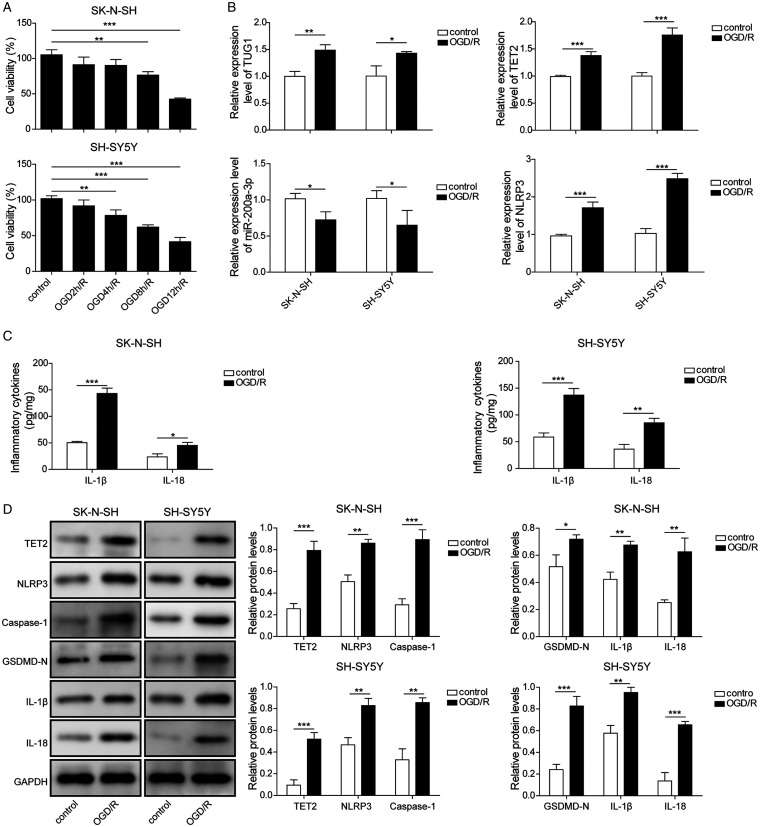
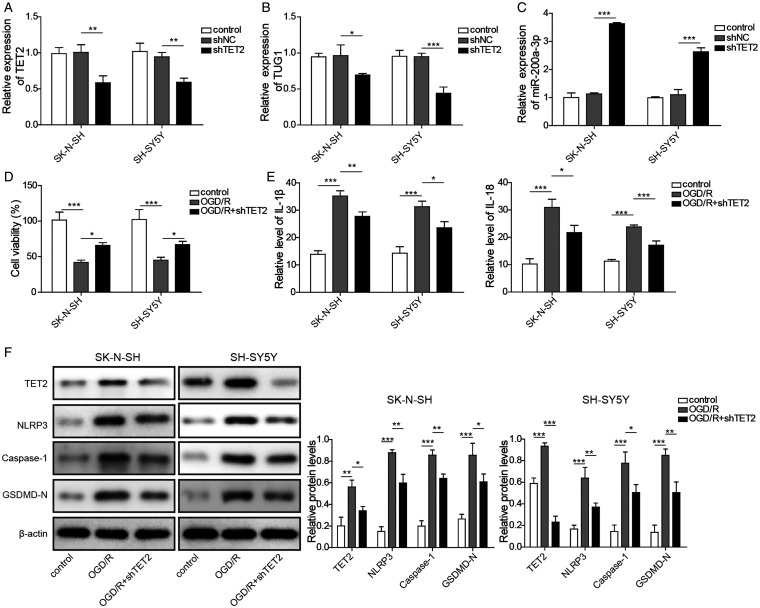
LncRNA TUG1 has not yet been reported in cerebral ischemia/reperfusion (I/R) injury. Methylcytosine dioxygenase TET2 is involved in ischemic damage. This study aimed to investigate the effects of TUG1 demethylated by TET2 on I/R-induced inflammatory response and identified its possible mechanisms.We found that TUG1 expression was significantly upregulated in oxygen-glucose deprivation and reoxygenation (OGD/R)-induced SH-SY5Y and SK-N-SH cells. Using the middle cerebral artery occlusion (MCAO) mice, we observed a similar effect. We also found that I/R injury could downregulate miR-200a-3p and upregulate NLRP3 and TET2. The knockdown of TUG1 could alleviate OGD/R-induced inflammatory response through upregulating miR-200a-3p and downregulating NLRP3 and other pro-inflammatory molecules. miR-200a-3p inhibition can partially reverse the effects of TUG1 silencing. Further experiments confirmed that TUG1 sponged miR-200a-3p to diminish miR-200a-3p and promote NLRP3 dependent inflammatory responses. Mechanically, knockdown of TET2 induced low levels of TUG1 and high levels of miR-200a-3p in both SK-N-SH and SH-SY5Y cells. IL-18, IL-1β, NLRP3, Caspase-1, and GSDMD-N were highly downregulated in OGD/R-induced SK-N-SH and SH-SY5Y cells after TET2 knockdown. TUG1 overexpression could reverse this effect. All the data indicated that TET2 could demethylate TUG1 and contribute to the inflammatory response. In additional experiments using the MCAO mice model, we confirmed knockdown of TET2 attenuated I/R-induced inflammatory response and brain injuries via decreasing TUG1 and increasing miR-200a-3p to inhibit NLRP3 expression. The demethylation of TUG1 by TET2 might aggravate I/R-induced inflammatory injury via modulating NLRP3 by miR-200a-3p. Our data confirmed that TET2 contributed to I/R-induced inflammatory response via the demethylation of TUG1 and regulated TUG1/miR-200a-3p/NLRP3 pathway.
长链非编码 RNA TUG1 在脑缺血/再灌注(I/R)损伤中尚未报道。甲基胞嘧啶双加氧酶 TET2 参与缺血性损伤。本研究旨在探讨 TET2 去甲基化的 TUG1 对 I/R 诱导的炎症反应的影响,并确定其可能的机制。
我们发现 TUG1 在氧葡萄糖剥夺和再氧合(OGD/R)诱导的 SH-SY5Y 和 SK-N-SH 细胞中表达显著上调。使用大脑中动脉闭塞(MCAO)小鼠,我们观察到类似的效果。我们还发现,I/R 损伤可下调 miR-200a-3p,上调 NLRP3 和 TET2。TUG1 的敲低可通过上调 miR-200a-3p 和下调 NLRP3 和其他促炎分子来减轻 OGD/R 诱导的炎症反应。miR-200a-3p 抑制可部分逆转 TUG1 沉默的作用。进一步的实验证实,TUG1 海绵吸附 miR-200a-3p,减少 miR-200a-3p,并促进 NLRP3 依赖性炎症反应。机制上,TET2 的敲低在 SK-N-SH 和 SH-SY5Y 细胞中诱导低水平的 TUG1 和高水平的 miR-200a-3p。在 TET2 敲低后,OGD/R 诱导的 SK-N-SH 和 SH-SY5Y 细胞中 IL-18、IL-1β、NLRP3、Caspase-1 和 GSDMD-N 高度下调。TUG1 的过表达可以逆转这种效应。所有数据表明,TET2 可以去甲基化 TUG1,并有助于炎症反应。在使用 MCAO 小鼠模型的额外实验中,我们证实 TET2 的敲低通过降低 TUG1 和增加 miR-200a-3p 来抑制 NLRP3 表达,从而减轻 I/R 诱导的炎症反应和脑损伤。TET2 对 TUG1 的去甲基化可能通过调节 miR-200a-3p 来加重 I/R 诱导的炎症损伤。我们的数据证实,TET2 通过 TUG1 的去甲基化参与 I/R 诱导的炎症反应,并调节 TUG1/miR-200a-3p/NLRP3 通路。