Yin Xiaoshen, Martinez Alexander S, Sepúlveda Maria S, Christie Mark R
Department of Biological Sciences, Purdue University, 915 W. State St., West Lafayette, Indiana, 47907-2054, USA.
Department of Forestry and Natural Resources, Purdue University, 715 W. State St., West Lafayette, Indiana, 47907-2054, USA.
BMC Genomics. 2021 Apr 14;22(1):269. doi: 10.1186/s12864-021-07553-x.
Uncovering the mechanisms underlying rapid genetic adaptation can provide insight into adaptive evolution and shed light on conservation, invasive species control, and natural resource management. However, it can be difficult to experimentally explore rapid adaptation due to the challenges associated with propagating and maintaining species in captive environments for long periods of time. By contrast, many introduced species have experienced strong selection when colonizing environments that differ substantially from their native range and thus provide a "natural experiment" for studying rapid genetic adaptation. One such example occurred when sea lamprey (Petromyzon marinus), native to the northern Atlantic, naturally migrated into Lake Champlain and expanded their range into the Great Lakes via man-made shipping canals.
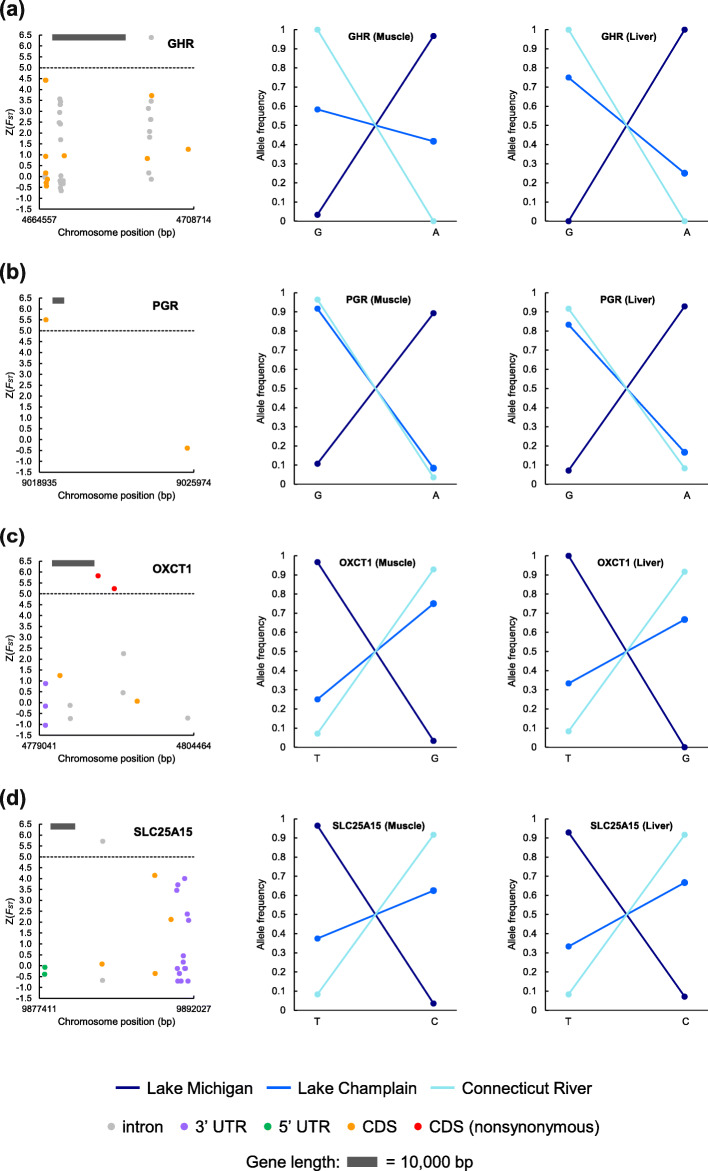
Utilizing 368,886 genome-wide single nucleotide polymorphisms (SNPs), we calculated genome-wide levels of genetic diversity (i.e., heterozygosity and π) for sea lamprey collected from native (Connecticut River), native but recently colonized (Lake Champlain), and invasive (Lake Michigan) populations, assessed genetic differentiation between all populations, and identified candidate genes that responded to selection imposed by the novel environments. We observed a 14 and 24% reduction in genetic diversity in Lake Michigan and Lake Champlain populations, respectively, compared to individuals from the Connecticut River, suggesting that sea lamprey populations underwent a genetic bottleneck during colonization. Additionally, we identified 121 and 43 outlier genes in comparisons between Lake Michigan and Connecticut River and between Lake Champlain and Connecticut River, respectively. Six outlier genes that contained synonymous SNPs in their coding regions and two genes that contained nonsynonymous SNPs may underlie the rapid evolution of growth (i.e., GHR), reproduction (i.e., PGR, TTC25, STARD10), and bioenergetics (i.e., OXCT1, PYGL, DIN4, SLC25A15).
By identifying the genomic basis of rapid adaptation to novel environments, we demonstrate that populations of invasive species can be a useful study system for understanding adaptive evolution. Furthermore, the reduction in genome-wide levels of genetic diversity associated with colonization coupled with the identification of outlier genes underlying key life history traits known to have changed in invasive sea lamprey populations (e.g., growth, reproduction) illustrate the utility in applying genomic approaches for the successful management of introduced species.
揭示快速遗传适应背后的机制有助于深入了解适应性进化,并为保护、入侵物种控制和自然资源管理提供启示。然而,由于在圈养环境中长时间繁殖和维持物种存在挑战,通过实验探索快速适应可能具有难度。相比之下,许多外来物种在殖民与原生范围差异很大的环境时经历了强烈的选择,因此为研究快速遗传适应提供了一个“自然实验”。一个这样的例子是,原产于北大西洋的海七鳃鳗(Petromyzon marinus)自然迁移到尚普兰湖,并通过人工运河将其分布范围扩展到大湖地区。
利用368,886个全基因组单核苷酸多态性(SNP),我们计算了从原生种群(康涅狄格河)、原生但近期殖民的种群(尚普兰湖)和入侵种群(密歇根湖)采集的海七鳃鳗的全基因组遗传多样性水平(即杂合度和π),评估了所有种群之间的遗传分化,并鉴定了对新环境施加的选择做出反应的候选基因。与来自康涅狄格河的个体相比,我们观察到密歇根湖和尚普兰湖种群的遗传多样性分别降低了14%和24%,这表明海七鳃鳗种群在殖民过程中经历了遗传瓶颈。此外,在密歇根湖与康涅狄格河以及尚普兰湖与康涅狄格河的比较中,我们分别鉴定出121个和43个异常基因。六个在编码区含有同义SNP的异常基因和两个含有非同义SNP的基因可能是生长(即GHR)、繁殖(即PGR、TTC25、STARD10)和生物能量学(即OXCT1、PYGL、DIN4、SLC25A15)快速进化的基础。
通过确定对新环境快速适应的基因组基础,我们证明入侵物种种群可以成为理解适应性进化的有用研究系统。此外,与殖民相关的全基因组遗传多样性水平的降低,以及在入侵海七鳃鳗种群中已知发生变化的关键生活史特征(如生长、繁殖)背后异常基因的鉴定,说明了应用基因组方法成功管理外来物种的实用性。