Primary Care Stratified Medicine group (PRISM), Division of Primary Care, University of Nottingham, Room 1402, Tower Building, Nottingham, NG7 2RD, UK.
BMC Public Health. 2021 Apr 15;21(1):576. doi: 10.1186/s12889-021-10606-1.
Although obesity is a well-recognised risk factor for cardiovascular disease (CVD), the impact of long-term body mass index (BMI) changes in overweight or obese adults, on the risk of heart failure, CVD and mortality has not been quantified.
This population-based cohort study used routine UK primary care electronic health data linked to secondary care and death-registry records. We identified adults who were overweight or obese, free from CVD and who had repeated BMI measures. Using group-based trajectory modelling, we examined the BMI trajectories of these individuals and then determined incidence rates of CVD, heart failure and mortality associated with the different trajectories. Cox-proportional hazards regression determined hazards ratios for incident outcomes.
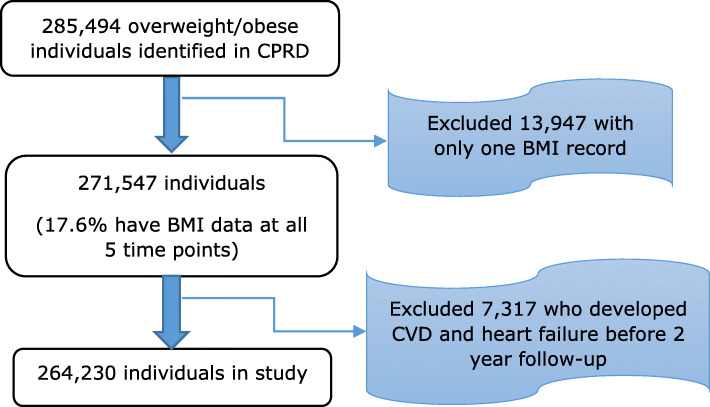
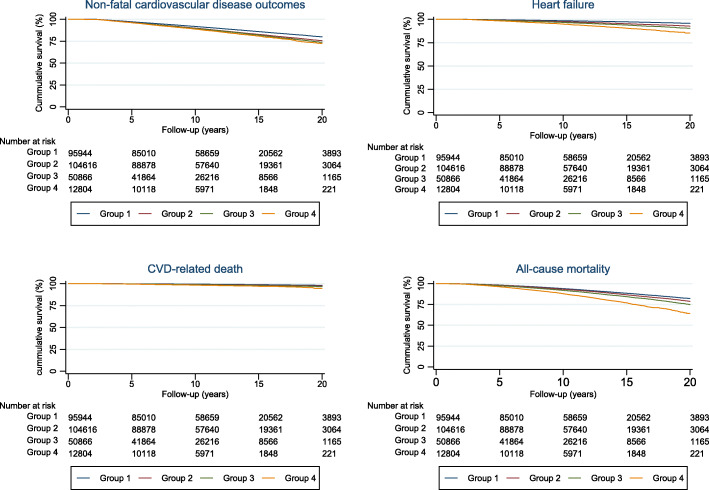
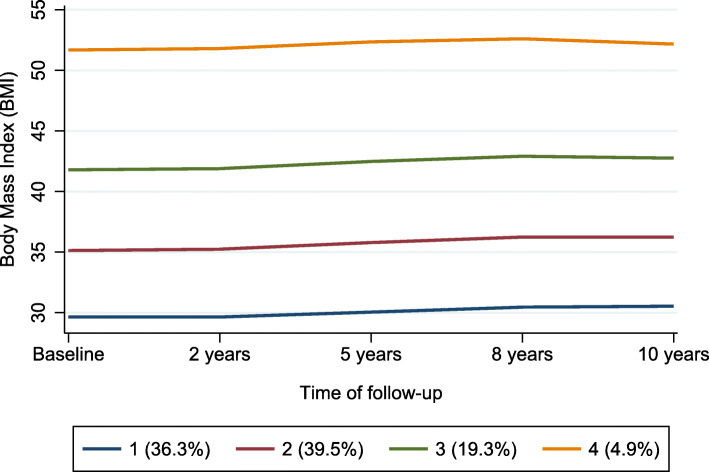
264,230 individuals (mean age 49.5 years (SD 12.7) and mean BMI 33.8 kg/m (SD 6.1)) were followed-up for a median duration of 10.9 years. Four BMI trajectories were identified, corresponding at baseline, with World Health Organisation BMI classifications for overweight, class-1, class-2 and class-3 obesity respectively. In all four groups, there was a small, stable upwards trajectory in BMI (mean BMI increase of 1.06 kg/m (± 3.8)). Compared with overweight individuals, class-3 obese individuals had hazards ratios (HR) of 3.26 (95% CI 2.98-3.57) for heart failure, HR of 2.72 (2.58-2.87) for all-cause mortality and HR of 3.31 (2.84-3.86) for CVD-related mortality, after adjusting for baseline demographic and cardiovascular risk factors.
The majority of adults who are overweight or obese retain their degree of overweight or obesity over the long term. Individuals with stable severe obesity experience the worst heart failure, CVD and mortality outcomes. These findings highlight the high cardiovascular toll exacted by continuing failure to tackle obesity.
尽管肥胖是心血管疾病(CVD)的一个公认危险因素,但超重或肥胖成年人长期体重指数(BMI)变化对心力衰竭、CVD 和死亡率风险的影响尚未量化。
本基于人群的队列研究使用了英国常规初级保健电子健康数据,这些数据与二级保健和死亡登记记录相关联。我们确定了超重或肥胖、无 CVD 且有重复 BMI 测量的成年人。我们使用基于群组的轨迹建模方法,检查了这些个体的 BMI 轨迹,然后确定了与不同轨迹相关的 CVD、心力衰竭和死亡率的发生率。Cox 比例风险回归确定了首发结局的风险比。
264230 名个体(平均年龄 49.5 岁(12.7 岁),平均 BMI 为 33.8kg/m2(6.1kg/m2))中位随访时间为 10.9 年。确定了四种 BMI 轨迹,分别对应于世界卫生组织超重、1 类、2 类和 3 类肥胖的 BMI 分类。在所有四个组中,BMI 都有一个微小的、稳定的上升轨迹(平均 BMI 增加 1.06kg/m2(±3.8kg/m2))。与超重者相比,3 类肥胖者发生心力衰竭的风险比(HR)为 3.26(95%CI 2.98-3.57),全因死亡率的 HR 为 2.72(2.58-2.87),CVD 相关死亡率的 HR 为 3.31(2.84-3.86),在调整了基线人口统计学和心血管危险因素后。
大多数超重或肥胖的成年人在长期内保持其超重或肥胖程度。稳定的严重肥胖个体经历了最严重的心力衰竭、CVD 和死亡率结局。这些发现突显了持续未能解决肥胖问题对心血管造成的高代价。