Rivers Lab, Department of Rehabilitation and Movement Science, Rutgers School of Health Professions, 65 Bergen Street, Newark, NJ, 07101, USA.
Motor Behavior Lab, Department of Rehab and Movement Science, Rutgers School of Health Professions, 65 Bergen Street, Newark, NJ, 07101, USA.
J Neuroeng Rehabil. 2021 Apr 14;18(1):63. doi: 10.1186/s12984-021-00850-2.
Active video games have been embraced for the rehabilitation of mobility and promotion of physical activity for persons post-stroke. This study seeks to compare carefully matched standard of care stepping activities, off-the-shelf (non-custom) active video games and custom active video games that are either self-paced or game-paced for promoting neuromuscular intensity and accuracy, cardiovascular intensity, enjoyment and perceived effort.
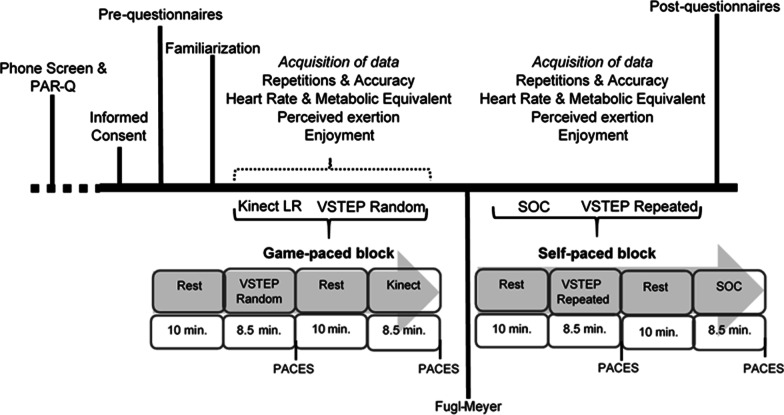
Fifteen persons (ages 38-72) with mild to moderate severity in the chronic phase post-stroke (average 8 years) participated in a single group counter balanced repeated measures study. Participants were included if they were greater than 6 months post-stroke, who could walk 100 feet without assistance and stand unsupported for three continuous minutes. They were excluded if they had cardiac, musculoskeletal or neurologic conditions that could interfere with repeated stepping and follow instructions. In a single session located in a laboratory setting, participants executed for 8.5 min each: repeated stepping, the Kinect-light race game, two custom stepping games for the Kinect, one was repeated and self-paced and the other was random and game paced. Custom video games were adjusted to the participants stepping volume. Ten-minute rest periods followed the exercise during which time participants rested and completed the PACES an enjoyment questionnaire. Participants were instrumented with a metabolic cart and heart rate sensor for collection of cardiovascular intensity (METs and % of max HR) data. Stepping frequency, accuracy and pattern were acquired via video. Data were analyzed using a RMANOVA and post-hoc comparison with a Holm's/Sidak correction.
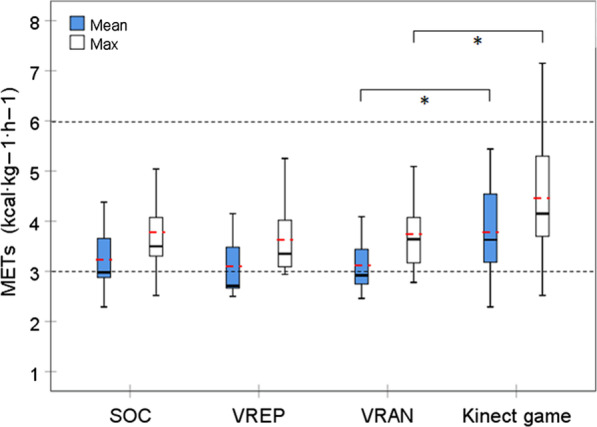
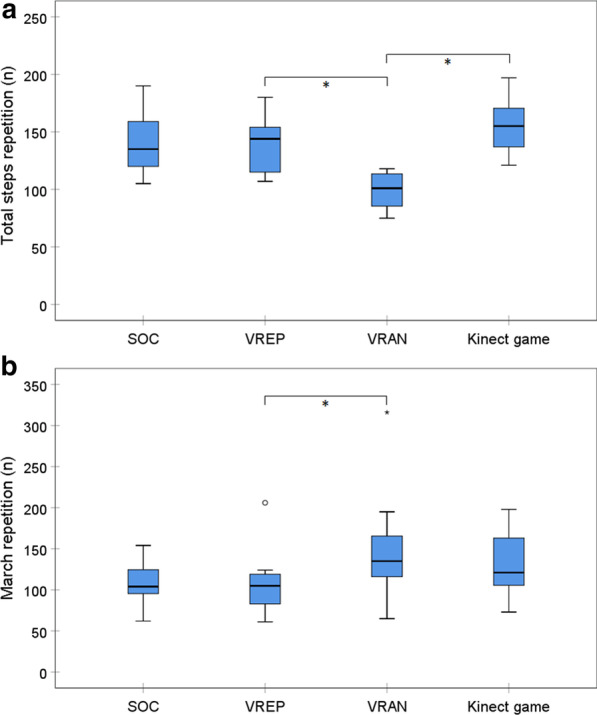
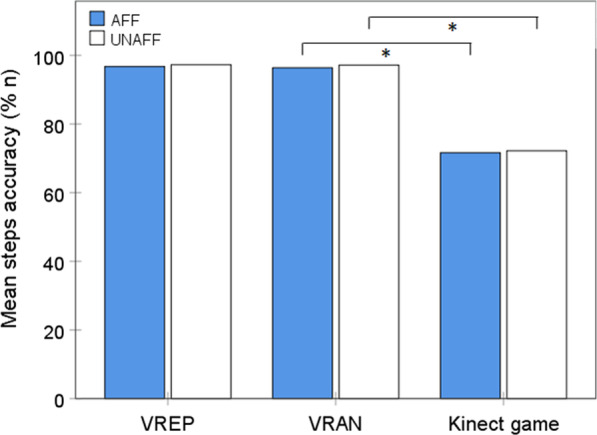
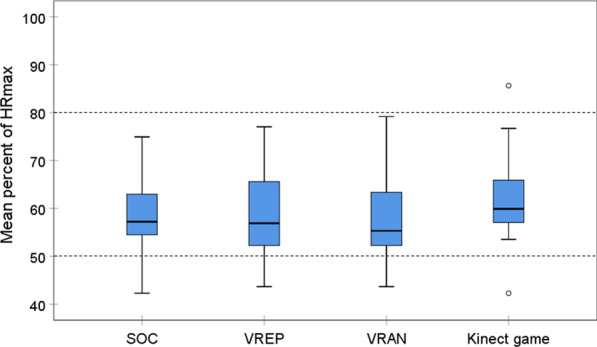
Neuromuscular intensity (repetitions) was significantly greater for the off-the-shelf and self-paced custom game, however accuracy was greater for the custom games. Cardiovascular intensity for all activities took place in the moderate intensity exercise band. Enjoyment (measured with a questionnaire and rankings) was greater for the custom active video games and rate of perceived exertion was lower for the custom active video games.
Custom active video games provided comparable intensity but better accuracy, greater enjoyment and less perceived exertion than standard of care stepping activities and a carefully matched off-the-shelf (non-custom) video game. There were no differences between the game-paced and self-paced custom active video games.
NCT04538326.
主动视频游戏已被广泛应用于脑卒中后患者的运动康复和身体活动促进。本研究旨在比较精心匹配的常规护理踏步行走活动、现成的(非定制)主动视频游戏和定制的主动视频游戏,这些游戏可以是自我调节的或游戏节奏的,以促进神经肌肉强度和准确性、心血管强度、享受度和感知努力度。
15 名轻度至中度脑卒中后慢性期(平均 8 年)的患者参与了一项单组交叉平衡重复测量研究。参与者如果满足以下条件则被纳入研究:脑卒中后 6 个月以上,能够在没有帮助的情况下行走 100 英尺,并且能够无支撑站立 3 分钟连续站立。如果他们有心脏、肌肉骨骼或神经系统疾病,可能会干扰重复踏步行走和遵循指令,则将其排除在外。在一个实验室环境中进行的单次会议中,参与者分别进行了 8.5 分钟的以下活动:重复踏步行走、Kinect-light 赛车游戏、两个用于 Kinect 的定制踏步行走游戏,一个是重复和自我调节的,另一个是随机和游戏节奏的。定制视频游戏根据参与者的踏步行走量进行调整。在锻炼后,参与者会休息 10 分钟,同时完成 PACES 和享受度问卷。参与者配备代谢箱和心率传感器,以收集心血管强度(MET 和最大 HR 的百分比)数据。通过视频获取踏步行走频率、准确性和模式。使用 RMANOVA 进行数据分析,并使用 Holm's/Sidak 校正进行事后比较。
现成的和自我调节的定制游戏的神经肌肉强度(重复次数)显著更高,但准确性更高的是定制游戏。所有活动的心血管强度都发生在中等强度运动带内。所有活动的享受度(通过问卷和排名测量)都更高的是定制主动视频游戏,而定制主动视频游戏的感知努力度更低。
与常规护理踏步行走活动和精心匹配的现成的(非定制)视频游戏相比,定制主动视频游戏提供了相当的强度,但准确性更高、享受度更高、感知努力度更低。游戏节奏和自我调节的定制主动视频游戏之间没有差异。
NCT04538326。