Li Long, Huang Caoxin, Yin Hongyan, Zhang Xiaofang, Wang Dongmei, Ma Chen, Li Jia, Zhao Yan, Li Xuejun
Department of Endocrinology and Diabetes, Xiamen Diabetes Institute, Fujian Key Laboratory of Translational Research for Diabetes, The First Affiliated Hospital of Xiamen University, Xiamen, Fujian, China.
Institute of Drug Discovery Technology, Ningbo University, Ningbo, China.
BMJ Open Diabetes Res Care. 2021 Apr;9(1). doi: 10.1136/bmjdrc-2020-001431.
Exercise training has been shown to be the most effective strategy to combat obesity and non-alcoholic fatty liver disease. However, exercise promotes loss of adipose tissue mass and improves obesity-related hepatic steatosis through mechanisms that remain obscure.
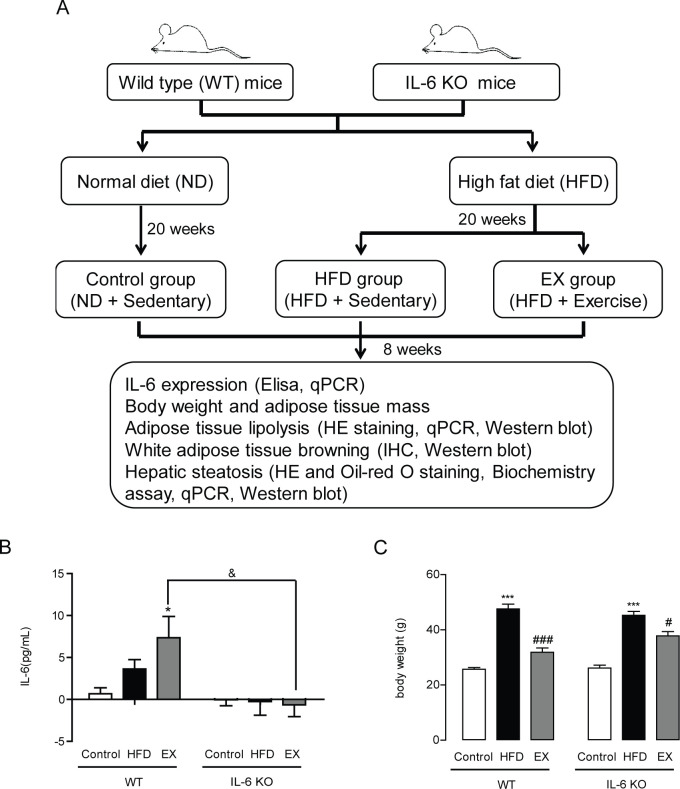
To study the role of interleukin-6 (IL-6) in high-fat diet (HFD)-induced adiposity and hepatic steatosis during treadmill running, IL-6 knockout (IL-6 KO) mice and wild-type (WT) mice were randomly divided into lean, obese (fed a HFD) and trained obese groups (fed a HFD and exercise trained).
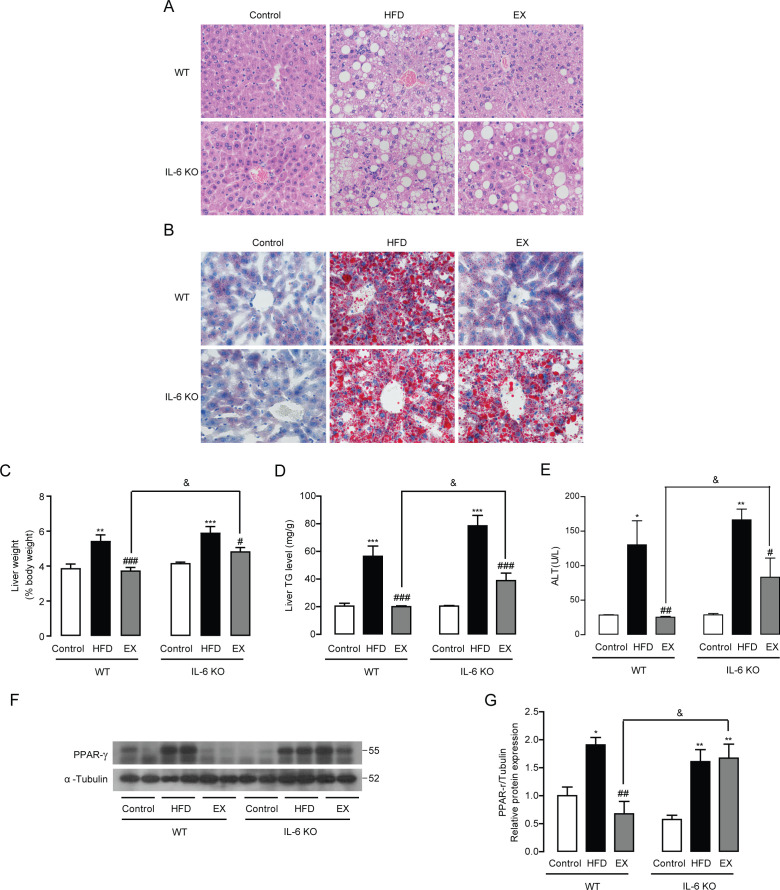
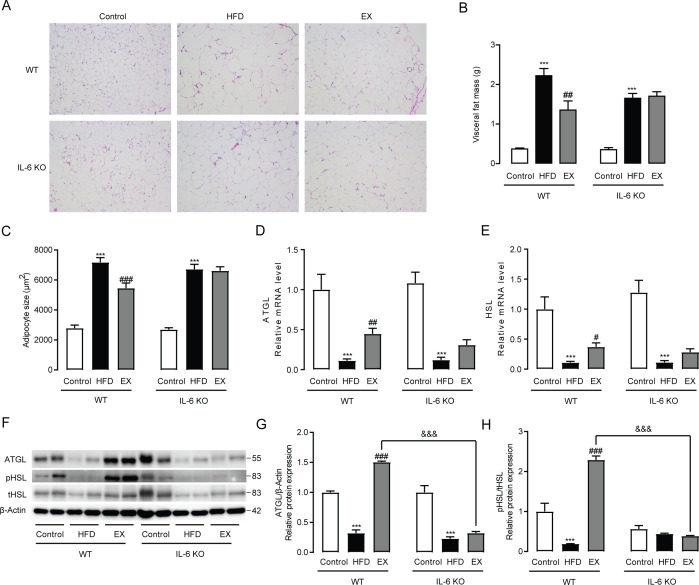
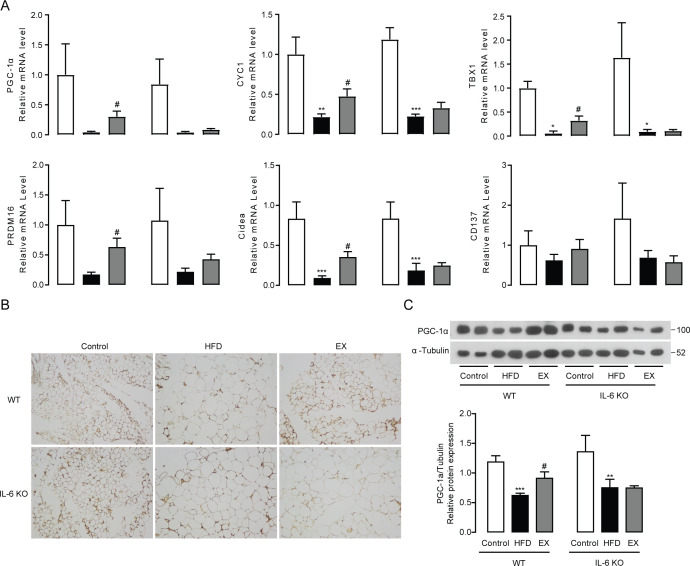
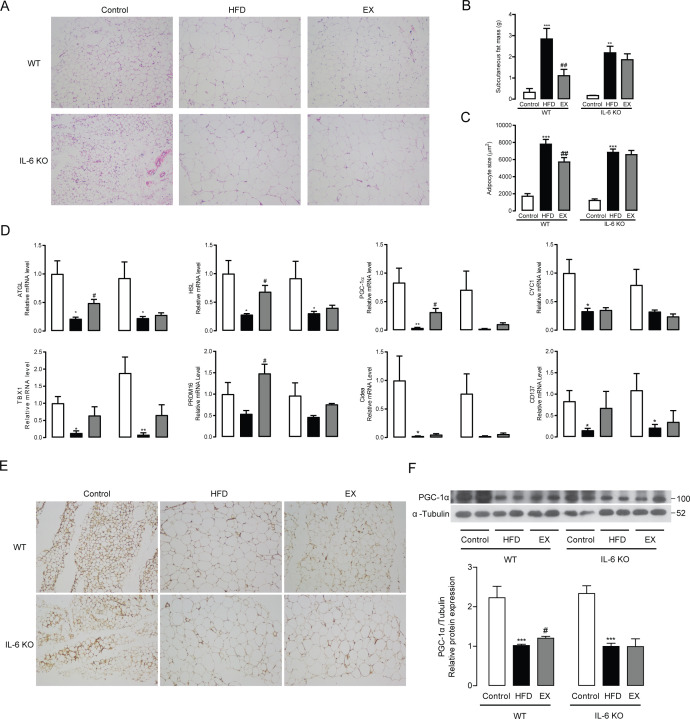
After 20 weeks of HFD feeding and 8 weeks of treadmill running, we found that exercise obviously reduced HFD-induced body weight gain, inhibited visceral adipose tissue (VAT) and subcutaneous adipose tissue (SAT) expansion and almost completely reversed obesity-related intrahepatic fat accumulation in WT mice. However, IL-6 knockout (IL-6 KO) mice are refractory to the benefits of treadmill training on body weight, VAT and SAT mass elevation, and hepatic steatosis. Moreover, a panel of lipolytic-related and thermogenic-related genes, including ATGL, HSL and PGC-1α, was upregulated in the VAT and SAT of WT mice that received exercise training compared with untrained mice, which was not observed in IL-6 KO mice. In addition, exercise training resulted in a significant inhibition of hepatic peroxisome proliferator-activated receptor gamma (PPAR-γ) expression in WT mice, and these effects were not noted in IL-6 KO mice.
These results revealed that IL-6 is involved in the prevention of obesity and hepatic fat accumulation during exercise training. The mechanisms underlying these antiobesity effects may be associated with enhanced lipolysis and thermogenesis in white adipose tissue. The improvement in hepatic steatosis by exercise training may benefit from the marked inhibition of PPAR-γ expression by IL-6.
运动训练已被证明是对抗肥胖和非酒精性脂肪性肝病最有效的策略。然而,运动通过尚不清楚的机制促进脂肪组织质量的减少并改善与肥胖相关的肝脂肪变性。
为研究白细胞介素-6(IL-6)在跑步机跑步期间高脂饮食(HFD)诱导的肥胖和肝脂肪变性中的作用,将IL-6基因敲除(IL-6 KO)小鼠和野生型(WT)小鼠随机分为瘦型、肥胖型(喂食HFD)和训练肥胖型组(喂食HFD并进行运动训练)。
在喂食HFD 20周和跑步机跑步8周后,我们发现运动明显减少了HFD诱导的体重增加,抑制了内脏脂肪组织(VAT)和皮下脂肪组织(SAT)的扩张,并几乎完全逆转了WT小鼠中与肥胖相关的肝内脂肪堆积。然而,IL-6基因敲除(IL-6 KO)小鼠对跑步机训练对体重、VAT和SAT质量增加以及肝脂肪变性的益处具有抗性。此外,与未训练的小鼠相比,接受运动训练的WT小鼠的VAT和SAT中一组与脂肪分解相关和产热相关的基因,包括脂肪甘油三酯脂肪酶(ATGL)、激素敏感脂肪酶(HSL)和过氧化物酶体增殖物激活受体γ共激活因子1α(PGC-1α)上调,而在IL-6 KO小鼠中未观察到这种情况。此外,运动训练导致WT小鼠肝脏中过氧化物酶体增殖物激活受体γ(PPAR-γ)表达受到显著抑制,而在IL-6 KO小鼠中未观察到这些作用。
这些结果表明,IL-6参与运动训练期间肥胖和肝脏脂肪堆积的预防。这些抗肥胖作用的潜在机制可能与白色脂肪组织中增强的脂肪分解和产热有关。运动训练对肝脂肪变性的改善可能受益于IL-6对PPAR-γ表达的显著抑制。