William Harvey Research Institute, Barts and The London School of Medicine and Dentistry, Queen Mary University of London, London, UK.
Nat Commun. 2021 Apr 14;12(1):2232. doi: 10.1038/s41467-021-22536-y.
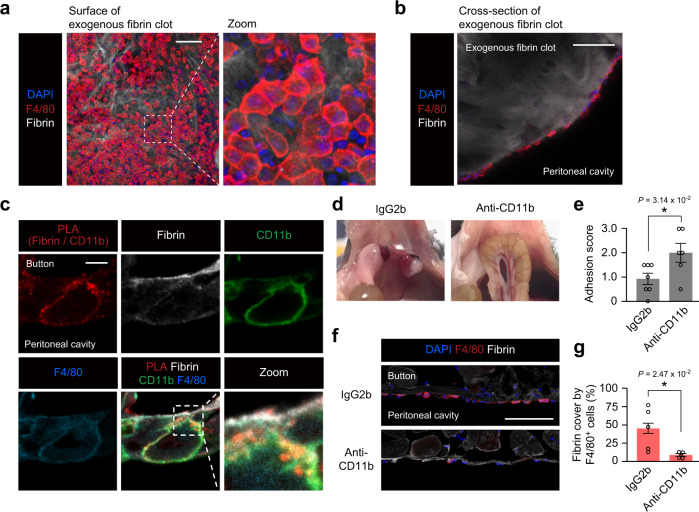
Post-operative adhesions are a leading cause of abdominal surgery-associated morbidity. Exposed fibrin clots on the damaged peritoneum, in which the mesothelial barrier is disrupted, readily adhere to surrounding tissues, resulting in adhesion formation. Here we show that resident F4/80CD206 peritoneal macrophages promptly accumulate on the lesion and form a 'macrophage barrier' to shield fibrin clots in place of the lost mesothelium in mice. Depletion of this macrophage subset or blockage of CD11b impairs the macrophage barrier and exacerbates adhesions. The macrophage barrier is usually insufficient to fully preclude the adhesion formation; however, it could be augmented by IL-4-based treatment or adoptive transfer of this macrophage subset, resulting in robust prevention of adhesions. By contrast, monocyte-derived recruited peritoneal macrophages are not involved in the macrophage barrier. These results highlight a previously unidentified cell barrier function of a specific macrophage subset, also proposing an innovative approach to prevent post-operative adhesions.
术后粘连是腹部手术相关发病率的主要原因。受损的腹膜上暴露的纤维蛋白凝块,其中间皮屏障被破坏,很容易附着在周围组织上,导致粘连形成。在这里,我们表明,驻留的 F4/80CD206 腹膜巨噬细胞迅速聚集在病变部位,并形成一个“巨噬细胞屏障”,以代替丢失的间皮来保护纤维蛋白凝块。这种巨噬细胞亚群的耗竭或 CD11b 的阻断会破坏巨噬细胞屏障并加剧粘连。巨噬细胞屏障通常不足以完全防止粘连形成;然而,它可以通过基于 IL-4 的治疗或这种巨噬细胞亚群的过继转移来增强,从而有效地预防粘连。相比之下,单核细胞衍生的募集的腹膜巨噬细胞不参与巨噬细胞屏障。这些结果突出了特定巨噬细胞亚群的以前未被识别的细胞屏障功能,也提出了一种预防术后粘连的创新方法。