Hannan Kelci B, Todd Makina K, Pearson Nicole J, Forbes Patrick A, Dakin Christopher J
Department of Kinesiology and Health Science, Utah State University, Logan, UT, USA.
Department of Neuroscience, Erasmus MC, University Medical Center Rotterdam, Rotterdam, The Netherlands.
Sci Rep. 2021 Apr 14;11(1):8127. doi: 10.1038/s41598-021-87485-4.
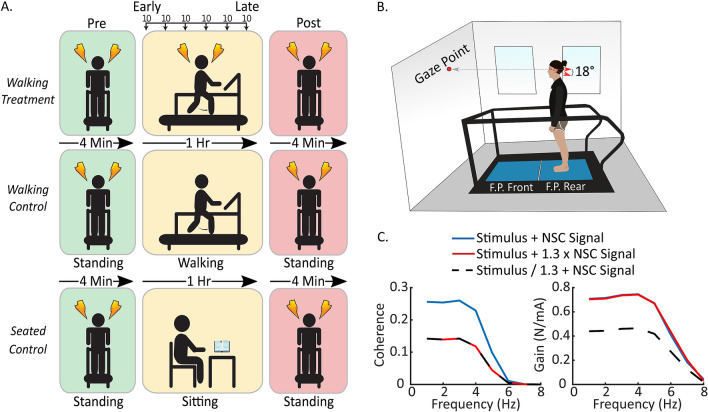
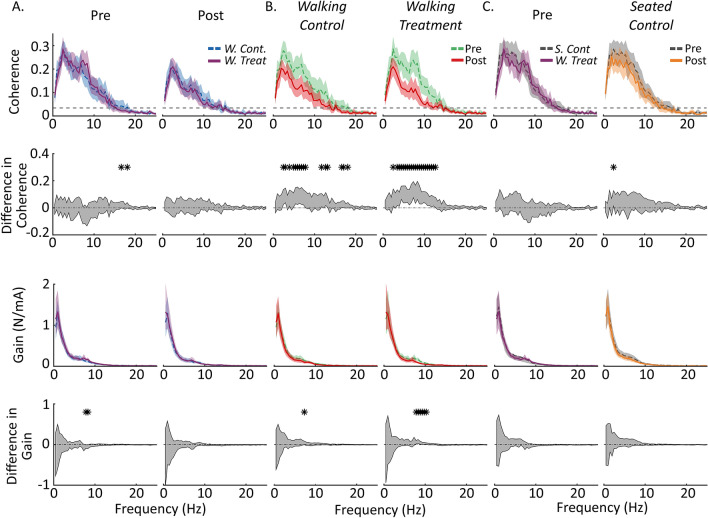
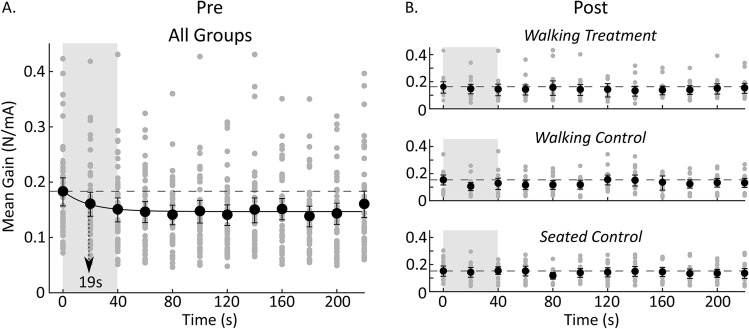
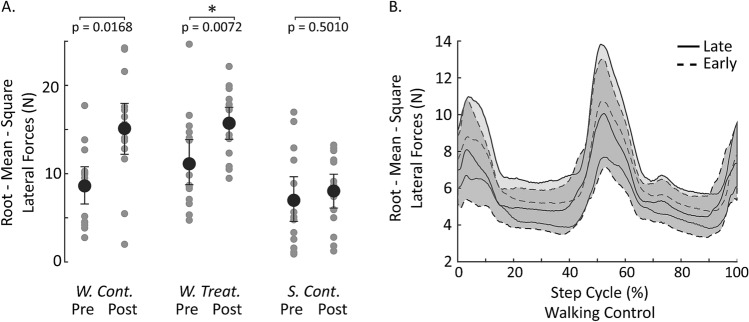
The ability to move and maintain posture is critically dependent on motion and orientation information provided by the vestibular system. When this system delivers noisy or erred information it can, in some cases, be attenuated through habituation. Here we investigate whether multiple mechanisms of attenuation act to decrease vestibular gain due to noise added using supra-threshold random-waveform galvanic vestibular stimulation (GVS). Forty-five participants completed one of three conditions. Each condition consisted of two 4-min standing periods with stimulation surrounding a 1-h period of either walking with stimulation, walking without stimulation, or sitting quietly. An instrumented treadmill recorded horizontal forces at the feet during standing and walking. We quantified response attenuation to GVS by comparing vestibular stimulus-horizontal force gain between conditions. First stimulus exposure caused an 18% decrease in gain during the first 40 s of standing. Attenuation recommenced only when subjects walked with stimulation, resulting in a 38% decrease in gain over 60 min that did not transfer to standing following walking. The disparity in attenuation dynamics and absent carry over between standing and walking suggests that two mechanisms of attenuation, one associated with first exposure to the stimulus and another that is task specific, may act to decrease vestibulomotor gain.
移动和维持姿势的能力严重依赖于前庭系统提供的运动和方向信息。当该系统传递嘈杂或错误的信息时,在某些情况下,可以通过习惯化来减弱。在这里,我们研究是否存在多种衰减机制,可降低由于使用阈上随机波形电刺激前庭刺激(GVS)添加噪声而导致的前庭增益。45名参与者完成了三种条件之一。每种条件包括两个4分钟的站立期,在1小时的刺激期前后,分别是在有刺激的情况下行走、在无刺激的情况下行走或安静地坐着。一台装有仪器的跑步机记录了站立和行走时脚部的水平力。我们通过比较不同条件下前庭刺激-水平力增益来量化对GVS的反应衰减。首次刺激暴露在站立的前40秒内使增益降低了18%。只有当受试者在有刺激的情况下行走时,衰减才会重新开始,导致在60分钟内增益降低38%,且在行走后站立时不会转移。站立和行走之间衰减动态的差异以及不存在延续效应表明,两种衰减机制,一种与首次接触刺激有关,另一种是特定任务的,可能会降低前庭运动增益。