Wang Shujie, Liu Wenjing, Ni Yueli, Wang Lifeng, Zhu Yuzhi, Shi Qiong, Yi Zihan, Wang Wenjie, Liu Lili, Yang Lijuan, Kuang Yingmin, Zhu Yuechun, Zhang Qiao, Yang Zhe
Department of pathology, The First Affiliated Hospital of Kunming Medical University, Yunnan, China.
Department of Biochemistry and Molecular Biology, School of Basic Medical Sciences, Kunming Medical University, Yunnan, China.
J Cancer. 2021 Mar 5;12(9):2550-2559. doi: 10.7150/jca.54576. eCollection 2021.
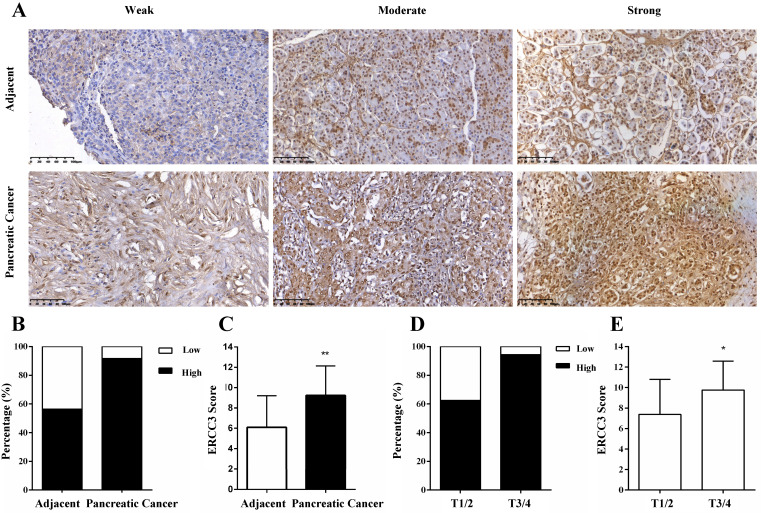
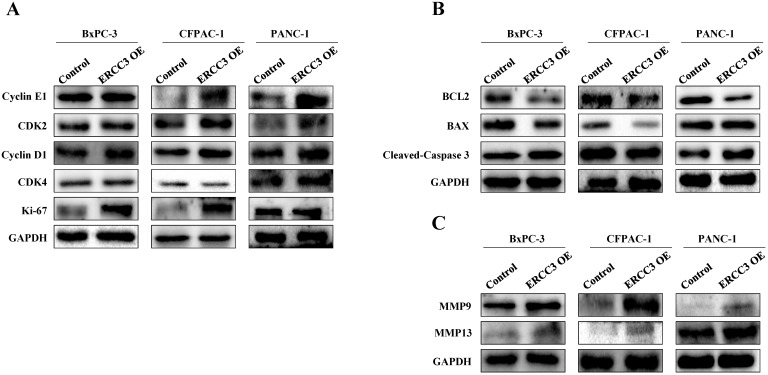
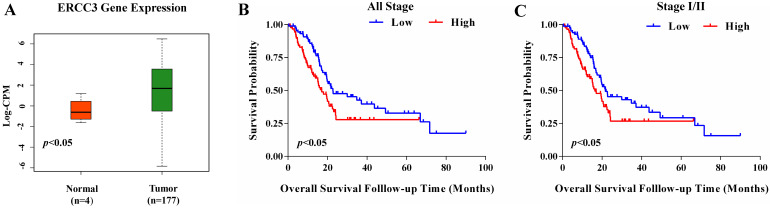
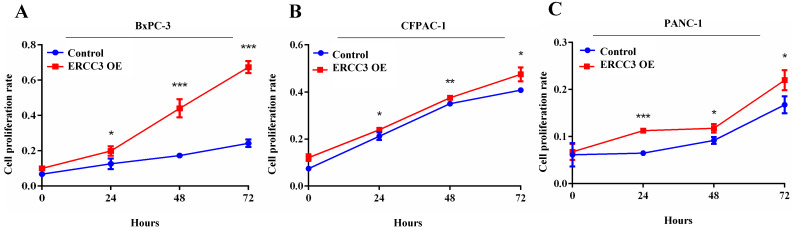
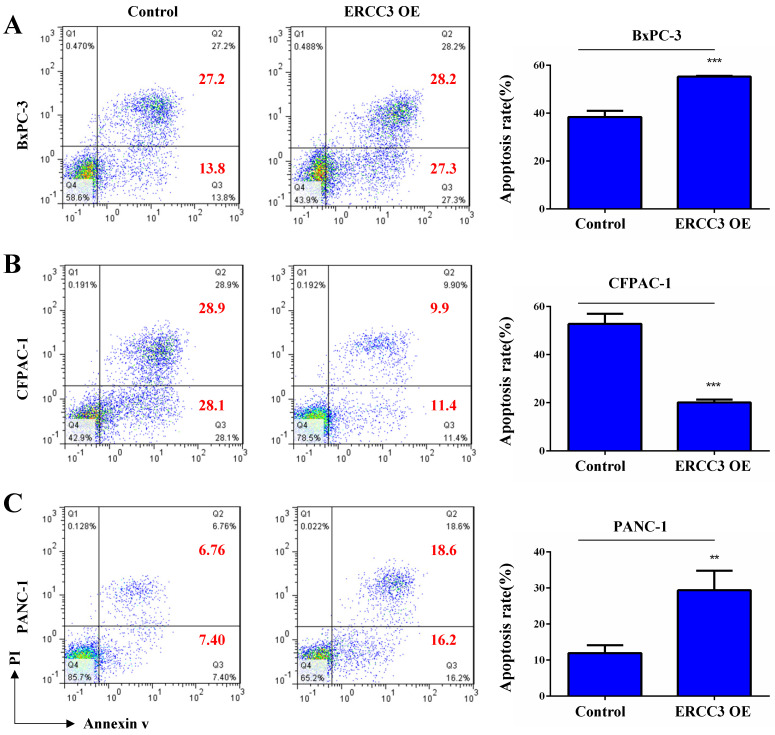
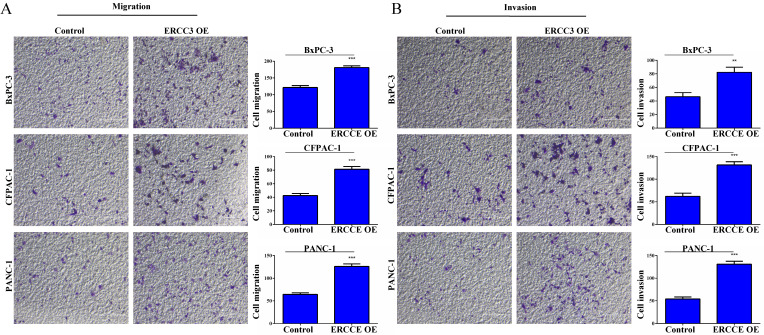
Pancreatic cancer is associated with poor prognosis due to limited therapeutic options. Excision repair cross-complementing 3 (ERCC3) is an important member of nucleotide excision repair (NER) that is overexpressed in some cancers and may be regarded as a poor prognostic factor. Yet, its role in pancreatic cancer remains unclear. This study aimed to investigate the expression and functions of ERCC3 in pancreatic cancer patients and its relation with clinicopathological features. Our data suggested that the protein expression level of ERCC3 was higher in tumor tissues than in adjacent tissues. In addition, the expression of ERCC3 has shown to be associated with the tumor extent (=0.035). Besides, analysis of the dataset in The Cancer Genome Atlas (TCGA) revealed that high expression of ERCC3 was associated with poor overall survival in pancreatic cancer patients (=0.0136). In Cox regression analysis, ERCC3 was an independent prognostic factor for overall survival in pancreatic cancer (<0.001). Furthermore, our data further suggested that the overexpression of ERCC3 significantly promoted pancreatic cancer (BxPC-3, CFPAC-1, and PANC-1 cells) proliferation, invasion, and migration. Taken together, this study suggested that high expression of ERCC3 might be a poor prognostic factor in human pancreatic cancer and might be used as a promising therapeutic target for pancreatic cancer treatment.
由于治疗选择有限,胰腺癌的预后较差。切除修复交叉互补蛋白3(ERCC3)是核苷酸切除修复(NER)的重要成员,在某些癌症中过表达,可能被视为不良预后因素。然而,其在胰腺癌中的作用仍不清楚。本研究旨在探讨ERCC3在胰腺癌患者中的表达、功能及其与临床病理特征的关系。我们的数据表明,ERCC3的蛋白表达水平在肿瘤组织中高于相邻组织。此外,ERCC3的表达已显示与肿瘤范围相关(P=0.035)。此外,对癌症基因组图谱(TCGA)数据集的分析显示,ERCC3的高表达与胰腺癌患者的总体生存率低相关(P=0.0136)。在Cox回归分析中,ERCC3是胰腺癌总体生存的独立预后因素(P<0.001)。此外,我们的数据进一步表明,ERCC3的过表达显著促进胰腺癌(BxPC-3、CFPAC-1和PANC-1细胞)的增殖、侵袭和迁移。综上所述,本研究表明,ERCC3的高表达可能是人类胰腺癌的不良预后因素,可能作为胰腺癌治疗的一个有前景的治疗靶点。