Ruhfus Maria, Giannakis Stamatios, Markus Mona, Stein Anja, Hoehn Thomas, Felderhoff-Mueser Ursula, Sabir Hemmen
Department of Pediatrics I/Neonatology, University Hospital Essen, University Duisburg-Essen, Essen, Germany.
Department of General Pediatrics, Neonatology and Pediatric Cardiology, Medical Faculty, University Children's Hospital Duesseldorf, Heinrich Heine University, Duesseldorf, Germany.
Front Pediatr. 2021 Mar 29;9:624652. doi: 10.3389/fped.2021.624652. eCollection 2021.
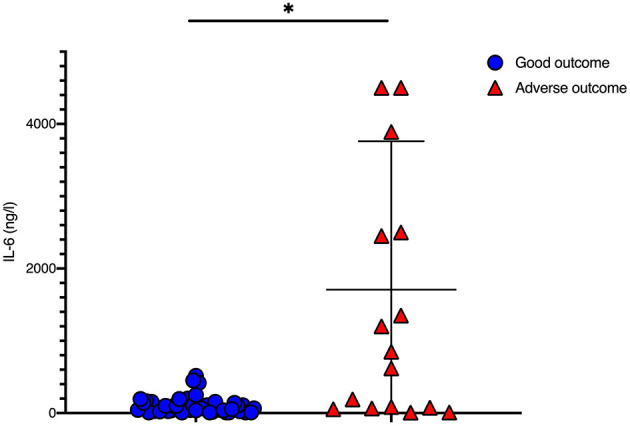
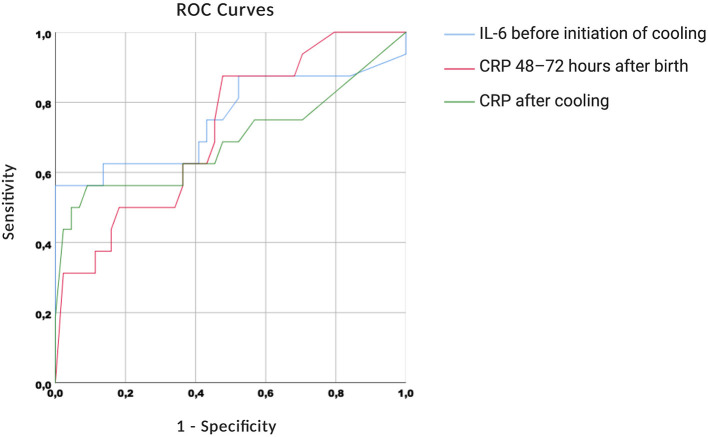
The neuroprotective treatment effect of therapeutic hypothermia (TH) following perinatal asphyxia may be negatively influenced by neonatal sepsis and concomitant inflammation. We aimed to correlate routinely used blood biomarkers for perinatal sepsis in cooled asphyxiated newborns with MRI findings. Perinatal data was retrospectively collected from 67 cooled asphyxiated newborns. Levels of C-reactive protein (CRP), white blood cells and platelets were analyzed before, during and after TH. Interleukin-6 blood levels were analyzed before initiation of TH. Magnetic resonance imaging (MRI) on postnatal day 5-7 was used defining short-term outcome. Adverse outcome was defined as death or adverse MRI findings. Amplitude-integrated electroencephalography (aEEG) was additionally analyzed and correlated with short-term MRI outcome. Forty-nine newborns had favorable short-term MRI outcome. Perinatal data referring to perinatal sepsis did not differ significantly between groups. IL-6 levels before initiation of TH and CRP levels on day three and after TH were significantly higher in newborns with adverse short-term MRI outcome. Males with adverse short-term MRI outcome had significantly increased CRP values at the end of the cooling phase. aEEG strongly correlated with short-term MRI outcome. Routinely used blood biomarkers may be helpful early identifying newborns at high risk of unfavorable outcome and in need of close neurodevelopmental follow-up.
围产期窒息后治疗性低温(TH)的神经保护治疗效果可能会受到新生儿败血症和伴随炎症的负面影响。我们旨在将冷却窒息新生儿围产期败血症的常规血液生物标志物与MRI结果相关联。回顾性收集了67例冷却窒息新生儿的围产期数据。在TH之前、期间和之后分析了C反应蛋白(CRP)、白细胞和血小板水平。在开始TH之前分析白细胞介素-6血液水平。在出生后第5 - 7天进行磁共振成像(MRI)以确定短期结果。不良结果定义为死亡或不良MRI结果。此外,还分析了振幅整合脑电图(aEEG)并将其与短期MRI结果相关联。49例新生儿有良好的短期MRI结果。两组之间与围产期败血症相关的围产期数据没有显著差异。短期MRI结果不良的新生儿在开始TH之前的IL-6水平以及TH后第三天和之后的CRP水平显著更高。短期MRI结果不良的男性在冷却阶段结束时CRP值显著升高。aEEG与短期MRI结果密切相关。常规使用的血液生物标志物可能有助于早期识别有不良结局高风险且需要密切神经发育随访的新生儿。