Department of Health Economics, Center for Public Health, Medical University of Vienna, Kinderspitalgasse 15/1, 1090, Vienna, Austria.
Institute for Advanced Studies, Josefstädterstraße 39, Vienna, Austria.
Eur J Health Econ. 2021 Aug;22(6):917-929. doi: 10.1007/s10198-021-01298-w. Epub 2021 Apr 15.
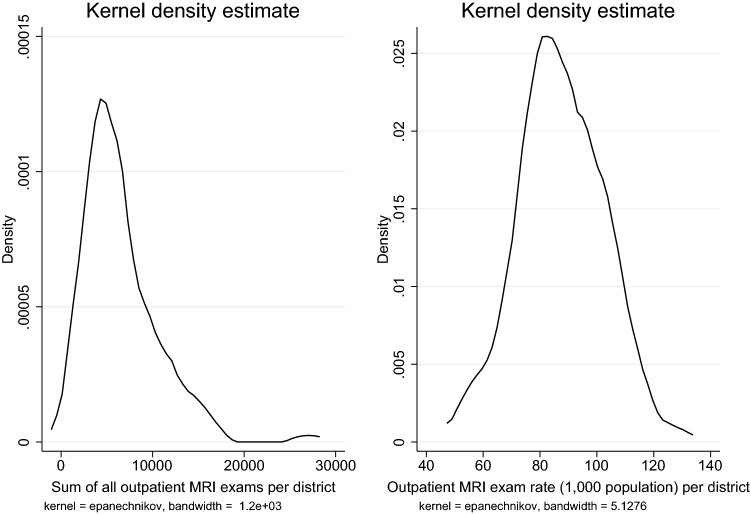
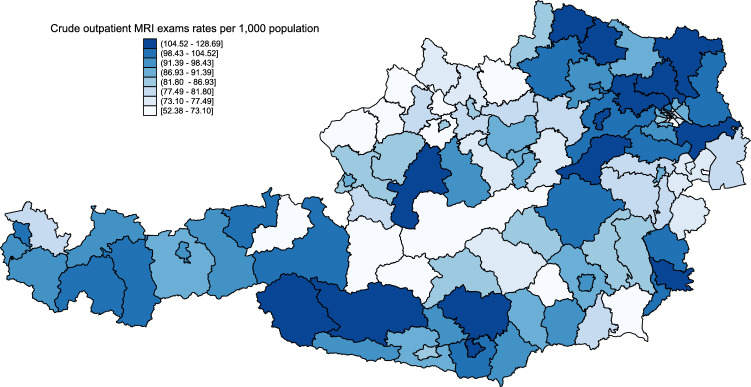
Magnetic resonance imaging (MRI) is a popular yet cost-intensive diagnostic measure whose strengths compared to other medical imaging technologies have led to increased application. But the benefits of aggressive testing are doubtful. The comparatively high MRI usage in Austria in combination with substantial regional variation has hence become a concern for its policy makers. We use a set of routine healthcare data on outpatient MRI service consumption of Austrian patients between Q3-2015 and Q2-2016 on the district level to investigate the extent of medical practice variation in a two-step statistical analysis combining multivariate regression models and Blinder-Oaxaca decomposition. District-level MRI exam rates per 1.000 inhabitants range from 52.38 to 128.69. Controlling for a set of regional characteristics in a multivariate regression model, we identify payer autonomy in regulating access to MRI scans as the biggest contributor to regional variation. Nevertheless, the statistical decomposition highlights that more than 70% of the regional variation remains unexplained by differences between the observable district characteristics. In the absence of epidemiological explanations, the substantial regional medical practice variation calls the efficiency of resource deployment into question.
磁共振成像(MRI)是一种广泛应用但成本高昂的诊断手段,与其他医学成像技术相比,其优势在于应用的增加。但过度检测的好处值得怀疑。奥地利 MRI 的使用相对较高,加上存在大量的区域性差异,因此引起了政策制定者的关注。我们使用了一组关于 2015 年第三季度至 2016 年第二季度奥地利患者门诊 MRI 服务消费的常规医疗保健数据,在对多变量回归模型和 Blinder-Oaxaca 分解进行两步统计分析的基础上,调查了医疗实践差异的程度。每个地区每 1000 名居民的 MRI 检查率范围为 52.38 至 128.69。在多变量回归模型中控制了一系列区域特征后,我们发现,在调节 MRI 扫描准入方面,支付者自主权是导致区域差异的最大因素。然而,统计分解突出表明,超过 70%的区域差异无法用可观察到的地区特征差异来解释。在没有流行病学解释的情况下,大量的区域医疗实践差异使得资源配置的效率受到质疑。