São Paulo School of Business Administration, Fundação Getulio Vargas, São Paulo, Brazil; Instituto de Estudos para Políticas de Saúde, São Paulo, Brazil.
Department of Global Health and Population, Harvard T H Chan School of Public Health, Boston, MA, USA.
Lancet Glob Health. 2021 Jun;9(6):e782-e792. doi: 10.1016/S2214-109X(21)00081-4. Epub 2021 Apr 12.
COVID-19 spread rapidly in Brazil despite the country's well established health and social protection systems. Understanding the relationships between health-system preparedness, responses to COVID-19, and the pattern of spread of the epidemic is particularly important in a country marked by wide inequalities in socioeconomic characteristics (eg, housing and employment status) and other health risks (age structure and burden of chronic disease).
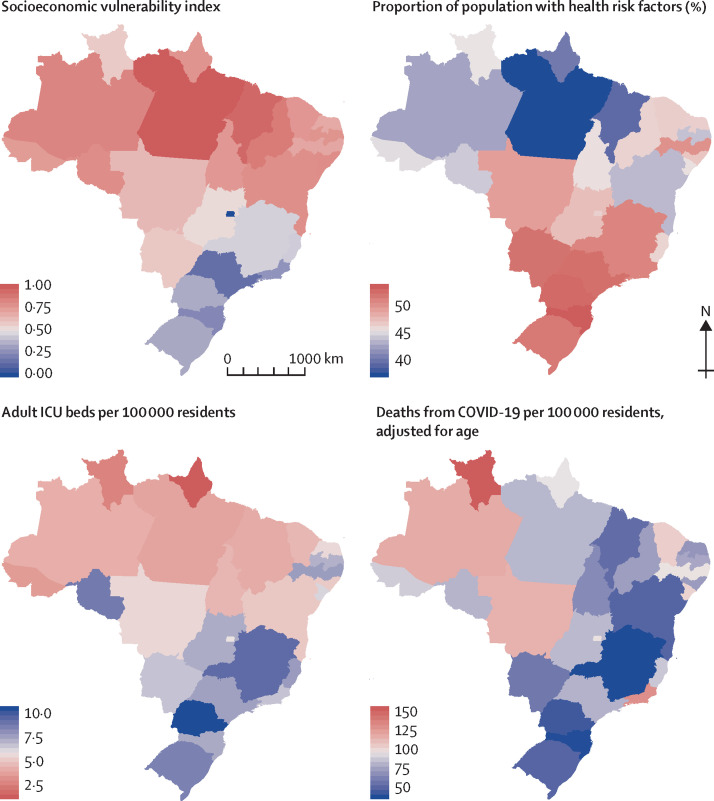
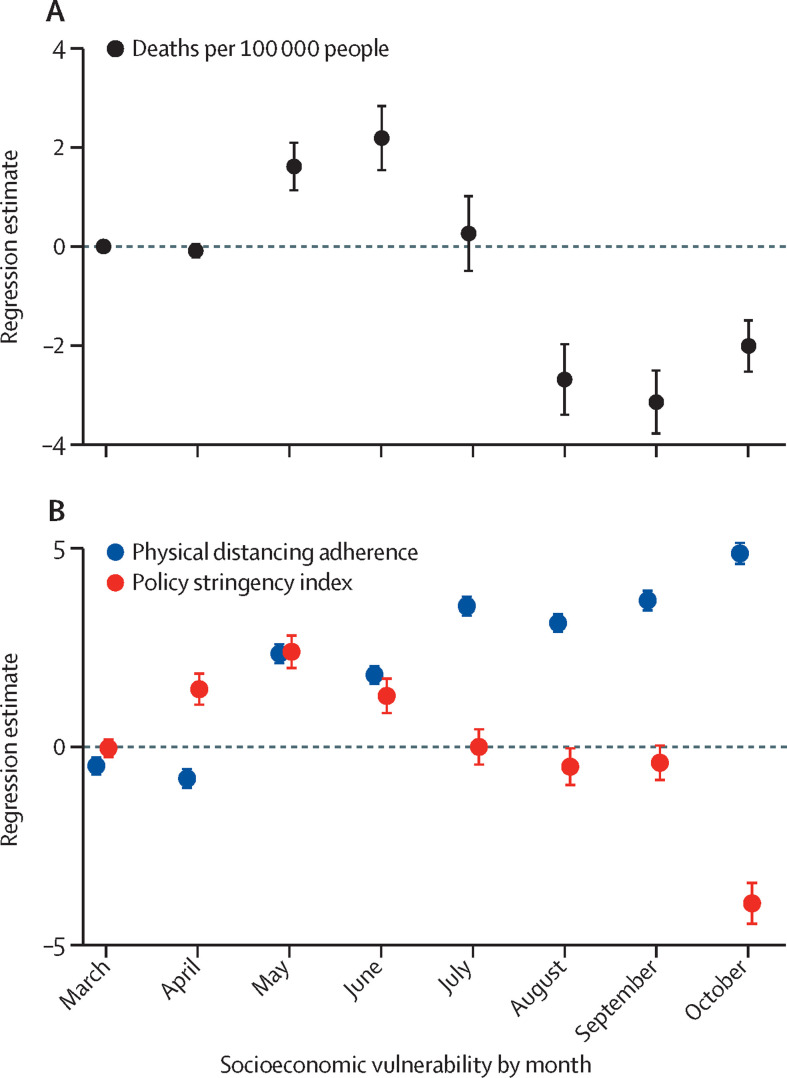
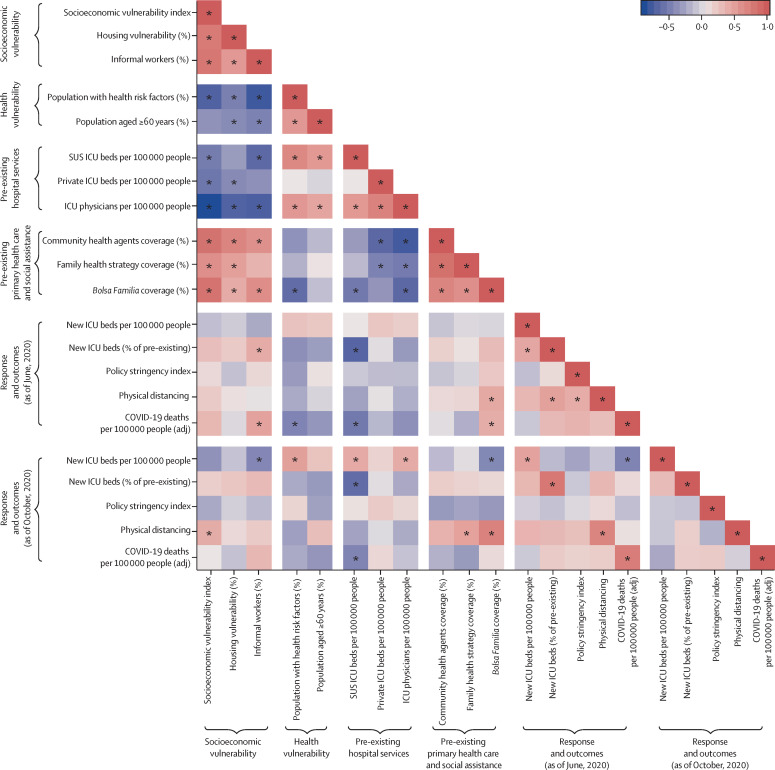
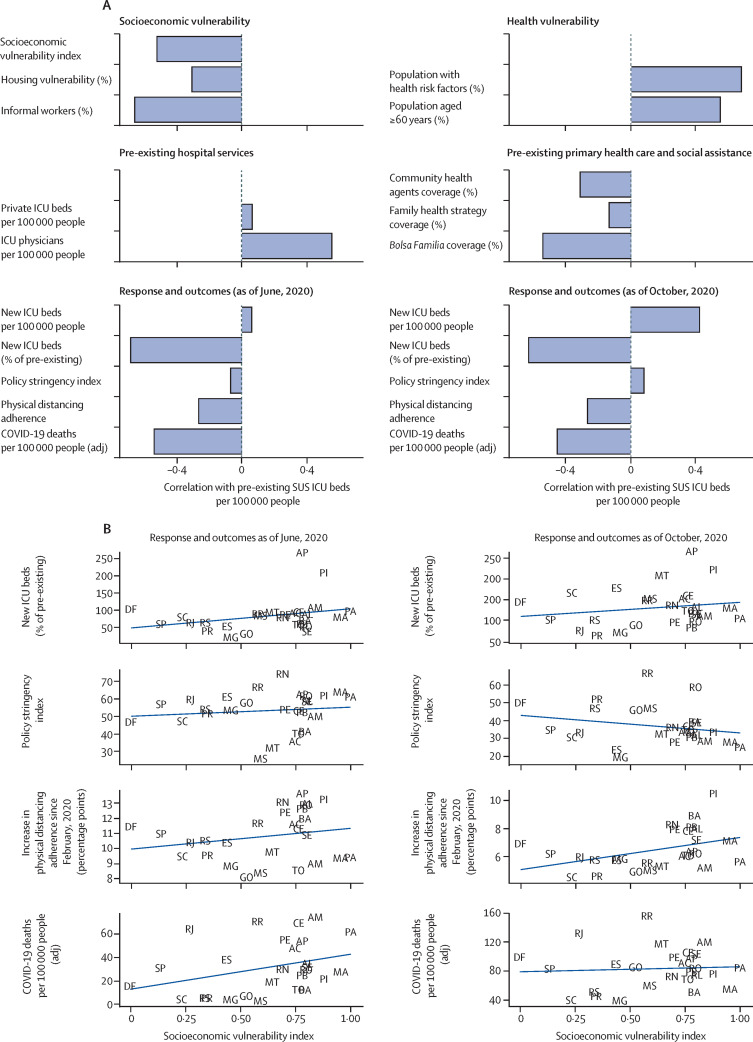
From several publicly available sources in Brazil, we obtained data on health risk factors for severe COVID-19 (proportion of the population with chronic disease and proportion aged ≥60 years), socioeconomic vulnerability (proportions of the population with housing vulnerability or without formal work), health-system capacity (numbers of intensive care unit beds and physicians), coverage of health and social assistance, deaths from COVID-19, and state-level responses of government in terms of physical distancing policies. We also obtained data on the proportion of the population staying at home, based on locational data, as a measure of physical distancing adherence. We developed a socioeconomic vulnerability index (SVI) based on household characteristics and the Human Development Index. Data were analysed at the state and municipal levels. Descriptive statistics and correlations between state-level indicators were used to characterise the relationship between the availability of health-care resources and socioeconomic characteristics and the spread of the epidemic and the response of governments and populations in terms of new investments, legislation, and physical distancing. We used linear regressions on a municipality-by-month dataset from February to October, 2020, to characterise the dynamics of COVID-19 deaths and response to the epidemic across municipalities.
The initial spread of COVID-19 was mostly affected by patterns of socioeconomic vulnerability as measured by the SVI rather than population age structure and prevalence of health risk factors. The states with a high (greater than median) SVI were able to expand hospital capacity, to enact stringent COVID-19-related legislation, and to increase physical distancing adherence in the population, although not sufficiently to prevent higher COVID-19 mortality during the initial phase of the epidemic compared with states with a low SVI. Death rates accelerated until June, 2020, particularly in municipalities with the highest socioeconomic vulnerability. Throughout the following months, however, differences in policy response converged in municipalities with lower and higher SVIs, while physical distancing remained relatively higher and death rates became relatively lower in the municipalities with the highest SVIs compared with those with lower SVIs.
In Brazil, existing socioeconomic inequalities, rather than age, health status, and other risk factors for COVID-19, have affected the course of the epidemic, with a disproportionate adverse burden on states and municipalities with high socioeconomic vulnerability. Local government responses and population behaviour in the states and municipalities with higher socioeconomic vulnerability have helped to contain the effects of the epidemic. Targeted policies and actions are needed to protect those with the greatest socioeconomic vulnerability. This experience could be relevant in other low-income and middle-income countries where socioeconomic vulnerability varies greatly.
None.
For the Portuguese translation of the abstract see Supplementary Materials section.
尽管巴西拥有完善的卫生和社会保护体系,但 COVID-19 仍在该国迅速传播。了解卫生系统准备情况、对 COVID-19 的应对措施以及疫情传播模式之间的关系,对于一个在社会经济特征(如住房和就业状况)和其他健康风险(年龄结构和慢性病负担)方面存在广泛不平等的国家尤为重要。
我们从巴西的几个公开来源获取了有关 COVID-19 严重程度的健康风险因素(患有慢性病的人口比例和≥60 岁的人口比例)、社会经济脆弱性(住房脆弱性或无正规工作的人口比例)、卫生系统能力(重症监护床位和医生人数)、卫生和社会援助覆盖范围、COVID-19 死亡人数以及政府在物理距离政策方面的州级应对措施的数据。我们还根据位置数据获得了人口留在家中的比例,作为遵守物理距离措施的衡量标准。我们根据家庭特征和人类发展指数制定了社会经济脆弱性指数(SVI)。数据在州和市级层面进行分析。描述性统计和州级指标之间的相关性用于描述医疗保健资源和社会经济特征的可获得性与疫情传播之间的关系,以及政府和人口在新投资、立法和物理距离方面的应对情况。我们使用 2020 年 2 月至 10 月的市逐月数据集进行线性回归,以描述全市范围内 COVID-19 死亡人数和对疫情的应对情况。
COVID-19 的初始传播主要受 SVI 衡量的社会经济脆弱性模式的影响,而不是人口年龄结构和健康风险因素的流行程度。SVI 较高(高于中位数)的州能够扩大医院容量,制定严格的 COVID-19 相关立法,并提高人口的物理距离遵守率,尽管在疫情的初始阶段,这仍不足以防止 SVI 较低的州的 COVID-19 死亡率更高。死亡率直到 2020 年 6 月才加速上升,特别是在社会经济脆弱性最高的城市。然而,在接下来的几个月里,SVI 较低和较高的城市之间的政策应对差异趋于收敛,而 SVI 较高的城市的物理距离仍然相对较高,死亡率相对较低。
在巴西,现有的社会经济不平等,而不是年龄、健康状况和 COVID-19 的其他风险因素,影响了疫情的进程,给社会经济脆弱性较高的州和城市带来了不成比例的不利负担。SVI 较高的州和城市的地方政府应对措施和人口行为有助于遏制疫情的影响。需要采取有针对性的政策和行动来保护那些社会经济最脆弱的人。这一经验可能与其他社会经济脆弱性差异很大的低收入和中等收入国家相关。
无。