Department of Hepatobiliary Surgery, Eastern Hepatobiliary Surgery Hospital, Second Military Medical University, Shanghai, 200438, People's Republic of China.
Department of Nuclear Medicine, Ruijin Hospital, Shanghai Jiaotong University School of Medicine, Shanghai, 200025, People's Republic of China.
J Nanobiotechnology. 2021 Apr 15;19(1):107. doi: 10.1186/s12951-021-00858-9.
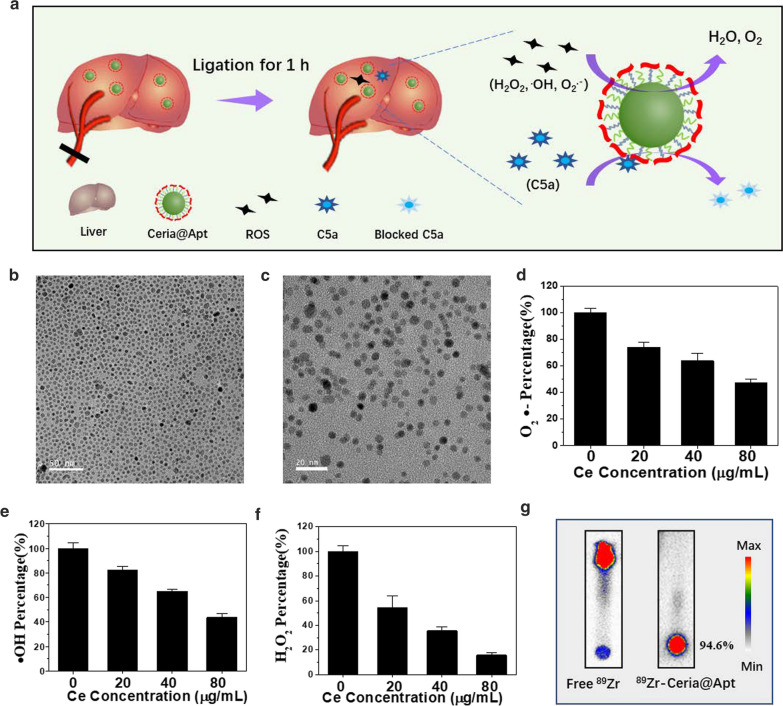
Nonspecific liver uptake of nanomaterials after intravenous injection has hindered nanomedicine for clinical translation. However, nanomaterials' propensity for liver distribution might enable their use in hepatic ischemia-reperfusion injury (IRI) repair. During hepatic IRI, reactive oxygen species (ROS) are generated and the fifth component of complement (C5a) is activated. In addition, C5a is confirmed to exacerbate the vicious cycle of oxidative stress and inflammatory damage. For these reasons, we have investigated the development of nanomaterials with liver uptake to scavenge ROS and block C5a for hepatic IRI repair.
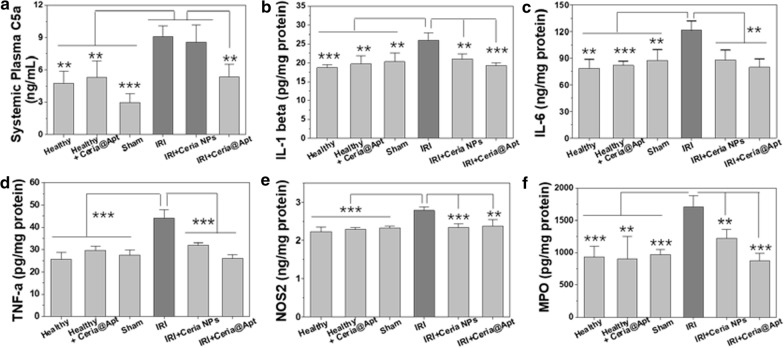
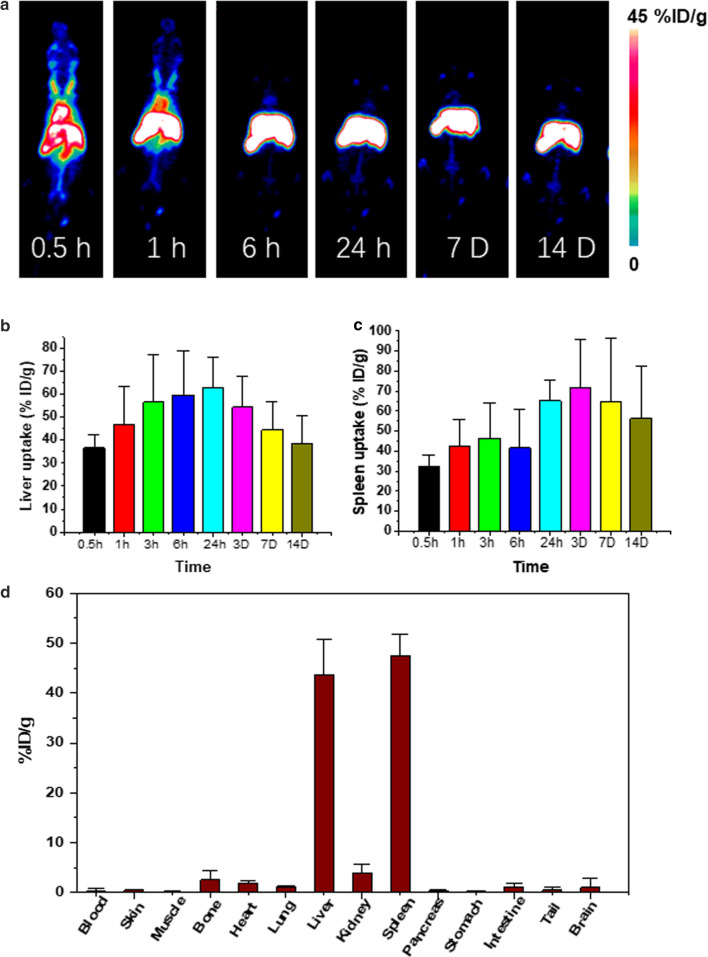
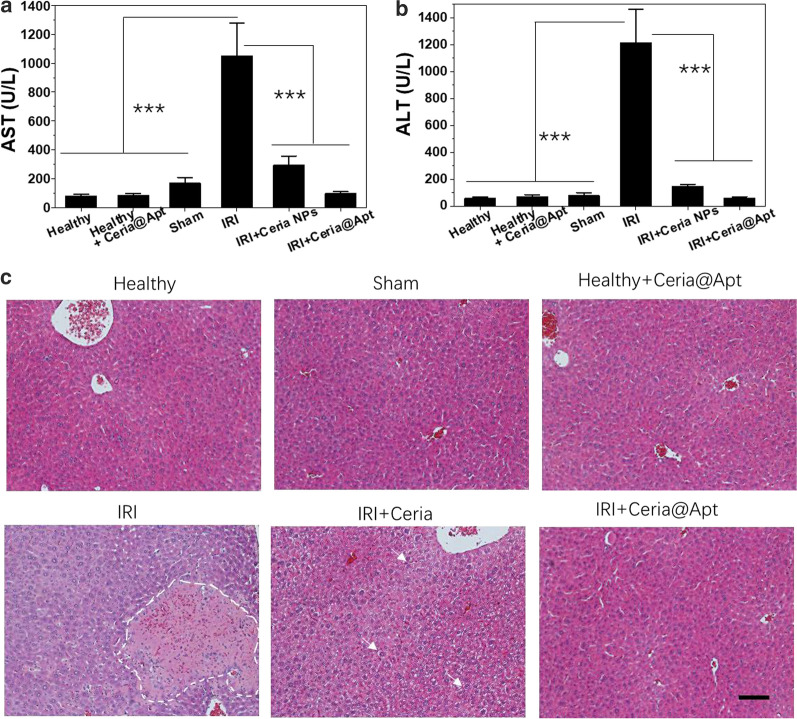
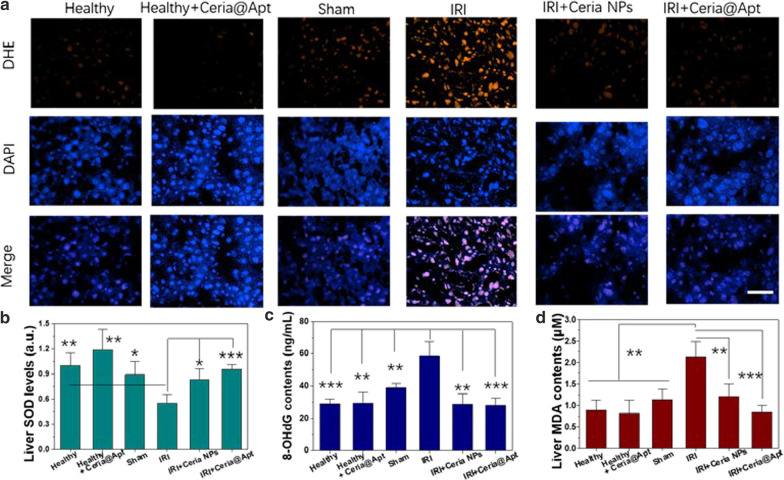
To achieve this goal, a traditional nanoantioxidant of nanoceria was surface conjugated with the anti-C5a aptamers (Ceria@Apt) to scavenge the ROS and reduce C5a-mediated inflammation. High uptake of Ceria@Apt in the liver was confirmed by preclinical positron emission tomography (PET) imaging. The clinical symptoms of hepatic IRI were effectively alleviated by Ceria@Apt with ROS scavenging and C5a blocking in mice model. The released pro-inflammatory cytokines were significantly reduced, and subsequent inflammatory reaction involved in the liver was inhibited.
The synthesized Ceria@Apt has great potential of medical application in hepatic IRI repair, which could also be applied for other ischemic-related diseases.
静脉注射后纳米材料在肝脏中的非特异性摄取阻碍了纳米医学的临床转化。然而,纳米材料在肝脏中的分布倾向可能使其能够用于肝脏缺血再灌注损伤(IRI)的修复。在肝脏 IRI 期间,会产生活性氧(ROS),并且补体的第五成分(C5a)被激活。此外,C5a 被证实会加剧氧化应激和炎症损伤的恶性循环。基于这些原因,我们研究了具有肝脏摄取能力的纳米材料的开发,以清除 ROS 并阻断 C5a 用于肝脏 IRI 的修复。
为了实现这一目标,传统的纳米抗氧化剂纳米氧化铈(Ceria@Apt)被表面偶联到抗 C5a 的适体(Ceria@Apt)上,以清除 ROS 并减少 C5a 介导的炎症。通过临床前正电子发射断层扫描(PET)成像证实了 Ceria@Apt 在肝脏中的高摄取。在小鼠模型中,Ceria@Apt 通过清除 ROS 和阻断 C5a,有效缓解了肝脏 IRI 的临床症状。释放的促炎细胞因子明显减少,随后抑制了肝脏中的炎症反应。
合成的 Ceria@Apt 在肝脏 IRI 修复的医学应用中具有很大的潜力,也可应用于其他与缺血相关的疾病。