Cognoa, Inc., Palo Alto, CA, USA.
J Biomed Semantics. 2021 Apr 15;12(1):8. doi: 10.1186/s13326-021-00242-4.
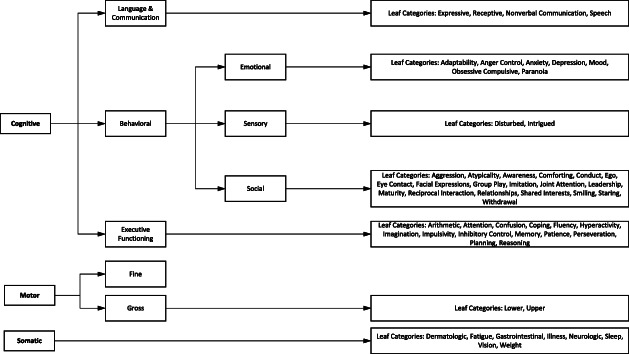
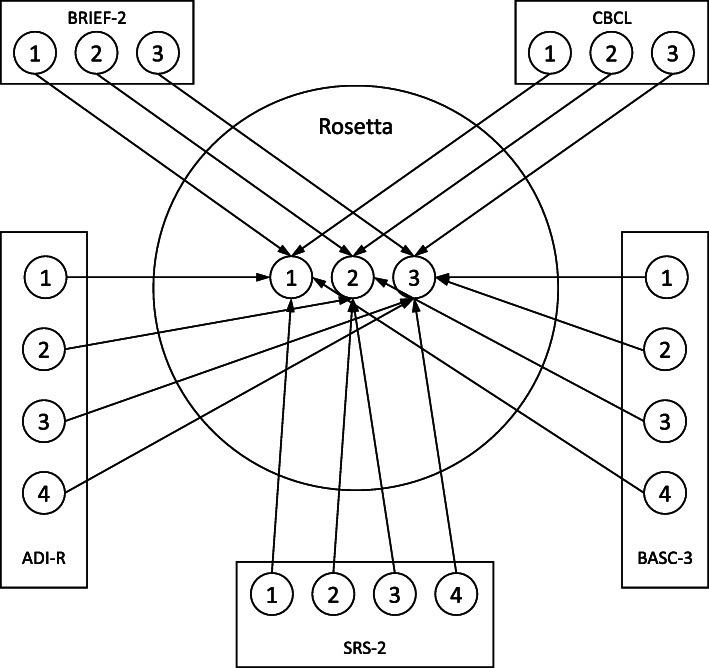
A wide array of existing instruments are commonly used to assess childhood behavior and development for the evaluation of social, emotional and behavioral disorders such as Autism Spectrum Disorder (ASD), attention-deficit/hyperactivity disorder (ADHD), and anxiety. Many of these instruments either focus on one diagnostic category or encompass a broad set of childhood behaviors. We analyze a wide range of standardized behavioral instruments and identify a comprehensive, structured semantic hierarchical grouping of child behavioral observational features. We use the hierarchy to create Rosetta: a new set of behavioral assessment questions, designed to be minimal yet comprehensive in its coverage of clinically relevant behaviors. We maintain a full mapping from every functional feature in every covered instrument to a corresponding question in Rosetta.
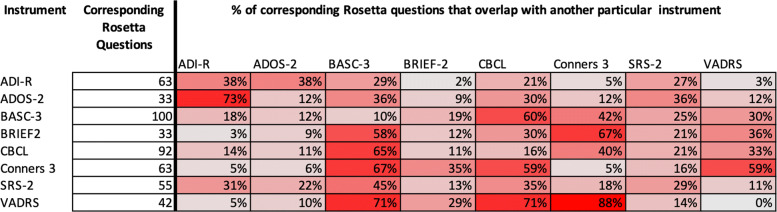
In all, 209 Rosetta questions are shown to cover all the behavioral concepts targeted in the eight existing standardized instruments.
The resulting hierarchy can be used to create more concise instruments across various ages and conditions, as well as create more robust overlapping datasets for both clinical and research use.
目前有许多用于评估儿童行为和发育的工具,如自闭症谱系障碍(ASD)、注意力缺陷/多动障碍(ADHD)和焦虑症等社会、情感和行为障碍。这些工具中的许多工具要么专注于一个诊断类别,要么涵盖了广泛的儿童行为。我们分析了各种标准化的行为工具,并确定了儿童行为观察特征的全面、结构化的语义层次分组。我们使用该层次结构创建了 Rosetta:一组新的行为评估问题,旨在在其涵盖的临床相关行为方面做到最小但全面。我们保持从每个涵盖的工具中的每个功能特征到 Rosetta 中相应问题的完整映射。
总共,209 个 Rosetta 问题被证明涵盖了八个现有标准化工具中针对的所有行为概念。
所得层次结构可用于创建跨越不同年龄和条件的更简洁的工具,并为临床和研究用途创建更强大的重叠数据集。