Doi Takehiko, Tsutsumimoto Kota, Ishii Hideaki, Nakakubo Sho, Kurita Satoshi, Shimada Hiroyuki
Department of Preventive Gerontology, Center for Gerontology and Social Science, National Center for Geriatrics and Gerontology, Obu, Aichi, Japan
Department of Preventive Gerontology, Center for Gerontology and Social Science, National Center for Geriatrics and Gerontology, Obu, Aichi, Japan.
BMJ Open. 2021 Apr 15;11(4):e042468. doi: 10.1136/bmjopen-2020-042468.
To examine the relationship of driving status and frailty with disability in older adults.
A prospective study.
The study included 8533 participants (mean age: 72.0±6.1 years (range: 60-98 years), women: 54.1%) in a community setting.
Driving status and frailty were assessed at baseline. The clinical definition of frailty was used according to the Japanese Cardiovascular Health Study index. Disability was prospectively determined using a record of Japanese long-term care insurance (LTCI).
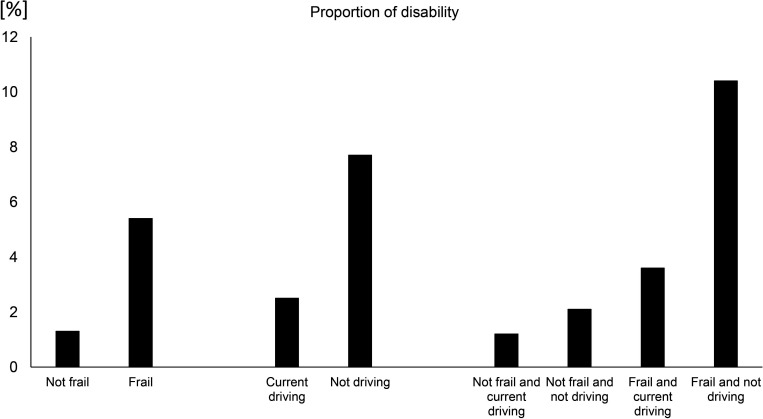
During the follow-up period (mean duration: 23.5 months), 58 (0.7%) participants were regarded as moving out of the city, 80 (0.9%) participants had died and 311 (3.6%) participants were certified by LTCI. The proportion of disability was 1.3% among the not-frail group and 5.3% among the frail group. The proportion of disability was 2.5% in participants who were currently driving and 7.5% in those not driving. Based on frailty status and driving, participants were further classified into four groups: not frail and currently driving (n=2945), not frail and not driving (n=642), frail and currently driving (n=3598) and frail and not driving (n=1348). Compared with older adults who are not frail and driving, the combined status of frail and not driving (adjusted HR: 2.28; 95% CI: 1.47 to 3.52) and frail and driving (HR: 1.91; 95% CI: 1.30-2.81) were risk factors for disability.
Not driving and frail were associated with a risk of disability in community-dwelling older adults.
研究老年人的驾驶状态和身体虚弱与残疾之间的关系。
一项前瞻性研究。
该研究纳入了8533名社区参与者(平均年龄:72.0±6.1岁(范围:60 - 98岁),女性占54.1%)。
在基线时评估驾驶状态和身体虚弱情况。身体虚弱的临床定义采用日本心血管健康研究指数。残疾情况通过日本长期护理保险(LTCI)记录进行前瞻性判定。
在随访期间(平均时长:23.5个月),58名(0.7%)参与者被视为搬离城市,80名(0.9%)参与者死亡,311名(3.6%)参与者通过LTCI认证。非虚弱组的残疾比例为1.3%,虚弱组为5.3%。当前仍在驾驶的参与者残疾比例为2.5%,未驾驶的参与者为7.5%。根据身体虚弱状态和驾驶情况,参与者进一步分为四组:非虚弱且当前仍在驾驶(n = 2945)、非虚弱且未驾驶(n = 642)、虚弱且当前仍在驾驶(n = 3598)以及虚弱且未驾驶(n = 1348)。与非虚弱且驾驶的老年人相比,虚弱且未驾驶(调整后HR:2.28;95%CI:1.47至3.52)以及虚弱且驾驶(HR:1.91;95%CI:1.30 - 2.81)的综合状态是残疾的危险因素。
在社区居住的老年人中,未驾驶和身体虚弱与残疾风险相关。