Center for Preventive Medical Sciences, Chiba University, 1-8-1 Inohana, Chuo Ward, Chiba City, Chiba, 260-8670, Japan.
Gerontology Research Center, Faculty of Sport and Health Sciences, University of Jyvaskyla, PO Box 35, FI-40014, Jyväskylä, Finland.
BMC Geriatr. 2018 Nov 8;18(1):271. doi: 10.1186/s12877-018-0956-3.
The purpose of the study was to explore the single and combined contributions of body mass index (BMI) and lower extremity performance as modifiable physical factors, and the influence of use of a private car as an environmental factor on prevalent and incident life-space restriction in community-dwelling older people.
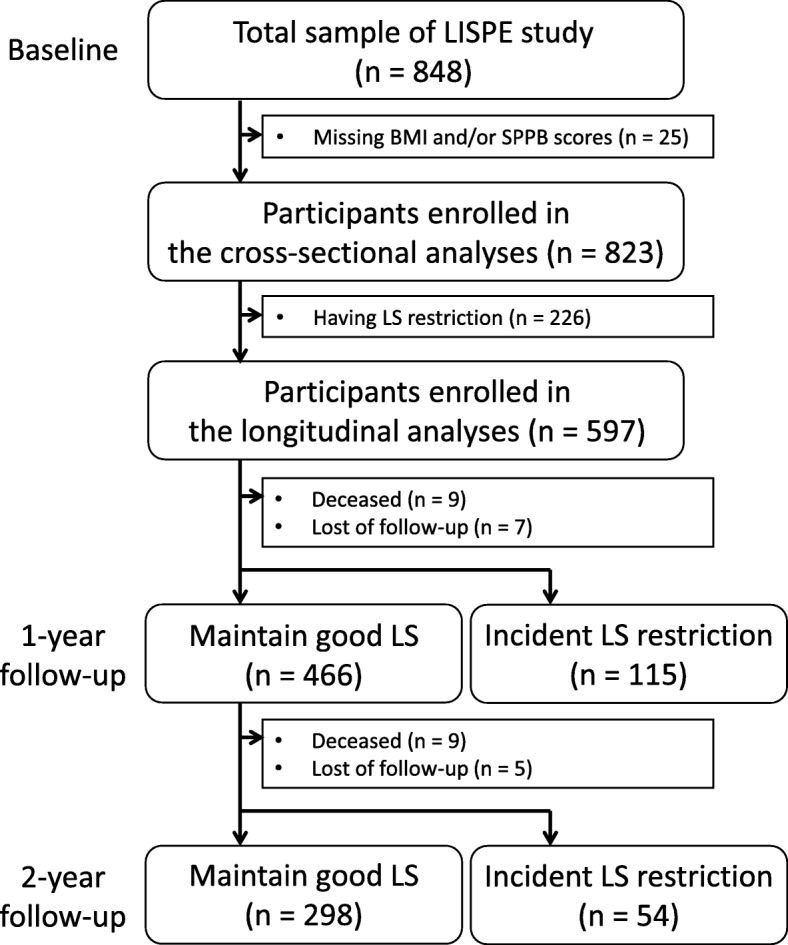
Community-dwelling people aged 75-90 years (n = 823) participated in the Life-Space Mobility in Old Age (LISPE) two-year follow-up study. Participants who reported that the largest life-space area they had attained, without aid from any device or another person, was the neighborhood or less were considered to have life-space restriction. Incident life-space restriction was the endpoint of Cox's proportional hazard model. BMI, lower extremity performance (Short Physical Performance Battery, SPPB), and use of a private car were predictors.
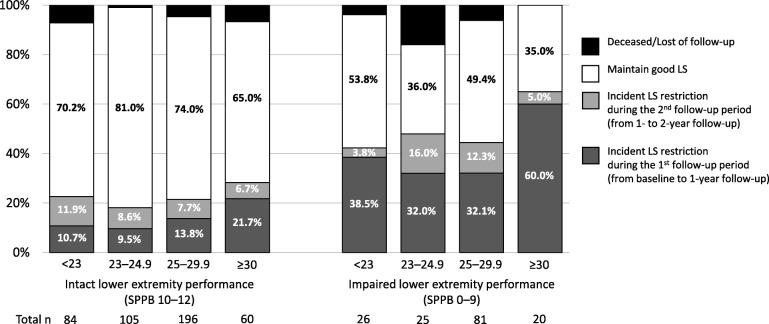
At baseline, people who had both obesity (BMI ≥30.0) and impaired lower extremity performance (SPPB 0-9) had a higher prevalence of life-space restriction (prevalence ratio 3.6, 95% confidence interval, CI, 2.0-6.3) compared to those with normal weight (BMI 23.0-24.9) and intact physical performance (SPPB 10-12). The 581 people without life-space restriction at the baseline contributed 1033 person-years during the two-year follow-up. Incident life-space restrictions were reported by 28.3% participants. A higher hazard ratio (HR) for incident life-space restriction was observed in subjects having both obesity and impaired lower extremity performance (HR 3.6, 95% CI, 1.7-7.4), impaired lower extremity performance only (HR 1.9, 95% CI 0.9-4.1), and obesity only (HR 1.8, 95% CI, 0.9-3.5) compared to those with normal weight and intact performance. Private car passengers (HR 2.0, 95% CI, 1.3-3.0) compared to car drivers had a higher risk of life-space restriction. All models were adjusted for age, sex, chronic diseases, and education.
Older people with impaired lower extremity performance have an increased risk of incident life-space restriction especially if combined with obesity. Also, not driving a car renders older people vulnerable to life-space restriction.
本研究旨在探讨身体质量指数(BMI)和下肢功能等可改变的身体因素,以及使用私家车等环境因素对社区居住的老年人普遍存在和新发生活空间受限的单一和联合贡献。
823 名 75-90 岁的社区居住者参加了老年生活空间流动性(LISPE)为期两年的随访研究。报告称,他们在没有任何设备或他人帮助的情况下能够到达的最大生活空间区域为社区或更小的参与者被认为存在生活空间受限。新发生活空间受限是 Cox 比例风险模型的终点。BMI、下肢功能(简短体能表现电池,SPPB)和使用私家车是预测因素。
在基线时,肥胖(BMI≥30.0)和下肢功能受损(SPPB 0-9)的人生活空间受限的患病率更高(患病率比 3.6,95%置信区间,CI,2.0-6.3)与体重正常(BMI 23.0-24.9)和完整的身体表现(SPPB 10-12)相比。基线时无生活空间受限的 581 人在两年的随访期间共提供了 1033 人年。28.3%的参与者报告了新发生活空间受限。在肥胖和下肢功能受损(HR 3.6,95%CI,1.7-7.4)、仅下肢功能受损(HR 1.9,95%CI,0.9-4.1)和肥胖仅(HR 1.8,95%CI,0.9-3.5)的参与者中,新发生活空间受限的风险比(HR)高于体重正常且功能完整的参与者。与驾车者相比,私家车乘客(HR 2.0,95%CI,1.3-3.0)发生生活空间受限的风险更高。所有模型均根据年龄、性别、慢性疾病和教育程度进行了调整。
下肢功能受损的老年人发生新发生活空间受限的风险增加,尤其是如果与肥胖相结合。此外,不驾车会使老年人容易发生生活空间受限。