Department of Orthopedic Surgery, Regensburg University Hospital, Asklepios Klinikum Bad Abbach, Kaiser-Karl V.-Allee 3, 93077, Bad Abbach, Germany.
Heidelberg University Orthopedic Hospital, Heidelberg, Germany.
Int Orthop. 2021 Nov;45(11):2765-2772. doi: 10.1007/s00264-021-05038-w. Epub 2021 Apr 15.
The Hospital Frailty Risk Score (HFRS) is a validated risk stratification model referring to the cumulative deficits model of frailty. The purpose of this study was to evaluate the HFRS as a predictor of 90-day readmission and complications after revision total hip (rTHA) and knee (rTKA) arthroplasty.
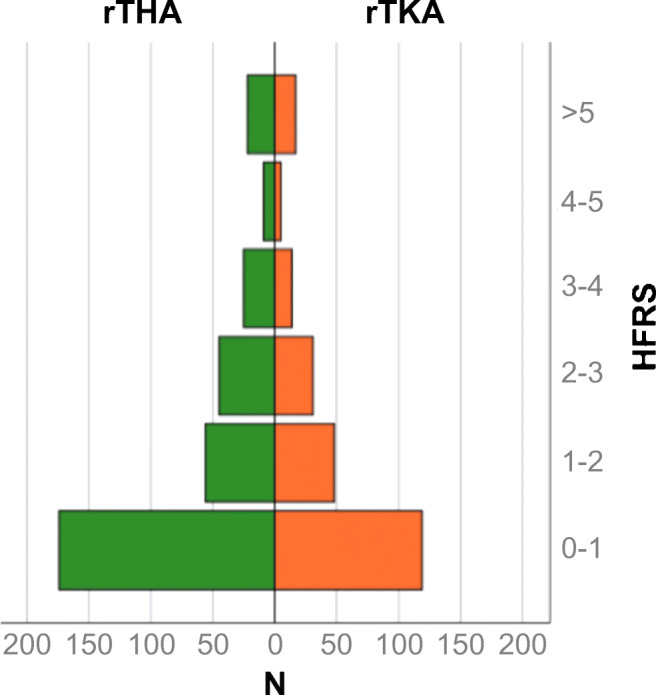
In a retrospective analysis of 565 patients who had undergone rTHA or rTKA between 2011 and 2019, the HFRS was calculated for each patient. Rates of adverse events were compared between patients with low and intermediate or high frailty risk. Multivariable logistic regression models were used to assess the relationship between the HFRS and post-operative adverse events.
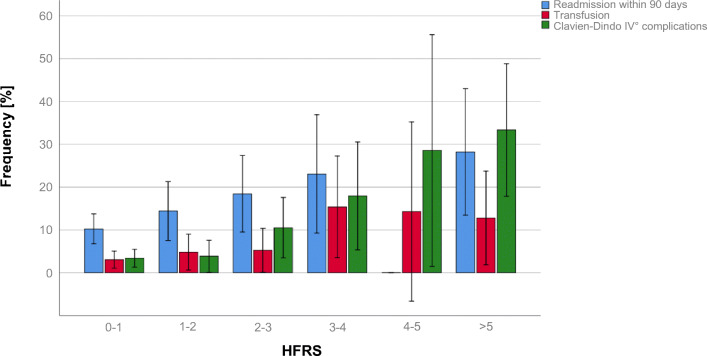
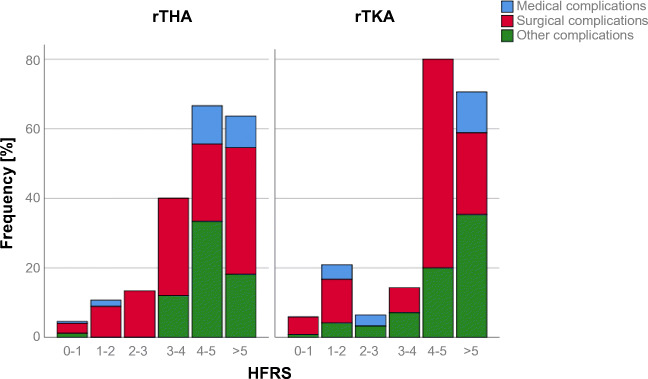
Patients with intermediate or high frailty risk showed higher rates of readmission (30days: 23.8% vs. 9.9%, p = 0.006; 90days: 26.2% vs. 13.0%, p < 0.018), surgical complications (28.6% vs. 7.8%, p < 0.001), medical complications (11.9% vs. 1.0%, p < 0.001), other complications (28.6% vs. 2.3%, p < 0.001), Clavien-Dindo grade IV complications (14.3% vs. 4.8%, p = 0.009), and transfusion (33.3% vs. 6.1%, p < 0.001). Multivariable logistic regression analyses revealed a high HFRS as independent risk factor for surgical complications (OR = 3.45, 95% CI 1.45-8.18, p = 0.005), medical complications (OR = 7.29, 95% CI 1.72-30.97, p = 0.007), and other complications (OR = 14.15, 95% CI 5.16-38.77, p < 0.001).
The HFRS predicts adverse events after rTHA and rTKA. As it derives from routinely collected data, the HFRS could be implemented automated in hospital information systems to facilitate identification of at-risk patients.
医院衰弱风险评分(HFRS)是一种经过验证的风险分层模型,指的是衰弱的累积缺陷模型。本研究的目的是评估 HFRS 作为预测 90 天内翻修全髋关节(rTHA)和全膝关节(rTKA)置换术后再入院和并发症的指标。
在对 2011 年至 2019 年间接受 rTHA 或 rTKA 的 565 名患者进行回顾性分析中,为每位患者计算了 HFRS。比较低、中或高脆弱性风险患者的不良事件发生率。使用多变量逻辑回归模型评估 HFRS 与术后不良事件之间的关系。
中或高脆弱性风险患者的再入院率较高(30 天:23.8%比 9.9%,p=0.006;90 天:26.2%比 13.0%,p<0.018),手术并发症(28.6%比 7.8%,p<0.001),医疗并发症(11.9%比 1.0%,p<0.001),其他并发症(28.6%比 2.3%,p<0.001),Clavien-Dindo 分级 IV 并发症(14.3%比 4.8%,p=0.009)和输血(33.3%比 6.1%,p<0.001)。多变量逻辑回归分析显示,HFRS 较高是手术并发症(OR=3.45,95%CI 1.45-8.18,p=0.005)、医疗并发症(OR=7.29,95%CI 1.72-30.97,p=0.007)和其他并发症(OR=14.15,95%CI 5.16-38.77,p<0.001)的独立危险因素。
HFRS 可预测 rTHA 和 rTKA 后的不良事件。由于它源于常规收集的数据,HFRS 可以在医院信息系统中自动实施,以方便识别高危患者。