School of Nursing, Jilin University, Jilin, China.
Breast Surgery, Jilin Province Tumor Hospital, Jilin, China.
PLoS One. 2021 Apr 16;16(4):e0250370. doi: 10.1371/journal.pone.0250370. eCollection 2021.
Accurately predicting the survival rate of breast cancer patients is a major issue for cancer researchers. Machine learning (ML) has attracted much attention with the hope that it could provide accurate results, but its modeling methods and prediction performance remain controversial. The aim of this systematic review is to identify and critically appraise current studies regarding the application of ML in predicting the 5-year survival rate of breast cancer.
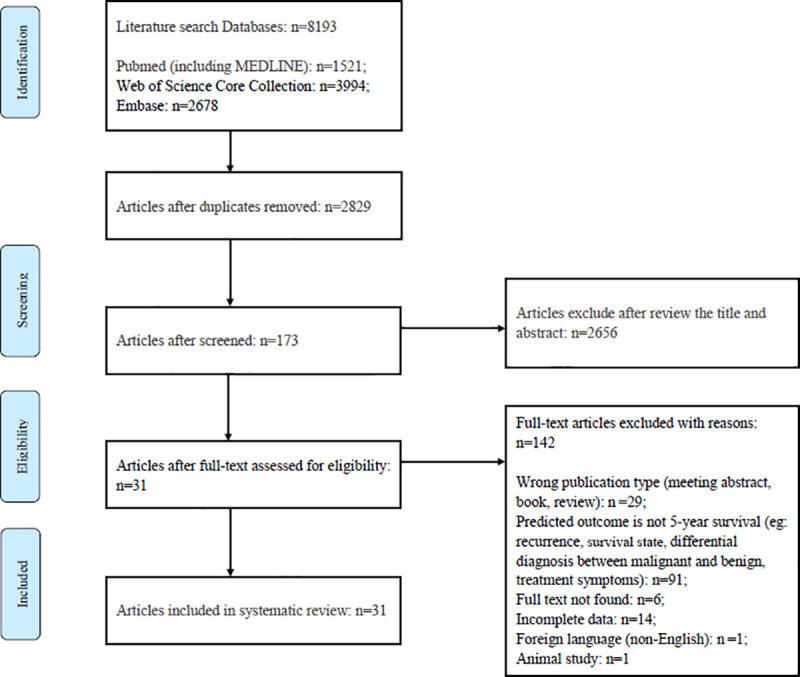
In accordance with the PRISMA guidelines, two researchers independently searched the PubMed (including MEDLINE), Embase, and Web of Science Core databases from inception to November 30, 2020. The search terms included breast neoplasms, survival, machine learning, and specific algorithm names. The included studies related to the use of ML to build a breast cancer survival prediction model and model performance that can be measured with the value of said verification results. The excluded studies in which the modeling process were not explained clearly and had incomplete information. The extracted information included literature information, database information, data preparation and modeling process information, model construction and performance evaluation information, and candidate predictor information.
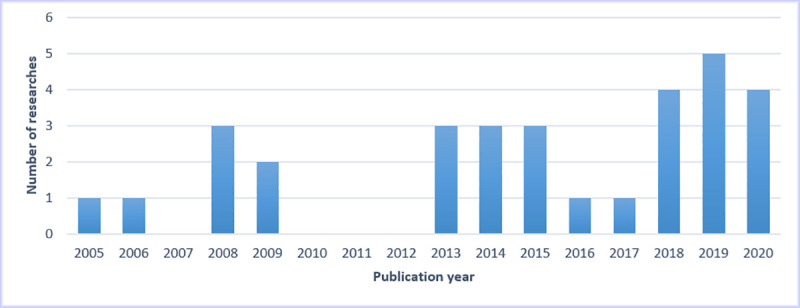
Thirty-one studies that met the inclusion criteria were included, most of which were published after 2013. The most frequently used ML methods were decision trees (19 studies, 61.3%), artificial neural networks (18 studies, 58.1%), support vector machines (16 studies, 51.6%), and ensemble learning (10 studies, 32.3%). The median sample size was 37256 (range 200 to 659820) patients, and the median predictor was 16 (range 3 to 625). The accuracy of 29 studies ranged from 0.510 to 0.971. The sensitivity of 25 studies ranged from 0.037 to 1. The specificity of 24 studies ranged from 0.008 to 0.993. The AUC of 20 studies ranged from 0.500 to 0.972. The precision of 6 studies ranged from 0.549 to 1. All of the models were internally validated, and only one was externally validated.
Overall, compared with traditional statistical methods, the performance of ML models does not necessarily show any improvement, and this area of research still faces limitations related to a lack of data preprocessing steps, the excessive differences of sample feature selection, and issues related to validation. Further optimization of the performance of the proposed model is also needed in the future, which requires more standardization and subsequent validation.
准确预测乳腺癌患者的生存率是癌症研究人员面临的主要问题。机器学习(ML)受到了广泛关注,希望它能够提供准确的结果,但它的建模方法和预测性能仍存在争议。本系统评价的目的是确定并批判性地评价当前关于 ML 在预测乳腺癌 5 年生存率方面应用的研究。
根据 PRISMA 指南,两名研究人员独立检索了从成立到 2020 年 11 月 30 日的 PubMed(包括 MEDLINE)、Embase 和 Web of Science Core 数据库。检索词包括乳腺肿瘤、生存、机器学习和特定算法名称。纳入的研究涉及使用 ML 构建乳腺癌生存预测模型以及可以通过验证结果值来衡量的模型性能。排除建模过程未被清楚解释且信息不完整的研究。提取的信息包括文献信息、数据库信息、数据准备和建模过程信息、模型构建和性能评估信息以及候选预测因子信息。
符合纳入标准的 31 项研究被纳入,其中大多数发表于 2013 年以后。最常使用的 ML 方法是决策树(19 项研究,61.3%)、人工神经网络(18 项研究,58.1%)、支持向量机(16 项研究,51.6%)和集成学习(10 项研究,32.3%)。中位样本量为 37256(范围 200-659820)例患者,中位预测因子为 16(范围 3-625)。29 项研究的准确性范围为 0.510-0.971。25 项研究的敏感性范围为 0.037-1。24 项研究的特异性范围为 0.008-0.993。20 项研究的 AUC 范围为 0.500-0.972。6 项研究的精确度范围为 0.549-1。所有模型均进行了内部验证,仅有一项进行了外部验证。
总体而言,与传统统计方法相比,ML 模型的性能不一定有所提高,该领域的研究仍然存在与数据预处理步骤缺乏、样本特征选择差异过大以及验证相关问题等局限性。未来还需要进一步优化所提出模型的性能,这需要更加标准化和后续验证。