Department of Personality, Assessment and Psychological Treatment, Faculty of Psychology, Universitat de València, Valencia, Spain.
Department of Psychology, Faculty of Health Sciences, Universidad Europea de Valencia, Valencia, Spain.
PLoS One. 2021 Apr 16;16(4):e0250384. doi: 10.1371/journal.pone.0250384. eCollection 2021.
Technologies provide a brilliant opportunity to promote social-emotional competences, well-being and adjustment in adolescence. Game-based programmes and serious games are digital tools that pursue an educational goal in an attractive environment for adolescents. The purpose of this study was therefore to determine the effectiveness of emoTIC, a game-based social-emotional programme designed according to Mayer, Caruso, and Salovey's model of emotional intelligence.
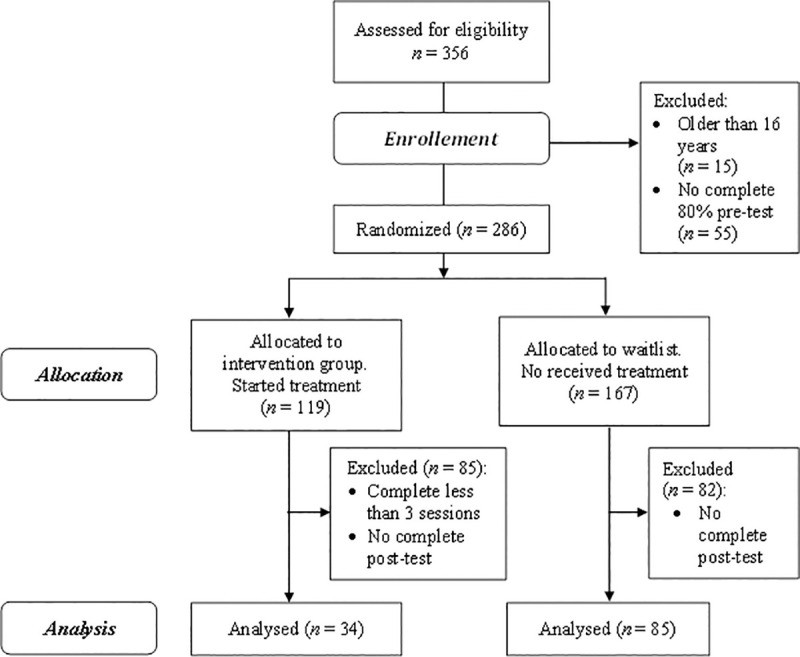
The participants were 119 adolescents between 11 and 15 years, randomly assigned to the experimental group and the control group. The adolescents completed questionnaires to assess their emotional intelligence, self-esteem, affect balance, difficulties, prosocial behaviour, depression, anxiety and stress.
The MANCOVA results showed that adolescents who completed the game-based programme had improved self-esteem, affect balance, emotional symptoms, behavioural problems, and hyperactivity (Wilks' λ = .77; F = 2.10; p = .035). Hierarchical multiple regression indicated that adolescents in the experimental group had a greater change in self-esteem and affect balance (positive β), while their emotional problems and hyperactivity decreased (negative β). Anxiety moderated the influence of the intervention on self-esteem (b = .04; t = -2.55; p ≤ .05; LLCI = -0.43, ULCI = -0.05). Adolescents with low or medium anxiety improved their self-esteem with the intervention, while those with high anxiety did not develop it.
The use of technology in social-emotional programmes could be the first step in increasing adolescents' interest in emotions and emoTIC could be considered a useful programme which influences their personal, emotional and social factors.
Clinical Trial identifier: NCT04414449.
技术为促进青少年的社会情感能力、幸福感和适应能力提供了绝佳机会。基于游戏的计划和严肃游戏是数字工具,它们在对青少年具有吸引力的环境中追求教育目标。因此,本研究的目的是确定 emoTIC 的有效性,emoTIC 是一种基于游戏的社会情感计划,根据 Mayer、Caruso 和 Salovey 的情商模型设计。
参与者是 119 名 11 至 15 岁的青少年,随机分配到实验组和对照组。青少年完成了评估他们的情商、自尊、情感平衡、困难、亲社会行为、抑郁、焦虑和压力的问卷。
MANCOVA 结果表明,完成基于游戏的计划的青少年的自尊、情感平衡、情绪症状、行为问题和多动性有所提高(Wilks' λ =.77;F = 2.10;p =.035)。分层多元回归表明,实验组的青少年在自尊和情感平衡方面有更大的变化(积极 β),而他们的情绪问题和多动性则有所下降(消极 β)。焦虑调节了干预对自尊的影响(b =.04;t = -2.55;p ≤.05;LLCI = -0.43,ULCI = -0.05)。焦虑程度低或中等的青少年通过干预提高了自尊,而焦虑程度高的青少年则没有提高。
在社会情感计划中使用技术可能是增加青少年对情绪兴趣的第一步,而 emoTIC 可以被认为是一个有用的计划,它影响他们的个人、情感和社会因素。
临床试验标识符:NCT04414449。