Department of Neurology, Brigham and Women's Hospital, Boston, MA, USA; Department of Neurology, Massachusetts General Hospital, Boston, MA, USA; Harvard Medical School, Boston, MA, USA.
Department of Neurology, Brigham and Women's Hospital, Boston, MA, USA; Harvard Medical School, Boston, MA, USA.
J Psychiatr Res. 2021 Jun;138:176-185. doi: 10.1016/j.jpsychires.2021.03.050. Epub 2021 Apr 2.
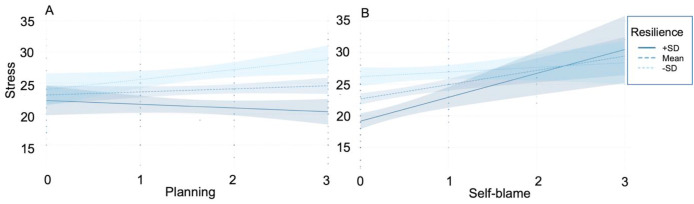
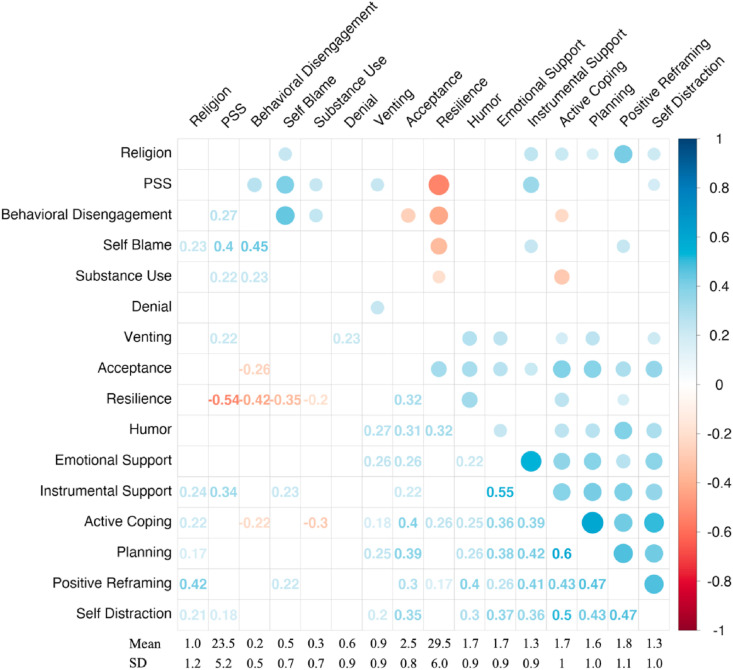
Assessing the impact of the COVID-19 pandemic on perceived stress in older adults is critical to understanding how to best support elderly individuals navigating stressful situations, with the aim to lessen the impact of stressors on their brain health. Here, we collected measures on perceived stress, resilience, and behavioral coping strategies, in the context of the COVID-19 pandemic, in a cross-sectional sample of 141 community dwelling older adults (mean age = 74.4 ± 8.4, 59% females) who were part of two longitudinal observational studies in Massachusetts, U.S. Our results indicate that participants demonstrated moderate levels of stress related to COVID-19 and showed relatively high levels of resilience. Higher resilience was associated with greater use of adaptive coping behaviors and less use of maladaptive coping behaviors. The use of maladaptive coping strategies was associated with more stress. Moreover, hierarchical regression analyses revealed that resilience was the strongest unique predictor of stress, thus, largely accounting for the observed coping-outcome associations. Individual differences in resilience levels moderated the effects of two coping strategies (planning and self-blame) on stress. Specifically, planning was associated with increased levels of stress for people with low resilience. In contrast, high personal resilience attenuated the negative effect of self-blame on their stress levels. Taken together, our findings suggest that resilience is critical for coping with stress during the COVID-19 pandemic. Future approaches for augmenting resilience could prove to be important potential interventions to help support older adults navigating stressful situations as well as lessen adverse effects on neurocognitive and mental health in the future.
评估 COVID-19 大流行对老年人感知压力的影响对于了解如何最好地支持老年人应对压力情况至关重要,目的是减轻压力源对他们大脑健康的影响。在这里,我们在 COVID-19 大流行的背景下,从马萨诸塞州的两项纵向观察研究中收集了 141 名居住在社区的老年人(平均年龄 74.4 ± 8.4 岁,59%为女性)的感知压力、韧性和行为应对策略方面的测量结果。我们的结果表明,参与者表现出与 COVID-19 相关的中度压力水平,并且表现出相对较高的韧性水平。较高的韧性与更多使用适应性应对行为和更少使用不良应对行为相关。不良应对策略的使用与更多的压力相关。此外,分层回归分析表明,韧性是压力的最强独特预测因子,因此,在很大程度上解释了观察到的应对结果关联。韧性水平的个体差异调节了两种应对策略(计划和自责)对压力的影响。具体而言,对于韧性水平较低的人来说,计划与压力水平的升高相关。相比之下,个人韧性高会减弱自责对其压力水平的负面影响。总之,我们的研究结果表明,韧性对于应对 COVID-19 大流行期间的压力至关重要。未来增强韧性的方法可能被证明是支持老年人应对压力情况的重要潜在干预措施,并且有助于减轻未来对神经认知和心理健康的不利影响。