Department of Psychiatry and Biobehavioral Sciences, University of California, Los Angeles, CA, USA.
Department of Psychology, Loma Linda University, Loma Linda, CA, USA.
J Neurodev Disord. 2021 Apr 17;13(1):15. doi: 10.1186/s11689-021-09363-4.
22q11.2 deletion syndrome (22q11DS) is a common recurrent neurogenetic condition associated with elevated risk for developmental neuropsychiatric disorders and intellectual disability. Children and adults with 22q11DS often exhibit marked social impairment as well as neurocognitive deficits, and have elevated rates of both autism spectrum disorder (ASD) and psychosis. However, the relationship between the basic processes of social cognition and cognitive ability has not been well studied in 22q11DS. Here, we examined differences in social cognition in 22q11DS, relative to multiple groups of idiopathic neuropsychiatric disorders, and typically developing healthy controls (HC). Additionally, we examined differences in intellectual functioning and its relationship to social cognitive abilities. Finally, we examined the relationship between social cognitive abilities and real-world social behavior.
We examined social cognition and intellectual functioning in 273 participants (mean age = 17.74 ± 5.18% female = 44.3%): 50 with 22q11DS, 49 youth with first episode psychosis (FEP), 48 at clinical high-risk (CHR) for psychosis, 24 participants with ASD, and 102 HC. Social cognition was assessed using The Awareness of Social Inference Test (TASIT), while reciprocal social behavior was assessed via parent/caregiver ratings on the Social Responsiveness Scale (SRS). Participants were also administered the Wechsler Abbreviated Scale of Intelligence, 2nd edition (WASI-II) to assess intellectual functioning.
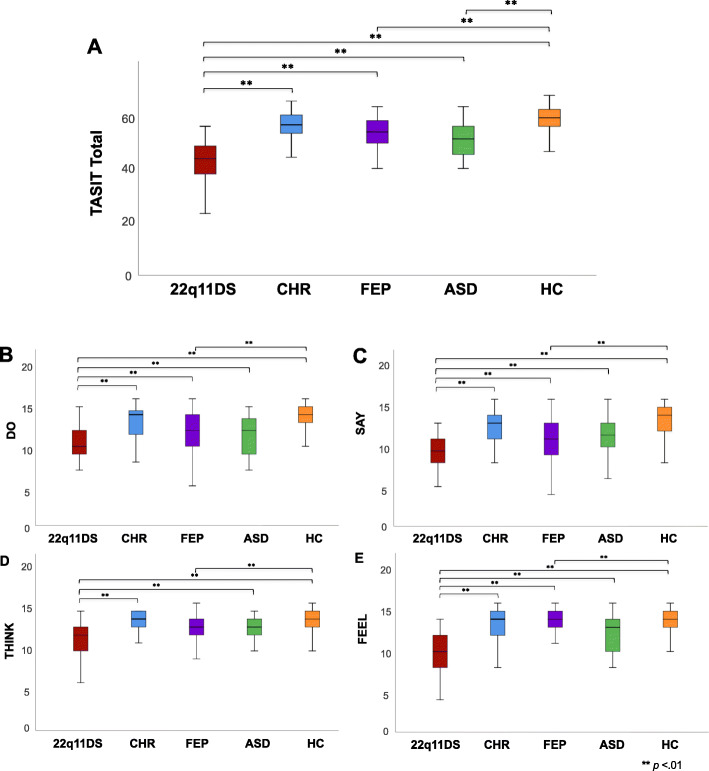
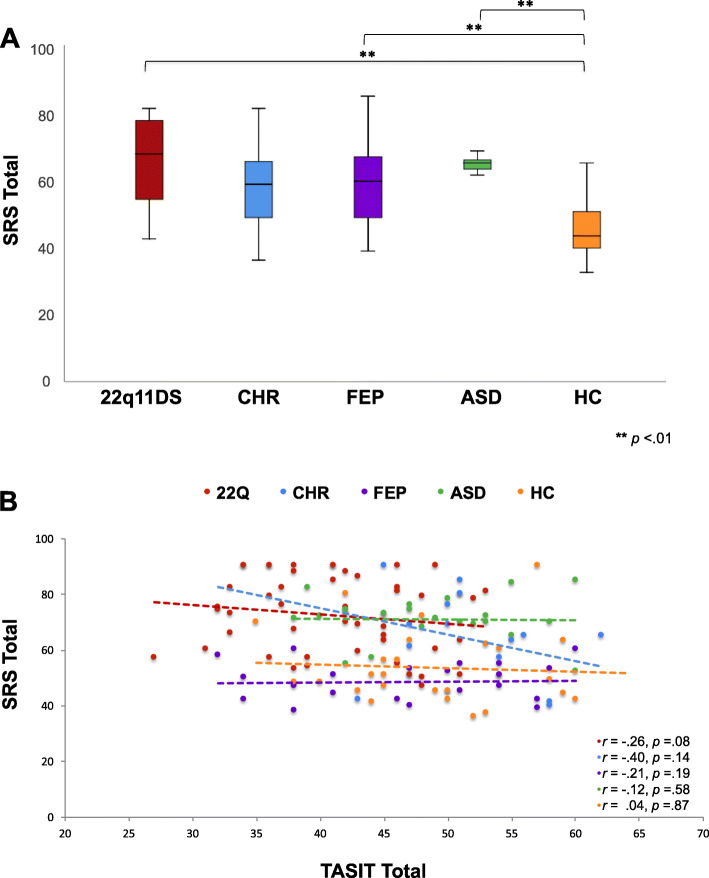
The 22q11DS group exhibited significantly lower social cognitive abilities compared to CHR, FEP, and HC groups after controlling for intellectual functioning, but not in comparison to the ASD group. Significant positive correlations were found between social cognition, as measured by the TASIT and IQ across groups. In contrast, no significant relationships were found between TASIT and real-world social behavior (SRS) for any group.
Our findings indicate social cognitive deficits are more prominent in 22q11DS than idiopathic neuropsychiatric conditions across the age range, even after adjusting for global intellectual function. These results contribute to our understanding of the intellectual and social vulnerabilities of 22q11DS in comparison to idiopathic neuropsychiatric disorders. Our findings of robust associations between intellectual ability and social cognition emphasizes the importance of accounting for neurocognitive deficits in social skills interventions and tailoring these existing treatment models for 22q11DS and other populations with intellectual impairment.
22q11.2 缺失综合征(22q11DS)是一种常见的复发性神经遗传疾病,与发育性神经精神障碍和智力障碍的风险升高有关。患有 22q11DS 的儿童和成人通常表现出明显的社交障碍以及认知缺陷,自闭症谱系障碍(ASD)和精神病的发病率也较高。然而,在 22q11DS 中,社会认知的基本过程与认知能力之间的关系尚未得到很好的研究。在这里,我们研究了 22q11DS 与多种特发性神经精神疾病组和典型健康对照组(HC)之间的社会认知差异。此外,我们还研究了智力功能的差异及其与社会认知能力的关系。最后,我们研究了社会认知能力与现实世界社会行为之间的关系。
我们检查了 273 名参与者(平均年龄=17.74±5.18%女性=44.3%)的社会认知和智力功能:50 名患有 22q11DS,49 名患有首发精神病(FEP)的青年,48 名处于精神病高危(CHR)状态,24 名患有 ASD,102 名 HC。社会认知使用社会推理测试(TASIT)进行评估,而互惠社会行为则通过父母/照顾者对社会反应量表(SRS)的评分进行评估。参与者还接受了韦氏简明智力量表,第二版(WASI-II)评估智力功能。
在控制智力功能后,22q11DS 组的社会认知能力明显低于 CHR、FEP 和 HC 组,但与 ASD 组没有差异。在所有组中,TASIT 和 IQ 之间均存在显著的正相关关系。相比之下,任何一组的 TASIT 与现实世界的社会行为(SRS)之间均没有显著关系。
我们的研究结果表明,与特发性神经精神疾病相比,22q11DS 患者的社会认知缺陷在整个年龄段更为明显,即使在调整了总体智力功能后也是如此。这些结果有助于我们了解 22q11DS 与特发性神经精神疾病相比在智力和社会方面的脆弱性。我们发现智力能力与社会认知之间存在很强的关联,这强调了在社会技能干预中考虑神经认知缺陷的重要性,并为 22q11DS 和其他智力障碍人群量身定制这些现有治疗模式。