Department of Oncology, NHC Key Laboratory of Cancer Proteomics, Laboratory of Structural Biology, Xiangya Hospital, Central South University, Changsha, Hunan, China.
Molecular and Computational Biology Program, Department of Biological Sciences and Department of Chemistry, University of Southern California, Los Angeles, CA, USA.
Nat Commun. 2021 Apr 16;12(1):2280. doi: 10.1038/s41467-021-22655-6.
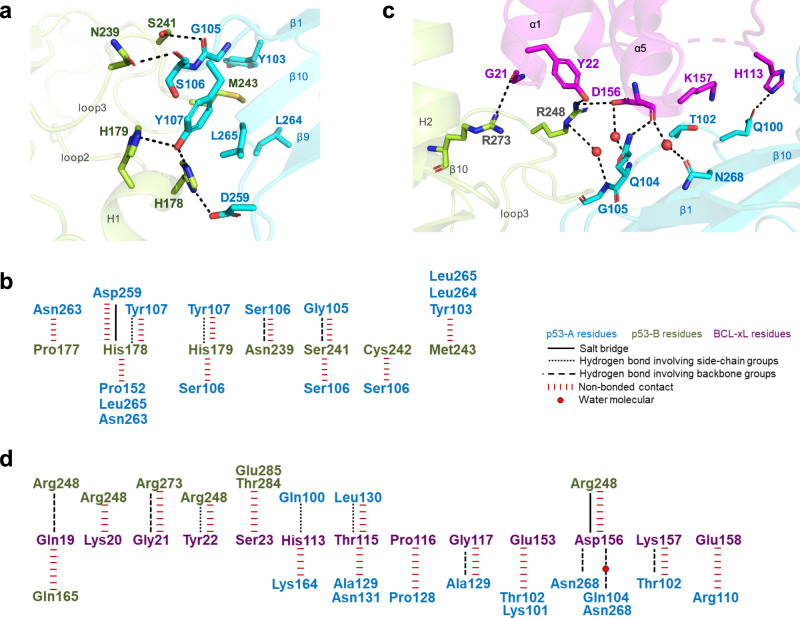
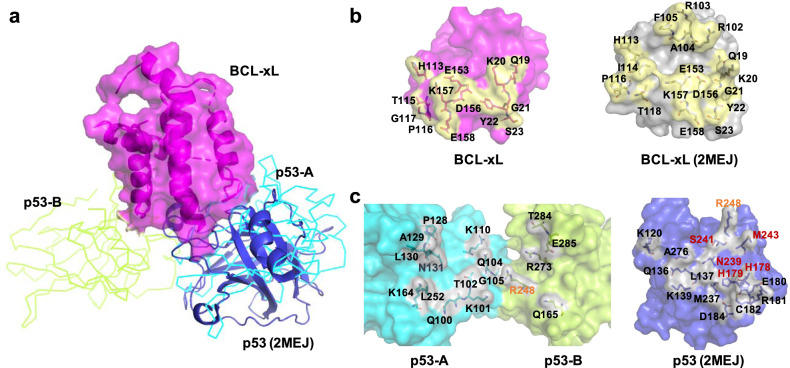
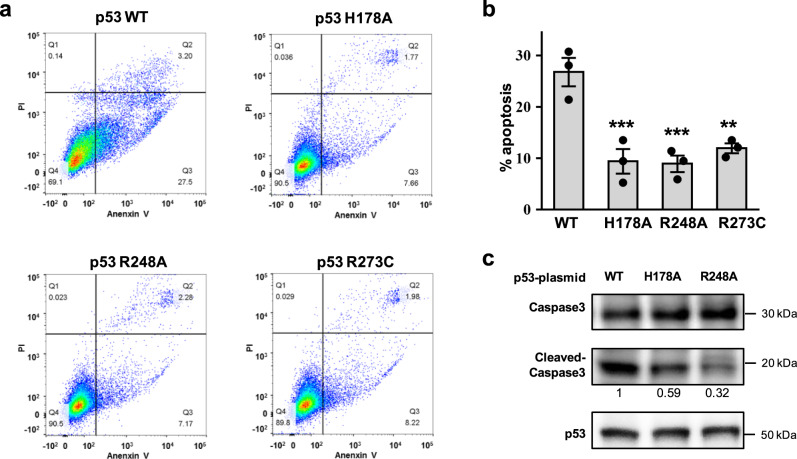
The tumor suppressor p53 is mutated in approximately half of all human cancers. p53 can induce apoptosis through mitochondrial membrane permeabilization by interacting with and antagonizing the anti-apoptotic proteins BCL-xL and BCL-2. However, the mechanisms by which p53 induces mitochondrial apoptosis remain elusive. Here, we report a 2.5 Å crystal structure of human p53/BCL-xL complex. In this structure, two p53 molecules interact as a homodimer, and bind one BCL-xL molecule to form a ternary complex with a 2:1 stoichiometry. Mutations at the p53 dimer interface or p53/BCL-xL interface disrupt p53/BCL-xL interaction and p53-mediated apoptosis. Overall, our current findings of the bona fide structure of p53/BCL-xL complex reveal the molecular basis of the interaction between p53 and BCL-xL, and provide insight into p53-mediated mitochondrial apoptosis.
抑癌基因 p53 在大约一半的人类癌症中发生突变。p53 可以通过与抗凋亡蛋白 BCL-xL 和 BCL-2 相互作用并拮抗它们来诱导线粒体膜通透性导致细胞凋亡。然而,p53 诱导线粒体凋亡的机制仍不清楚。在这里,我们报告了人源 p53/BCL-xL 复合物的 2.5 Å 晶体结构。在这个结构中,两个 p53 分子相互作用形成同源二聚体,并结合一个 BCL-xL 分子形成具有 2:1 计量比的三元复合物。p53 二聚体界面或 p53/BCL-xL 界面的突变会破坏 p53/BCL-xL 相互作用和 p53 介导的细胞凋亡。总的来说,我们目前发现的 p53/BCL-xL 复合物的真实结构揭示了 p53 和 BCL-xL 之间相互作用的分子基础,并为 p53 介导的线粒体凋亡提供了新的见解。