Freshwater Biological Laboratory, Department of Biology, University of Copenhagen, Universitetsparken 4, 3rd floor, 2100, Copenhagen, Denmark.
Department of Agricultural, Food, Environmental and Animal Sciences, University of Udine, via delle Scienze 91, 33100, Udine, Italy.
Sci Rep. 2021 Apr 16;11(1):8385. doi: 10.1038/s41598-021-87806-7.
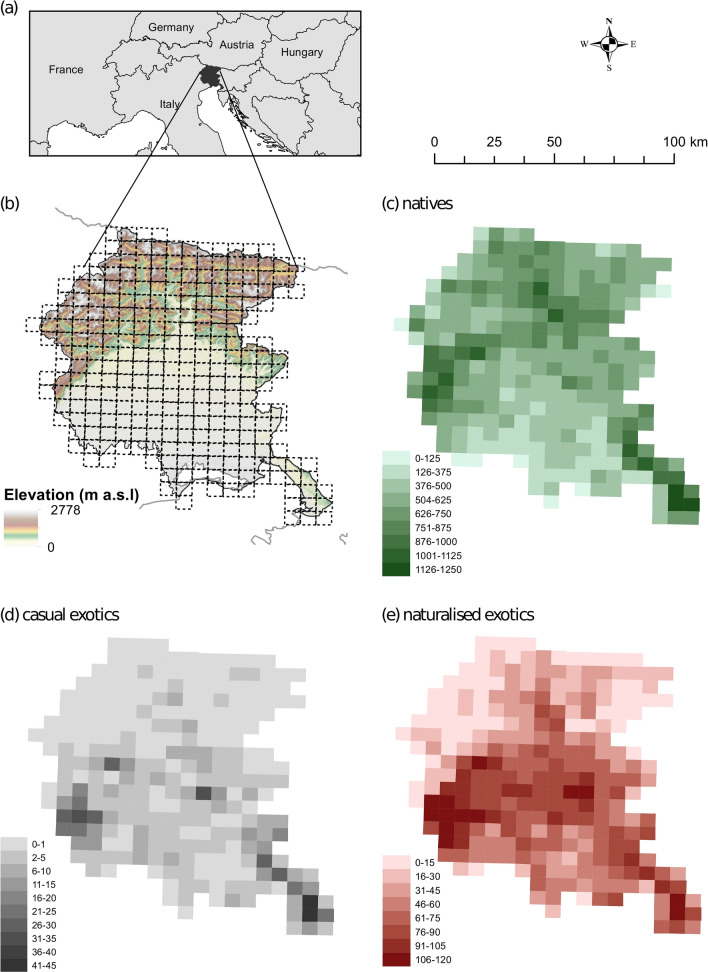
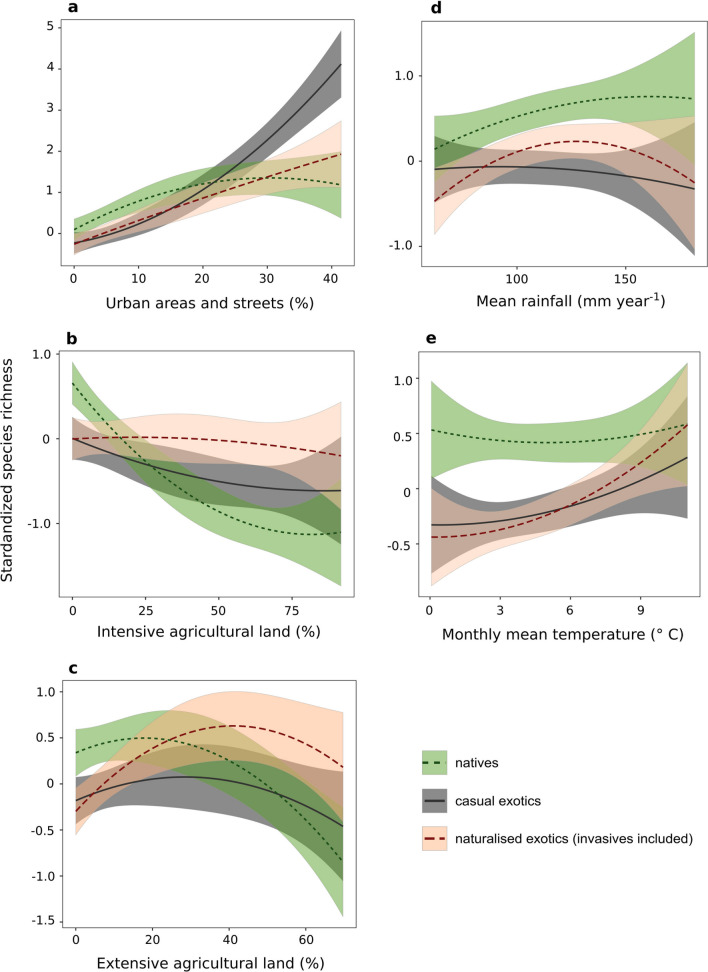
Unveiling the processes driving exotic plant invasion represent a central issue in taking decisions aimed at constraining the loss of biodiversity and related ecosystem services. The invasion success is often linked to anthropogenic land uses and warming due to climate change. We studied the responses of native versus casual and naturalised exotic species richness to land uses and climate at the landscape level, relying on a large floristic survey undertaken in North - Eastern Italy. Both climate and land use drove exotic species richness. Our results suggest that the success of plant invasion at this scale is mainly due to warm climatic conditions and the extent of urban and agricultural land, but with different effects on casual and naturalized exotic species. The occurrence of non-linear trends showed that a small percentage of extensive agricultural land in the landscape may concurrently reduce the number of exotic plant while sustaining native plant diversity. Plant invasion could be potentially limited by land management, mainly focusing on areas with extensive agricultural land use. A more consciousness land management is more and more commonly required by local administrations. According to our results, a shift of intensive to extensive agricultural land, by implementing green infrastructures, seems to be a win-win solution favouring native species while controlling the oversimplification of the flora due to plant invasion.
揭示推动外来植物入侵的过程是做出旨在限制生物多样性和相关生态系统服务丧失的决策的核心问题。入侵的成功通常与人为土地利用和气候变化导致的变暖有关。我们研究了本地种与偶然种和归化外来种丰富度对景观水平上土地利用和气候的响应,这依赖于在意大利东北部进行的一项大型植物学调查。气候和土地利用都驱动了外来物种的丰富度。我们的结果表明,在这个尺度上植物入侵的成功主要归因于温暖的气候条件和城市及农业土地的范围,但对偶然种和归化外来种有不同的影响。非线性趋势的出现表明,景观中少量的大面积农业用地可能同时减少外来植物的数量,同时维持本地植物的多样性。通过土地管理,主要集中在广泛的农业土地利用区域,植物入侵可能会受到限制。地方当局越来越需要更有意识的土地管理。根据我们的结果,通过实施绿色基础设施,将集约农业用地转变为广域农业用地,似乎是一种双赢的解决方案,既有利于本地物种,又能控制因植物入侵而导致的植物群的过度简化。