Department of Child and Adolescent Psychiatry, Psychosomatics and Psychotherapy, University Hospital, LMU Munich, Munich, Germany.
Department of Clinical Psychology and Psychotherapy, LMU Munich, Munich, Germany.
Res Child Adolesc Psychopathol. 2021 Oct;49(10):1345-1358. doi: 10.1007/s10802-021-00814-z. Epub 2021 Apr 16.
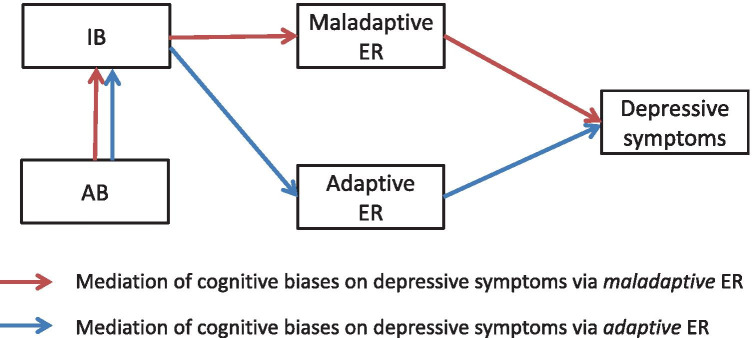
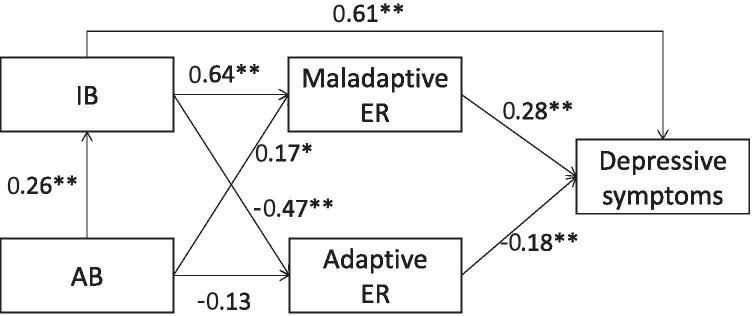
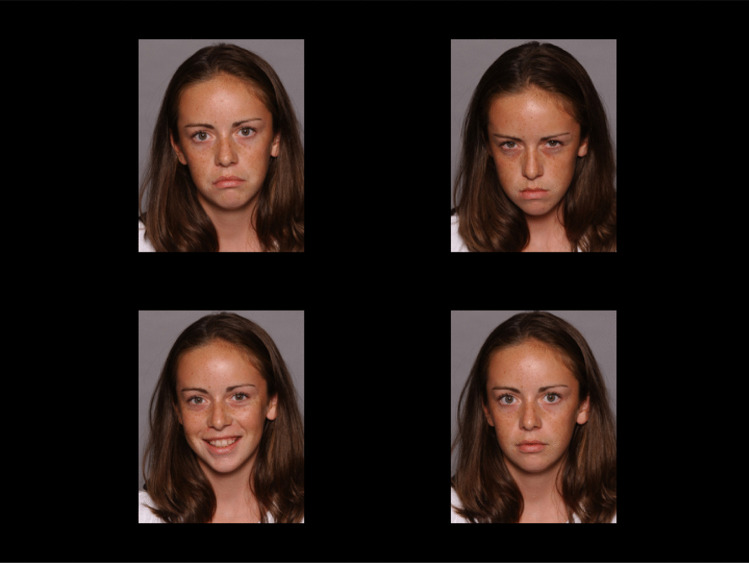
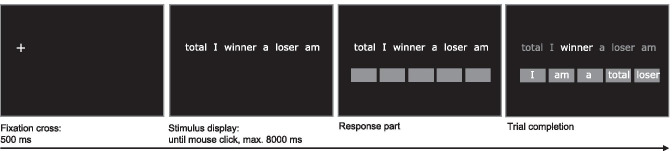
Contemporary cognitive models of depression propose that cognitive biases for negative information at the level of attention (attention biases; AB) and interpretation (interpretation biases; IB) increase depression risk by promoting maladaptive emotion regulation (ER). So far, empirical support testing interactions between these variables is restricted to non-clinical and clinical adult samples. The aim of the current study was to extend these findings to a sample of children and adolescents. This cross-sectional study included 109 children aged 9-14 years who completed behavioural measures of AB (passive-viewing task) and IB (scrambled sentences task) as well as self-report measures of ER and depressive symptoms. In order to maximize the variance in these outcomes we included participants with a clinical diagnosis of depression as well as non-depressed youth with an elevated familial risk of depression and non-depressed youth with a low familial risk of depression. Path model analysis indicated that all variables (AB, IB, adaptive and maladaptive ER) had a direct effect on depressive symptoms. IB and AB also had significant indirect effects on depressive symptoms via maladaptive and adaptive ER. These findings provide initial support for the role of ER as a mediator between cognitive biases and depressive symptoms and provide the foundations for future experimental and longitudinal studies. In contrast to studies in adult samples, both adaptive as well as maladaptive ER mediated the effect of cognitive biases on depressive symptoms. This suggests potentially developmental differences in the role of ER across the lifespan.
当代抑郁认知模型提出,在注意力层面上对负面信息的认知偏差(注意偏差;AB)和解释(解释偏差;IB)通过促进适应性情绪调节(ER)来增加抑郁风险。到目前为止,检验这些变量之间相互作用的实证支持仅限于非临床和临床成年样本。本研究的目的是将这些发现扩展到儿童和青少年样本中。这项横断面研究包括 109 名 9-14 岁的儿童,他们完成了 AB(被动观察任务)和 IB(杂乱句子任务)的行为测量,以及 ER 和抑郁症状的自我报告测量。为了最大限度地增加这些结果的差异,我们纳入了有临床诊断的抑郁患者以及抑郁家族风险较高的非抑郁青少年和抑郁家族风险较低的非抑郁青少年。路径模型分析表明,所有变量(AB、IB、适应性和适应性 ER)对抑郁症状都有直接影响。IB 和 AB 还通过适应性和适应性 ER 对抑郁症状有显著的间接影响。这些发现为 ER 在认知偏差和抑郁症状之间的中介作用提供了初步支持,并为未来的实验和纵向研究奠定了基础。与成人样本的研究不同,适应性和适应性 ER 都在认知偏差对抑郁症状的影响中起到了中介作用。这表明 ER 在整个生命周期中的作用可能存在潜在的发展差异。