HRB Centre for Primary Care Research, Department of General Practice, Royal College of Surgeons in Ireland, Dublin, Ireland.
School of Pharmacy and Biomolecular Sciences, Royal College of Surgeons in Ireland, 111 St Stephen's Green, Dublin 2, Ireland.
Arch Osteoporos. 2021 Apr 17;16(1):71. doi: 10.1007/s11657-021-00932-7.
Gaps in pharmacological treatment for osteoporosis can reduce effectiveness. Among older adults, we found about half of new users of oral bisphosphonate and denosumab persisted with their treatment at 2 years, with few switching to alternative therapy. Persistence is suboptimal and warrants evaluation of interventions to improve this.
Gaps in pharmacological treatment for osteoporosis can reduce effectiveness. This study aimed to estimate persistence rates for oral bisphosphonates and denosumab in older primary care patients and identify factors associated with discontinuation.
Older patients newly prescribed oral bisphosphonates or denosumab during 2012-2017 were identified from 44 general practices (GP) in Ireland. Persistence without a coverage gap of >90 days was calculated for both medications from therapy initiation. Factors associated with time to discontinuation were explored using Cox regression analysis. Exposures included age group, osteoporosis diagnosis, fracture history, calcium/vitamin D prescription, number of other medications, health cover, dosing frequency (bisphosphonates) and previous bone-health medication (denosumab).
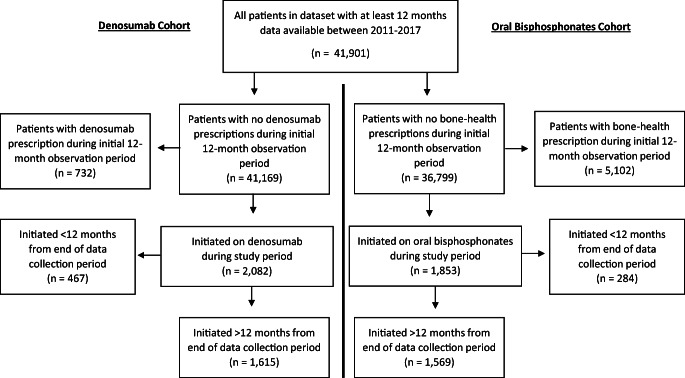
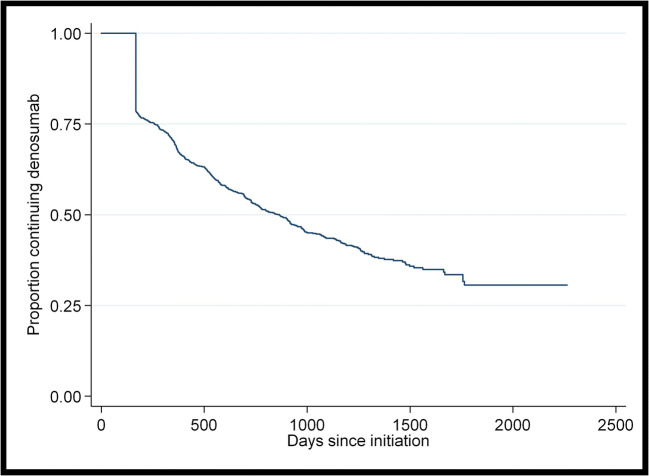
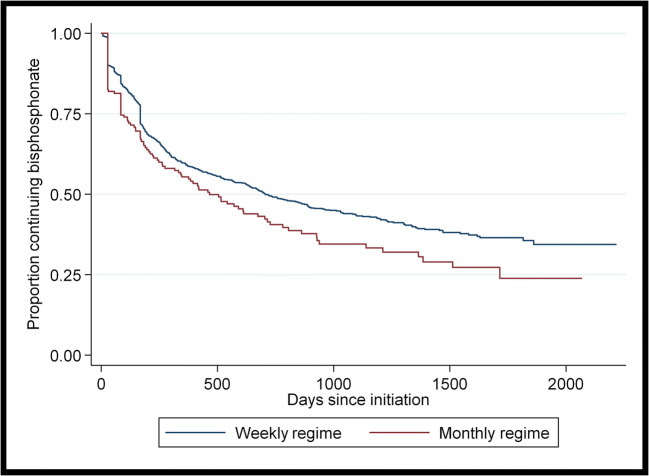
Of 41,901 patients, n=1569 were newly initiated on oral bisphosphonates and n=1615 on denosumab. Two-year persistence was 49.4% for oral bisphosphonates and 53.8% for denosumab and <10% were switched to other medication. Having state-funded health cover was associated with a lower hazard of discontinuation for both oral bisphosphonates (HR=0.49, 95% CI=0.36-0.66, p<0.01) and denosumab (HR=0.71, 95% CI=0.57-0.89, p<0.01). Older age group, number of medications and calcium/vitamin D prescription were also associated with better bisphosphonate persistence, while having osteoporosis diagnosed was associated with better denosumab persistence.
Persistence for osteoporosis medications is suboptimal. Of concern, few patients are switched to other bone-health treatments when denosumab is stopped which could increase fracture risk. Free access to GP services and medications may have resulted in better medication persistence in this cohort. Future research should explore prescribing choices in primary care osteoporosis management and evaluate cost-effectiveness of interventions for improving persistence.
骨质疏松症的药物治疗存在空白可能会降低疗效。在老年人中,我们发现新使用口服双膦酸盐和地舒单抗的患者中,有大约一半在 2 年内坚持治疗,很少有患者转而使用替代疗法。这种持续性并不理想,需要评估改善这种情况的干预措施。
骨质疏松症的药物治疗存在空白可能会降低疗效。本研究旨在评估爱尔兰 44 家全科诊所中,新接受口服双膦酸盐和地舒单抗治疗的老年患者的持续性,并确定与停药相关的因素。
从爱尔兰 44 家全科诊所中确定了 2012 年至 2017 年间新开始口服双膦酸盐或地舒单抗治疗的老年患者。从治疗开始时计算两种药物无 90 天以上覆盖缺口的持续性。使用 Cox 回归分析探讨与停药时间相关的因素。暴露因素包括年龄组、骨质疏松症诊断、骨折史、钙/维生素 D 处方、其他药物数量、健康保险、用药频率(双膦酸盐)和以前的骨健康药物(地舒单抗)。
在 41901 名患者中,有 1569 名新开始口服双膦酸盐治疗,有 1615 名新开始地舒单抗治疗。口服双膦酸盐的两年持续性为 49.4%,地舒单抗的持续性为 53.8%,不到 10%的患者转而使用其他药物。有国家资助的健康保险与口服双膦酸盐(HR=0.49,95%CI=0.36-0.66,p<0.01)和地舒单抗(HR=0.71,95%CI=0.57-0.89,p<0.01)的停药风险降低相关。年龄较大的年龄组、药物数量和钙/维生素 D 处方也与更好的双膦酸盐持续性相关,而诊断为骨质疏松症与更好的地舒单抗持续性相关。
骨质疏松症药物的持续性不理想。值得关注的是,当停用地舒单抗时,很少有患者转而使用其他骨健康治疗药物,这可能会增加骨折风险。在本队列中,免费获得全科医生服务和药物可能导致了更好的药物持续性。未来的研究应探讨初级保健中骨质疏松症管理的处方选择,并评估改善持续性的干预措施的成本效益。