Northwestern University, Department of Medical Social Sciences, 625 N Michigan Ave, Chicago, IL, 60611, United States; Northwestern University, Institute for Sexual and Gender Minority Health and Wellbeing, 625 N Michigan Ave, Chicago, IL, 60611, United States.
Northwestern University, Department of Medical Social Sciences, 625 N Michigan Ave, Chicago, IL, 60611, United States; Northwestern University, Institute for Sexual and Gender Minority Health and Wellbeing, 625 N Michigan Ave, Chicago, IL, 60611, United States.
Drug Alcohol Depend. 2021 Jun 1;223:108701. doi: 10.1016/j.drugalcdep.2021.108701. Epub 2021 Apr 10.
Substantial concern exists regarding the impact of the COVID-19 pandemic on substance use behaviors. This is especially true for subpopulations like young men who have sex with men and young transgender women (YMSM-YTW) who report higher rates of substance use. This study examines changes in prevalence and frequency of marijuana and non-marijuana drug use among YMSM-YTW following the onset of the pandemic.
Data for this analysis (n = 458 participants, 1356 observations) come from an ongoing longitudinal cohort study of YMSM-YTW. A series of Bayesian multilevel models were used to examine change in prevalence and frequency of use for marijuana and non-marijuana drugs.
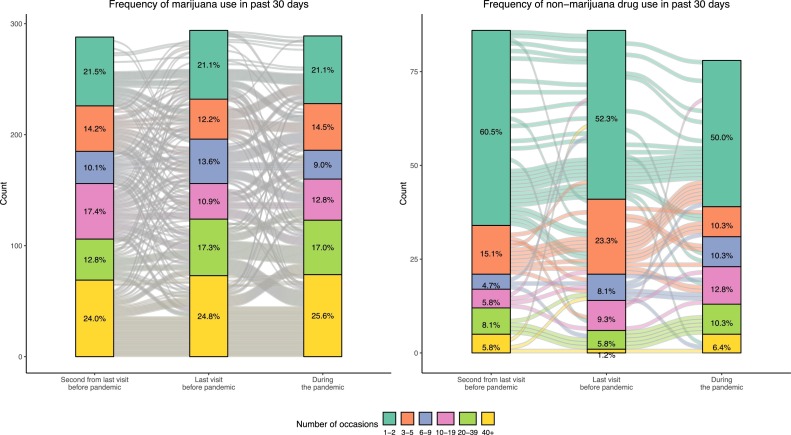
Results indicated no systematic change in prevalence or frequency of marijuana use. However, a decrease in non-marijuana drug use was observed (OR = 0.60, 95 % CrI: [0.37, 0.94]) following the onset of the pandemic. Furthermore, a small increase in the frequency of non-marijuana drug use was observed (OR = 1.79, 95 % CrI: [1.02, 3.21]) among individuals who used these substances.
These findings concur with a small number of studies identifying a decrease in drug use prevalence but increase in frequency among those who continue to use drugs. Despite the protective effect of lower drug use prevalence, higher frequency of use may lead to additional negative health outcomes of drug use, particularly among groups facing multiple health challenges such as YMSM-YTW. However, the pandemic likely has a unique impact on substance use behaviors across subpopulations.
人们对 COVID-19 大流行对物质使用行为的影响存在很大的担忧。对于像男男性行为者和年轻跨性别女性(YMSM-YTW)这样的亚人群来说,情况尤其如此,他们报告的物质使用率更高。本研究考察了大流行开始后 YMSM-YTW 中大麻和非大麻药物使用的流行率和频率的变化。
本分析的数据(n = 458 名参与者,1356 次观察)来自一项正在进行的 YMSM-YTW 纵向队列研究。使用一系列贝叶斯多层次模型来检查大麻和非大麻药物使用的流行率和频率的变化。
结果表明,大麻使用的流行率或频率没有系统变化。然而,在大流行开始后,非大麻药物的使用量观察到减少(OR = 0.60,95 % CrI:[0.37, 0.94])。此外,观察到使用这些物质的个体的非大麻药物使用频率略有增加(OR = 1.79,95 % CrI:[1.02, 3.21])。
这些发现与少数几项研究一致,这些研究表明,药物使用流行率下降,但继续使用药物的人的频率增加。尽管较低的药物使用流行率具有保护作用,但更高的使用频率可能会导致药物使用的额外负面健康后果,尤其是在面临多种健康挑战的群体中,如 YMSM-YTW。然而,大流行可能对不同亚人群的物质使用行为产生独特的影响。