Muller Christina K S, Spagnuolo Julian, Audigé Annette, Chancellor Andrew, Russenberger Doris, Scherrer Alexandra U, Hoffmann Matthias, Kouyos Roger, Battegay Manuel, De Libero Gennaro, Speck Roberto F
Department of Infectious Diseases and Hospital Epidemiology, University Hospital of Zurich, University of Zurich, Zurich, Switzerland.
Department of Infectious Diseases and Hospital Hygiene, University Hospital of Basel, Basel, Switzerland.
Infect Agent Cancer. 2021 Apr 17;16(1):24. doi: 10.1186/s13027-021-00365-4.
Despite successful combined antiretroviral therapy (cART), the risk of non-AIDS defining cancers (NADCs) remains higher for HIV-infected individuals than the general population. The reason for this increase is highly disputed. Here, we hypothesized that T-cell receptor (TCR) γδ cells and/or mucosal-associated invariant T (MAIT) cells might be associated with the increased risk of NADCs. γδ T cells and MAIT cells both serve as a link between the adaptive and the innate immune system, and also to exert direct anti-viral and anti-tumor activity.
We performed a longitudinal phenotypic characterization of TCR γδ cells and MAIT cells in HIV-infected individuals developing Hodgkin's lymphoma (HL), the most common type of NADCs. Cryopreserved PBMCs of HIV-infected individuals developing HL, matched HIV-infected controls without (w/o) HL and healthy controls were used for immunophenotyping by polychromatic flow cytometry, including markers for activation, exhaustion and chemokine receptors.
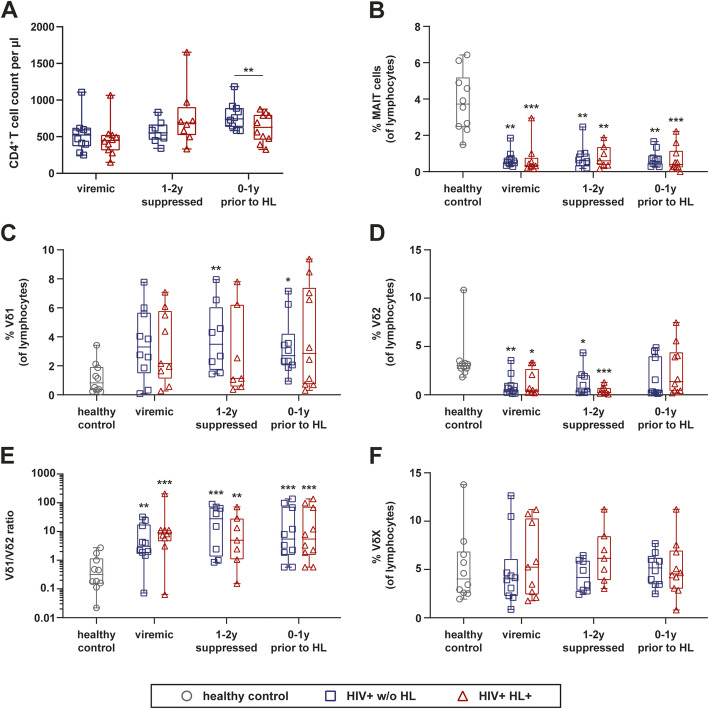
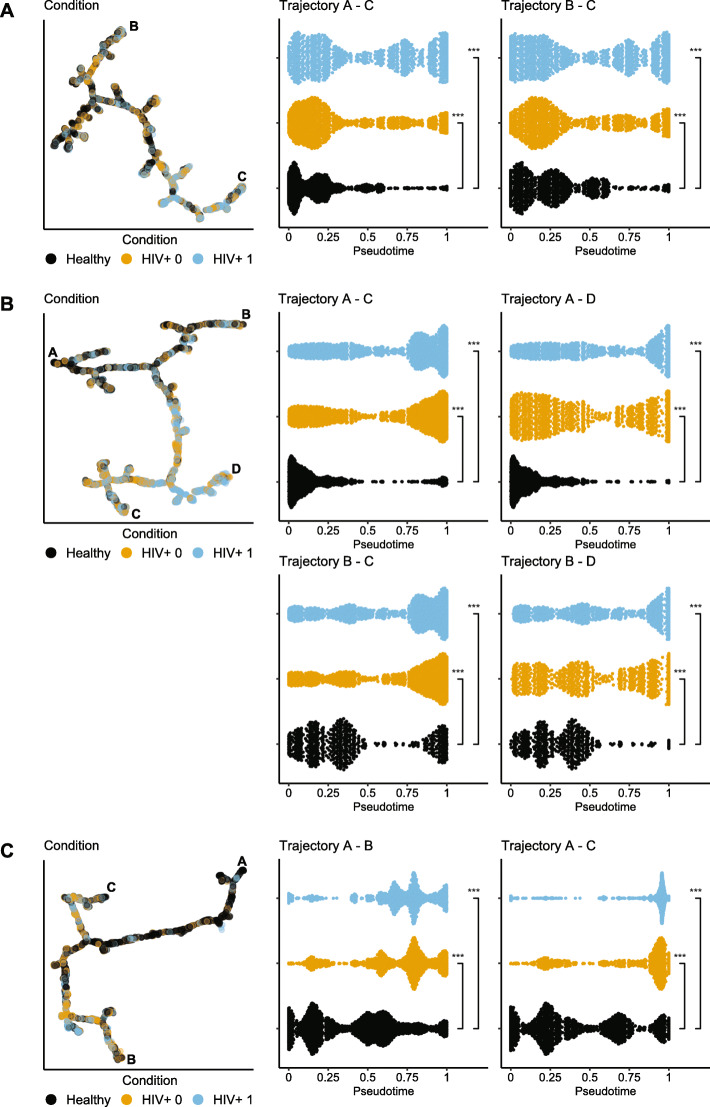
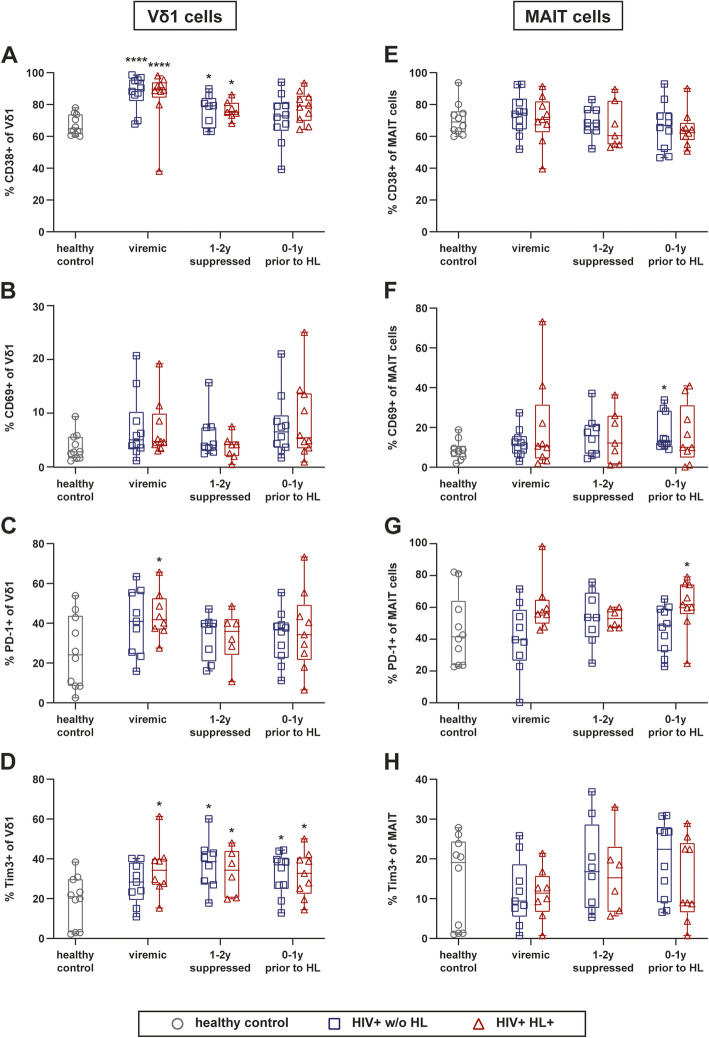
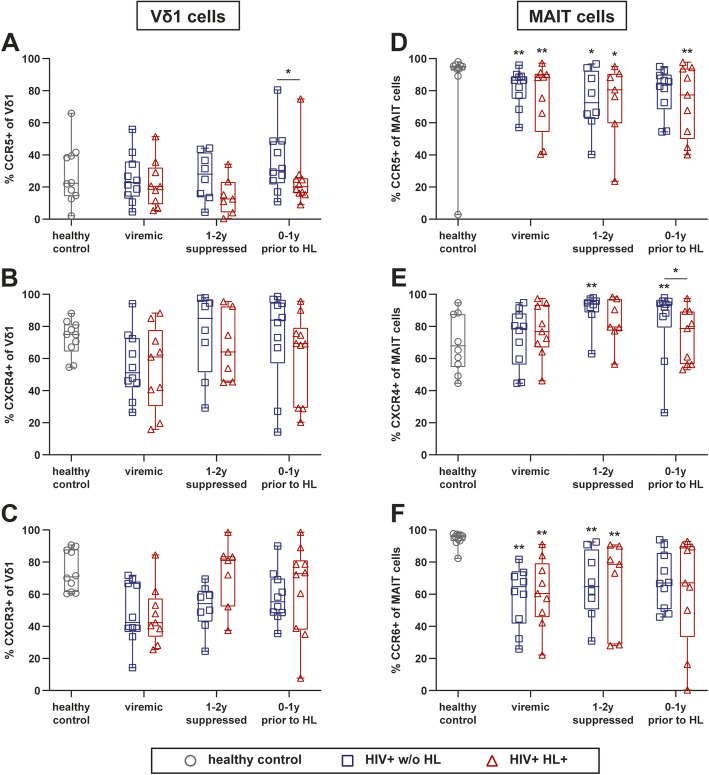
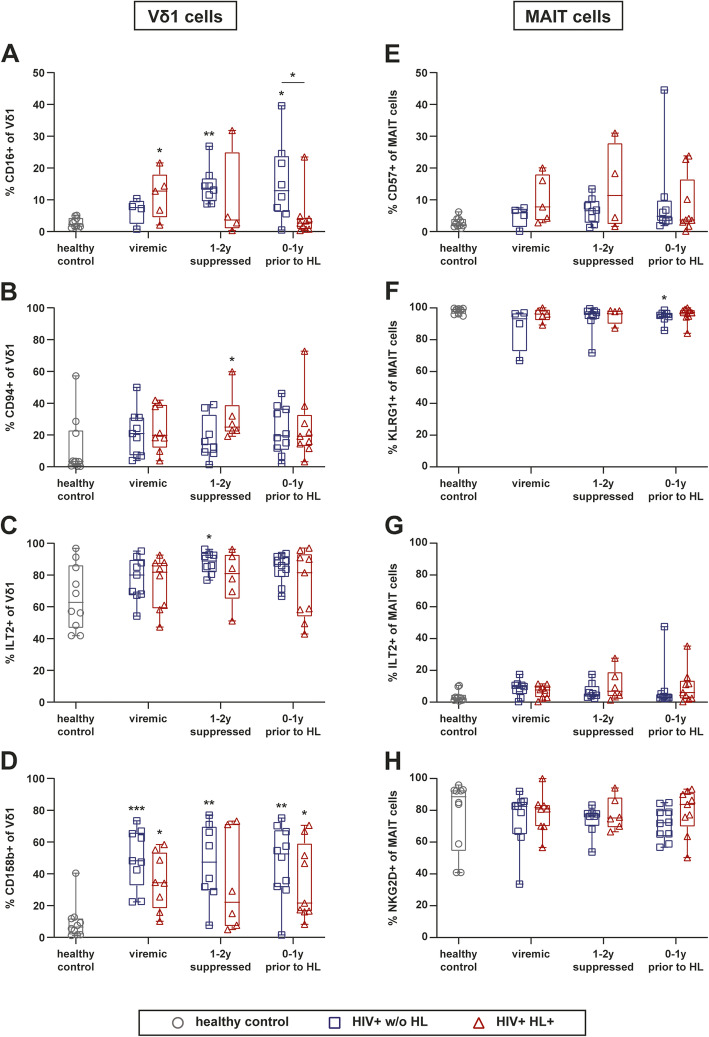
We identified significant differences in the CD4 T cell count between HIV-infected individuals developing HL and HIV-infected matched controls within 1 year before cancer diagnosis. We observed substantial differences in the cellular phenotype mainly between healthy controls and HIV infection irrespective of HL. A number of markers tended to be different in Vδ1 and MAIT cells in HIVHL patients vs. HIV w/o HL patients; notably, we observed significant differences for the expression of CCR5, CCR6 and CD16 between these two groups of HIV patients.
TCR Vδ1 and MAIT cells in HIV-infected individuals developing HL show subtle phenotypical differences as compared to the ones in HIV-infected controls, which may go along with functional impairment and thereby may be less efficient in detecting and eliminating malignant cells. Further, our results support the potential of longitudinal CD4 T cell count analysis for the identification of patients at higher risk to develop HL.
尽管联合抗逆转录病毒疗法(cART)取得了成功,但与普通人群相比,HIV感染者发生非艾滋病定义癌症(NADC)的风险仍然更高。这种风险增加的原因备受争议。在此,我们假设T细胞受体(TCR)γδ细胞和/或黏膜相关恒定T(MAIT)细胞可能与NADC风险增加有关。γδT细胞和MAIT细胞均作为适应性免疫系统与先天性免疫系统之间的联系,并且还发挥直接的抗病毒和抗肿瘤活性。
我们对发生霍奇金淋巴瘤(HL,最常见的NADC类型)的HIV感染者的TCRγδ细胞和MAIT细胞进行了纵向表型特征分析。将发生HL的HIV感染者、匹配的未患HL的HIV感染对照者以及健康对照者的冻存外周血单核细胞(PBMC)用于多色流式细胞术免疫表型分析,包括激活、耗竭和趋化因子受体的标志物。
我们发现,在癌症诊断前1年内,发生HL的HIV感染者与匹配的HIV感染对照者之间的CD4 T细胞计数存在显著差异。我们观察到,无论是否患有HL,健康对照者与HIV感染者之间的细胞表型存在实质性差异。与未患HL的HIV患者相比,HIV-HL患者的Vδ1细胞和MAIT细胞中的许多标志物往往有所不同;值得注意的是,我们观察到这两组HIV患者之间CCR5、CCR6和CD16的表达存在显著差异。
与HIV感染对照者相比,发生HL的HIV感染者中的TCR Vδ1细胞和MAIT细胞表现出细微的表型差异,这可能与功能受损有关,从而在检测和消除恶性细胞方面效率可能较低。此外,我们的结果支持通过纵向CD4 T细胞计数分析来识别发生HL风险较高的患者的潜力。