Department of Geriatrics/Radboud Alzheimer Center, Radboud Institute for Health Sciences, Radboud University Medical Center, Nijmegen, the Netherlands.
The Irish Longitudinal Study on Ageing, Trinity College Dublin, Dublin, Ireland.
J Cereb Blood Flow Metab. 2021 Oct;41(10):2607-2616. doi: 10.1177/0271678X211009382. Epub 2021 Apr 17.
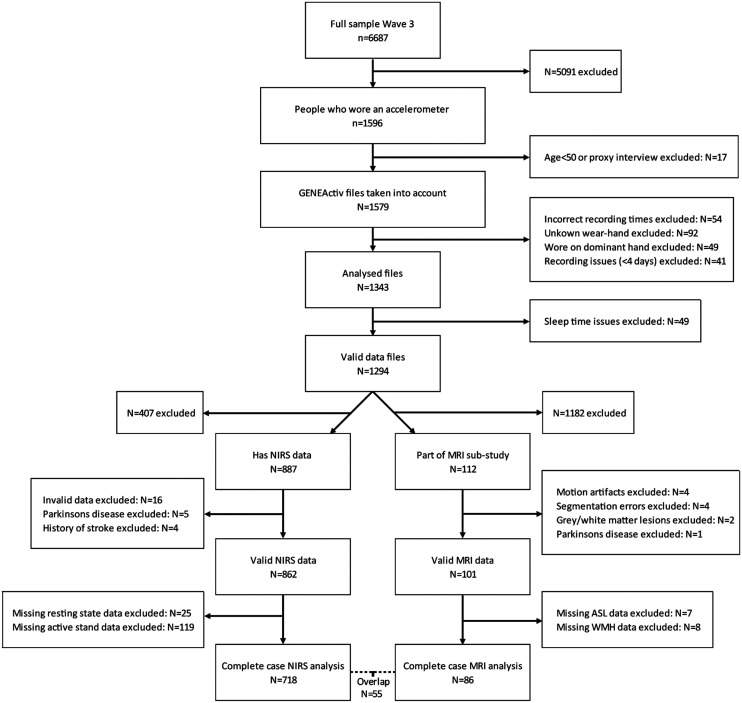
Due to its cardiovascular effects sedentary behaviour might impact cerebrovascular function in the long term, affecting cerebrovascular regulatory mechanisms and perfusion levels. Consequently this could underly potential structural brain abnormalities associated with cognitive decline. We therefore assessed the association between sedentary behaviour and brain measures of cerebrovascular perfusion and structural abnormalities in community-dwelling older adults. Using accelerometery (GENEActiv) data from The Irish Longitudinal Study on Ageing (TILDA) we categorised individuals by low- and high-sedentary behaviour (≤8 vs >8 hours/day). We examined prefrontal haemoglobin oxygenation levels using Near-Infrared Spectroscopy during rest and after an orthostatic challenge in 718 individuals (66 ± 8 years, 52% female). Global grey matter cerebral blood flow, total grey and white matter volume, total and subfield hippocampal volumes, cortical thickness, and white matter hyperintensities were measured using arterial spin labelling, T1, and FLAIR MRI in 86 individuals (72 ± 6 years, 55% female). While no differences in prefrontal or global cerebral hemodynamics were found between groups, high-sedentary individuals showed lower hippocampal volumes and increased white matter hyperintensities compared to their low-sedentary counterparts. Since these structural cerebral abnormalities are associated with cognitive decline and Alzheimer's disease, future work exploring the causal pathways underlying these differences is needed.
由于久坐行为对心血管的影响,其可能会对长期的脑血管功能产生影响,从而影响脑血管调节机制和灌注水平。因此,这可能是与认知能力下降相关的潜在结构性脑异常的基础。因此,我们评估了久坐行为与社区居住的老年人脑血管灌注和结构异常的脑测量之间的关联。我们使用爱尔兰老龄化纵向研究(TILDA)中的加速度计(GENEActiv)数据,根据低久坐行为(≤8 小时/天)和高久坐行为(>8 小时/天)对个体进行分类。我们在 718 名个体(66±8 岁,52%为女性)中使用近红外光谱技术(Near-Infrared Spectroscopy)在休息时和直立挑战后检测前额叶血红蛋白氧合水平。我们在 86 名个体(72±6 岁,55%为女性)中使用动脉自旋标记、T1 和 FLAIR MRI 测量全脑灰质脑血流、总灰质和白质体积、总海马和亚区海马体积、皮质厚度和脑白质高信号。虽然在两组之间没有发现前额叶或全脑血液动力学的差异,但与低久坐行为者相比,高久坐行为者的海马体积较低,脑白质高信号增加。由于这些结构性脑异常与认知能力下降和阿尔茨海默病有关,因此需要进一步研究探索这些差异背后的因果关系。