Sudo Kasumi, Yamada Manabu, Ochiai Mariko, Iwamoto Shoko, Sakaki Hajime, Kushida Chiho, Yamashita Maiko, Yamamoto Atsushi, Nagasaka Takao, Oidemizu Mikio, Saito Akito, Yamamoto Kinya
National Veterinary Assay Laboratory, Ministry of Agriculture, Forestry and Fisheries, 1-15-1 Tokura, Kokubunji, Tokyo 185-8511, Japan.
Present address: Food and Agriculture Organization of the United Nations, Viale delle Terme di Caracalla, 00153 Rome, Italy.
J Vet Med Sci. 2021 Jul 10;83(6):990-993. doi: 10.1292/jvms.20-0654. Epub 2021 Apr 19.
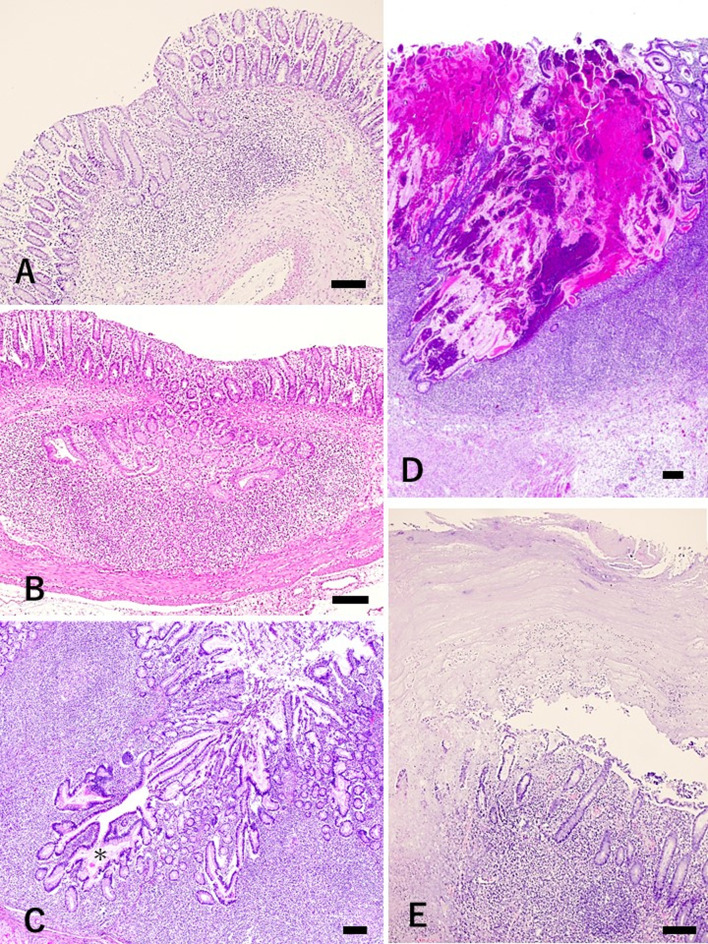
We evaluated the role of classical swine fever virus (CSFV) in the formation of button ulcers in the mucosa of the gastrointestinal tract. Histopathological and immunohistochemical analyses of pigs experimentally infected with a subgenotype 2.1 isolate of CSFV, which was isolated in Japan in 2019, revealed follicular necrosis in the submucosal mucosa-associated lymphoid tissue and herniation of crypts as factors that contribute to the development of button ulcers during CSFV infection. These findings indicate that CSFV induces follicular necrosis and is one of the causative agents of button ulcers in pigs.
我们评估了经典猪瘟病毒(CSFV)在胃肠道黏膜纽扣状溃疡形成中的作用。对2019年在日本分离的CSFV亚基因型2.1毒株进行实验性感染的猪进行组织病理学和免疫组织化学分析,结果显示黏膜下黏膜相关淋巴组织中的滤泡坏死以及隐窝疝出是CSFV感染期间促成纽扣状溃疡发展的因素。这些发现表明,CSFV可诱导滤泡坏死,是猪纽扣状溃疡的致病因素之一。